Everyday ecommerce operations—processing orders, issuing refunds, managing subscriptions—now run almost entirely on digital payments. That convenience also expands the attack surface. From chargebacks to account takeovers, types of payment fraud have grown more complex and more costly for online sellers. Fraud is no longer limited to stolen cards. It now spans identity abuse, automated attacks, and post-purchase manipulation. This guide will explain how modern payment fraud works, why it affects merchants directly, and how to detect and prevent it using practical, up-to-date strategies.
Modern payment fraud trends and landscape
Today's threat landscape is defined by "industrialized" fraud, where criminals use the same automation tools as legitimate businesses to scale their attacks.
Payment fraud growth and impact
The data reveals a high-stakes environment for merchants. According to the 2025 AFP Payments Fraud and Control Survey, a staggering 79% of organizations reported being victims of attempted or actual payment fraud activity. Furthermore, the rise of "synthetic identities"—fake personas created using a mix of real and fabricated data—is now surpassing classic card theft in many sectors, creating an "invisible" threat that legacy systems fail to catch. With cross-border spending projected to hit $320 trillion by 2032, international attack vectors are becoming more frequent and costly for ecommerce sellers.
Attack vectors shaping fraud
The tools of the trade have evolved into high-tech weaponry. AI-powered credential stuffing now allows bots to test millions of stolen login combinations in seconds, while deepfake technology is being used to bypass biometric "liveness" checks during account setup. We are also seeing a spike in emulator and injection attacks, where fraudsters use software to mimic legitimate mobile devices to trick fraud filters. These evolving patterns, including complex triangulation fraud on social commerce platforms, mean that static rules are no longer enough to protect your store.
10 Common types of payment fraud: definition, detection, and prevention
The variety of attacks can be overwhelming, but knowing the specific mechanics of each is the first step. You might be asking, "How can I detect and prevent fraud in online transactions?" The following breakdown provides the targeted solutions you need:
- Chargeback abuse (or friendly fraud)
- Card-not-present (CNP) fraud
- Phishing and social engineering
- Refund, return, and merchant scheme fraud
- Synthetic identity fraud
- Skimming
- Account takeover (ATO) fraud
- Device spoofing and emulator attacks
- Business Email Compromise (BEC)
- Money mule and layering schemes
Chargeback abuse (or friendly fraud)
Chargeback abuse, often termed "friendly fraud," occurs when a customer makes a legitimate online purchase but subsequently disputes the transaction with their bank to secure a refund while retaining the merchandise. This is a growing epidemic; in early 2026, reports surfaced of coordinated "refund groups" on social media platforms specifically targeting mid-sized electronics retailers, leading to millions in lost inventory. In 2025 alone, chargeback abuse would cost the ecommerce industry around over $33.79 billion (expected data from Chargeflow in 2025). Industry data suggests that nearly 75% of all chargebacks are actually instances of friendly fraud.
How to detect chargeback abuse?
To spot abuse, monitor for "serial disputers"—customers with a history of reversals across different platforms. Red flags include high-value orders placed with expedited shipping followed by an immediate claim of "item not received," despite confirmed tracking. Additionally, watch for customers who bypass your support team entirely to file a dispute directly with their issuing bank.
How to prevent chargeback abuse?
Effective prevention starts with transparent communication: use clear billing descriptors and send automated order updates. You should also utilize delivery confirmation services that require a signature for high-ticket items.
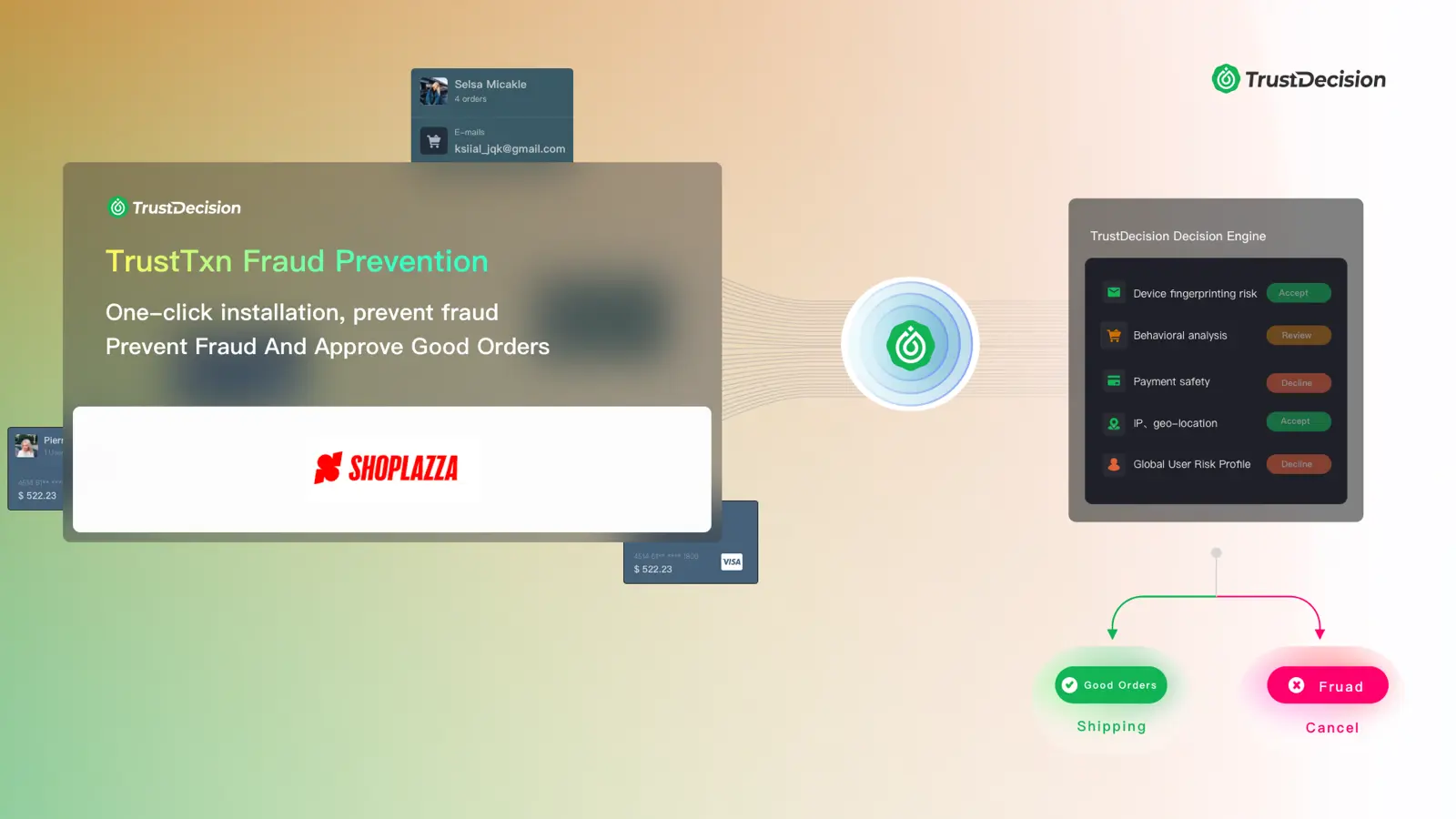
For the most robust defense, ecommerce sellers can integrate the TrustDecision Fraud Prevention plugin via Shoplazza. This specialized tool provides a three-layered shield:
- Block Fraud Orders Up To 90%: It identifies and stops high-risk attackers before they checkout, saving you from regulatory penalties.
- Reduce False Declines Up To 90%: It ensures legitimate customers aren't blocked, preventing the reputation loss that occurs when frustrated users abandon your store.
- Chargeback Protection Up To 100%: For qualifying orders, TrustDecision offers a full guarantee, keeping your revenue stable even if an abusive dispute is filed.
Card-not-present (CNP) fraud
Card-not-present (CNP) fraud occurs when a criminal uses stolen payment credentials, such as the card number, CVV, and expiry date, to make a purchase without physically presenting the card. This typically happens via online checkouts, mobile apps, or phone orders. It remains the most dominant threat in digital commerce. For example, a luxury fashion retailer reported a loss of over $5 million in a single week after a sophisticated botnet used stolen "dark web" credentials to bypass basic security filters during a flash sale.
How to detect card-not-present fraud?
Detection relies on spotting behavioral anomalies. Key indicators include "card testing," where bots run multiple low-value transactions in seconds to verify stolen details. You should also flag orders where the customer's IP address is thousands of miles from the shipping destination, or when a single device attempts to use multiple different card numbers in a single session.
How to prevent card-not-present fraud?
To mitigate CNP risk, you must move beyond simple data entry:
- Implement 3D Secure (3DS2), which uses risk-based authentication to challenge only suspicious transactions with biometrics or SMS codes.
- Enforcing strict Address Verification Service (AVS), requiring a full street number match rather than just a ZIP code, is also a proven deterrent.
- For the highest security, use network tokenization to replace raw card data with secure, non-sensitive tokens.
Solutions like Shoplazza Payments offer 3D Secure (3DS), allowing you to automatically block risks while maintaining a "frictionless" checkout for your legitimate, high-trust customers.
Phishing and social engineering
Phishing and social engineering represent the "human hack" of the payment world. Unlike technical exploits, these methods rely on psychological manipulation, like fear, urgency, or curiosity, to trick individuals into surrendering sensitive data like banking credentials or multi-factor authentication (MFA) codes.
The global "Operation Red Card 2.0" led by INTERPOL highlighted the scale of this threat, uncovering over $45 million in losses from scams that combined fraudulent mobile loan apps with sophisticated messaging-based social engineering. Fraudsters are now even using AI to clone executive voices (vishing) or generate personalized, error-free emails that achieve click rates as high as 54%.
How to detect phishing?
To spot a modern phish, look for "quishing" (malicious QR codes) in invoices or "account suspension" alerts that bypass text-based filters. Red flags include slightly off-brand domains (e.g., micros0ft-support.net), urgent requests to "verify now" to avoid penalties, and the use of Telephone-Oriented Attack Delivery (TOAD), where an email prompts you to call a fake "support" number to resolve a non-existent fraud issue.
How to prevent phishing?
Phishing scams are typically designed to:
- Deploy malware that compromises merchant systems or admin access
- Capture login credentials for payment gateways, dashboards, or email accounts
- Take over business-critical accounts (stores, ads, payouts, or CRM tools)
- Manipulate staff into authorizing fraudulent payments, refunds, or data transfers
As you see, these attacks target people rather than just software, your defense must combine strict technical gatekeeping with a culture of skepticism. To shield your business and employees from these deceptive tactics, you should adopt the following high-impact strategies:
- Enforce Phishing-Resistant MFA: Move beyond SMS codes to hardware security keys (FIDO2/WebAuthn) or passkeys, which cannot be easily intercepted by a fake login page.
- Implement DMARC at "Reject": Configure your email domain settings to p=reject to ensure that any spoofed emails pretending to be from your brand are automatically blocked before reaching your customers or staff.
- Establish Out-of-Band Verification: Create a mandatory policy that any high-risk request—such as changing a supplier's bank details or authorized wire transfers—must be verified via a second, trusted communication channel (like a known phone number).
- Deploy AI-Driven Email Security: Use modern gateways that analyze the intent and tone of messages rather than just looking for malicious links, catching AI-generated lures that look linguistically perfect.
- Conduct Regular Simulations: Run unannounced phishing tests to identify which team members are most vulnerable, providing immediate, targeted training to those who click on the simulated "bait".
Refund, return, and merchant scheme fraud
Refund and return fraud involve exploiting a merchant's service policies to recoup money or goods through deception. This ranges:
- "Wardrobing": Buying an item for one-time use and returning it.
- "Empty Box" Scams: A fraudster returns a package filled with rocks or paper to trigger an automated refund.
- "Bricking": Stripping an electronic device of its valuable internal components before returning the non-functional "shell."
- "Switch Fraud": Purchasing a genuine product and returning a cheaper counterfeit or an older, broken version in its place.
On the other side, merchant scheme fraud, specifically, often involves "triangulation," where a scammer sets up a fake storefront, takes a real customer's money, and then uses a stolen card to buy the item from your store to fulfill that order. Take an example, a massive "professional refunder" ring was dismantled after defrauding major retailers of over $6 million by using AI to generate fake police reports and altered shipping labels.
How to detect merchant scheme fraud?
Detection requires looking for a mismatch between the buyer and the recipient. Watch for high-value orders where the billing name and email are new, but the shipping address belongs to a repeat, "good" customer who didn't actually place the order.Another major signal is "FTID" (Fake Tracking ID) fraud, where the return tracking shows as "delivered" to your warehouse, but the actual package was redirected to a dummy address elsewhere to trick your automated refund system.
How to prevent merchant scheme fraud?
To protect your bottom line from these sophisticated circles, your return process must be data-driven rather than just "customer-first." Consider these tactical steps:
- Segment Refund Speed: Delay refunds for first-time or high-risk buyers until the warehouse physically inspects the item, while offering "instant credit" only to proven, loyal customers.
- Validate Return Tracking: Use a returns management portal that verifies the weight and destination of a return label in real-time to catch FTID or "empty box" attempts before the refund triggers.
- Link Analysis: Use fraud tools that can identify if multiple accounts are sharing the same device ID or IP address, which often signals a "professional refunder" service operating on behalf of different users.
- Audit High-Risk SKUs: Frequently target electronics or designer goods for manual return inspection, as these items have the highest resale value for fraud rings.
Synthetic identity fraud
Synthetic identity fraud is a sophisticated form of identity theft where criminals combine real data—often stolen Social Security numbers from children or the deceased—with fabricated names, addresses, and AI-generated social media profiles.This has become the "invisible threat," as these fake personas don't have a real victim to report the crime initially. US lenders faced an estimated $3.3 billion in exposure from synthetic identities in early 2025 alone, with fraudsters often "nurturing" these accounts for months to build high credit scores before "busting out" with massive purchases.
How to detect identity theft and fraud?
As an ecommerce seller, you don't need to be a data scientist to spot these "ghost" customers. Look for these common red flags in your order queue:
- The "New Person" Signal: A customer with a high-value order whose email address and physical address have no history in your system or on basic search engines.
- Mismatched Details: Look for small inconsistencies, such as a phone number with an area code that doesn't match the shipping state, or an email address that looks like a random string of letters and numbers.
- "Card Testing" Patterns: Be wary if you see several small, declined transactions from different cards followed by one large successful order; scammers often use synthetic IDs to "warm up" stolen card data.
How to prevent identity theft and fraud?
You can stop these fake identities from draining your inventory by adding a few simple, common-sense checks to your workflow:
- Verify Contact Info: Before shipping an expensive order to a new customer, send a quick "order confirmation" text or email. If the phone number is invalid or the email bounces, cancel the order immediately.
- Use "Social" Proof: Check if the customer has a basic digital footprint. Most real shoppers have some presence on social media or professional networks; a total lack of any "online life" is a major warning sign.
Skimming
Digital skimming, also known as Magecart or e-skimming, is a highly sophisticated attack where cybercriminals inject malicious JavaScript code into a merchant's website, typically on the checkout page. Unlike a data breach that steals a static database, skimming acts as a "virtual card reader," capturing credit card numbers, CVVs, and personal data in real-time as customers type them.
How to detect skimming?
Skimming is notoriously difficult to detect because the website continues to function perfectly for the customer. Key detection signals include:
- Unauthorized Script Changes: Using automated file integrity monitoring (FIM) to alert you the moment a JavaScript file is modified.
- Network Exfiltration Alerts: Monitoring for outbound "GET" or "POST" requests to unknown domains (often disguised as "analytics" or "image" endpoints) that originate from your payment page.
- Admin-Detection Routine Checks: Fraudulent scripts in 2026 often include code to "self-destruct" or hide if they detect a logged-in admin or a specific developer IP address, making manual site-checks unreliable.
How to prevent skimming?
Prevention is driven by the strict PCI DSS 4.0 requirements, which mandate that merchants actively manage and authorize every script running on their payment pages. To shield your store from these invisible sniffers, you should implement the following technical guardrails:
- Implement Content Security Policy (CSP): Configure a strong CSP header that strictly defines which domains are allowed to execute scripts and where form data can be sent, effectively blocking "exfiltration" to criminal servers.
- Use Subresource Integrity (SRI): Apply SRI hashes to third-party scripts (like chatbots or analytics) so the browser will refuse to execute them if even a single line of code has been altered by a hacker.
- Shift to Hosted Payment Pages (iFrames): Use a payment provider like Shoplazza Payments that uses "sandboxed" iFrames. Because the sensitive fields are hosted on the provider's fortified servers, your store's JavaScript cannot "see" or "skim" the data entered by the customer.
- Regular Automated Scanning: Deploy specialized client-side security tools that "crawl" your checkout exactly like a customer would, identifying malicious behavior that standard server-side antivirus software might miss.
Account takeover (ATO) fraud
Account takeover (ATO) fraud occurs when a criminal gains unauthorized access to a user's accountm, be it an ecommerce profile, a loyalty program, or a bank portal, to steal funds, sensitive data, or stored value. In 2025, the FBI's Internet Crime Complaint Center (IC3) reported that ATO losses surged to over $262 million in a single year, driven largely by "credential stuffing" where bots use billions of leaked passwords from unrelated breaches to find matches on new sites. Once inside, attackers move "quietly," often changing email notification settings or adding new shipping addresses before draining the account's value.
How to detect account takeover?
Early detection focuses on identifying "impossible travel" or session anomalies. Look for:
- Mismatched Geolocation: A user who typically logs in from New York suddenly appearing from a high-risk IP range in another country.
- Rapid Info Changes: A password reset followed immediately by a change in the primary email address and a high-value order.
- Device Fingerprint Shifts: A login from a brand-new device that uses a suspicious browser configuration (like an emulator or a spoofed user agent).
How to prevent account takeover?
Preventing ATO requires a "Zero Trust" approach where you verify every login attempt rather than assuming the password is sufficient.() You can defend your customers by implementing:
- Phishing-Resistant MFA: Replace SMS codes with FIDO2/WebAuthn passkeys or hardware tokens, as 2026-era bots can easily bypass legacy SMS authentication.
- Behavioral Biometrics: Analyze how a user types or moves their mouse; bots or unauthorized users often have a "rhythm" that differs significantly from the real account owner.
- Continuous Monitoring: Implement real-time risk scoring that triggers a "Step-up" verification (like FaceID) only when a session looks suspicious, keeping the experience smooth for the 99% of good users.
Device spoofing and emulator attacks
Device spoofing and emulator attacks involve fraudsters using specialized software to make a single computer mimic thousands of different mobile devices. By spoofing hardware IDs, GPS locations, and even battery levels, they bypass security filters that limit how many times a single device can interact with a store. This is the primary engine for card testing, where automated bots attempt thousands of small transactions to see which stolen credit cards are still active.
How to detect device spoofing and attacks?
As a seller, you can spot these high-tech intruders by looking for "robotic" consistency. Watch for a sudden spike in declined transactions from the same IP range or a single "device" that appears to be using dozens of different credit cards in a few minutes. Another clear signal is a mismatch between the reported device (e.g., an iPhone 15) and its technical behavior, such as a "mobile device" that doesn't have a touch-screen input or shows a 100% constant battery level.
How to prevent device spoofing and attacks?
To stop these virtual armies from overwhelming your checkout, you need tools that can "see through" the digital mask:
- Implement Velocity Limits: Set a cap on how many transaction attempts can originate from a single IP or device fingerprint within a 24-hour window.
- Use Behavioral Analytics: Deploy scripts that can tell the difference between a bot's perfect, straight-line "clicks" and a real human's shaky mouse movements.
- Enforce CAPTCHA for High-Risk Sessions: Trigger a visual challenge only when the system detects a potential bot, ensuring your real customers aren't slowed down while scammers are stopped cold.
Business email compromise (BEC)
Business Email Compromise (BEC) is a high-stakes "no-malware" scam where fraudsters impersonate a trusted figure, such as a CEO, a high-ranking executive, or a regular supplier, to trick employees into redirecting payments or sharing sensitive data. Unlike traditional hacking that uses viruses, BEC relies purely on psychological manipulation and the exploitation of professional trust. In 2024 alone, BEC attacks resulted in nearly $2.8 billion in reported losses, with attackers increasingly using sophisticated tactics to create more convincing and personalized fraudulent communications.
How to detect business email compromise?
The hallmark of a BEC attack is a sudden, urgent change to "normal" procedures. Look for emails from "executives" who are suddenly "in a meeting and can only text," or a long-term supplier claiming their bank is "under audit" and asking you to send payment to a new, personal-sounding account. Scrutinize the email address carefully—scammers often use "look-alike" domains like [email protected] instead of the legitimate shoplazza.com.
How to prevent business email compromise?
Because BEC targets your team's trust, you should protect your business by establishing these non-negotiable rules:
- Secondary Channel Verification: Never change payment details based on an email alone. Always call the supplier at a known, pre-existing phone number to confirm the request live.
- Dual-Approval for Wires: Require two different employees to sign off on any bank transfer over a certain threshold (e.g., $1,000).
- Technical Email Guardrails: Set up DMARC, SPF, and DKIM records. These protocols tell other email servers that "if it doesn't come from my authorized server, it's a fake," which stops scammers from spoofing your own brand to trick your staff.
Money mule and layering schemes
Money mules are individuals who—knowingly or not—transfer stolen funds through their own bank accounts to help criminals "wash" the money. This is often the "layering" stage of money laundering, where illicit cash is moved through multiple people to hide its origin. Researchers found that 1 in 3 young people had been targeted by "job scams" on social media that were actually recruitment fronts for mule herders. For a merchant, this often looks like an order that is paid for with stolen funds and then "returned" to a different account, effectively using your store to clean the money.
How to detect money mule and layering schemes?
Detection requires looking for "pass-through" behavior. Be suspicious of customers who place a large order and then immediately request a refund to a different payment method or a different bank account. Another red flag is a customer whose account has been dormant for years but suddenly receives a high-value "push" payment and immediately tries to spend it all in your store.
How to prevent money mule and layering schemes?
To keep your store from becoming a cog in a laundering machine, you should follow these rigorous anti-money laundering (AML) practices:
- Enforce "Refund-to-Source" Policies: Never, under any circumstances, refund a customer to a different card or bank account than the one used for the original purchase.
- Monitor "High-Velocity" Accounts: Flag any account that makes multiple purchases and requests multiple refunds within the same week.
- KYC (Know Your Customer) Checkpoints: For high-value B2B transactions, use a platform that automatically cross-references buyers against global AML and "Sanctions" watchlists to ensure you aren't dealing with known mule networks.
Real pain points when merchants face payment frauds
Navigating the digital landscape requires a delicate balance of security and speed, as inefficient fraud detection in online payments can often harm a business more than the actual theft.
False positives blocking revenue
False positives occur when legitimate customers are mistakenly flagged as fraudsters and their transactions are declined. Some merchants are rejecting up to 10% of good orders due to rigid security settings. This not only results in immediate lost sales but also causes long-term "churn," as frustrated shoppers rarely return to a store that rejected them.
Chargeback disputes and account health
Chargebacks are a structural threat. For example, for every $100 lost to a dispute, the "true cost" to a merchant may be roughly $150-$200, or even more, after fees and lost inventory are factored in. Beyond the financial hit, breaching a 1% chargeback ratio can lead to "high-risk" labeling by banks, resulting in higher processing fees or even total account termination.
Refund fraud rings & velocity patterns
Professional fraud rings now use AI to exploit return policies at scale, often by using "empty box" or "fake tracking" tactics. These groups monitor merchant policies for weaknesses; once they find a gap, they use high-velocity bot attacks to drain inventory before the merchant's manual review team can even identify the spike.
Authentication challenges in subscription models
Subscription businesses face unique hurdles with Strong Customer Authentication (SCA) and 3D Secure. Strict friction at the point of renewal often leads to "unintentional churn," where a long-term customer's recurring payment is blocked by an over-aggressive bank filter, forcing the merchant to spend more on re-acquiring that same user.
What fraud prevention tech and tools help commerce sellers?
Modern technology provides a multi-layered defense that allows merchants to outpace sophisticated scammers by turning massive amounts of transaction data into actionable, real-time security insights.
Early Fraud Warning (EFW)
Advanced systems like Shoplazza Payments, developed by the SaaS platform Shoplazza, gives merchants access to Early Fraud Warning (EFW) data. This information is pulled directly from Visa's TC40 and Mastercard's SAFE reports, which are generated when issuing banks suspect a transaction is fraudulent. Because the EFW system operates independently from the formal dispute process, it serves as a critical "heads-up" for sellers. If you receive an EFW, you can proactively refund the order to stop a dispute before it harms your account health. Without action, roughly 80% of these warnings escalate into costly fraudulent disputes. Merchants should use this window to review order details, contact the customer to confirm the purchase, or delay shipping until the risk is cleared.
Device intelligence platforms
Device intelligence platforms like SHIELD analyze the "DNA" of a user's device in real-time to identify high-risk signals. By examining thousands of attributes—such as whether a device is a bot-run emulator, a spoofed mobile phone, or part of a coordinated "device farm"—they block technical exploits before they can ever reach your checkout.
Network and identity trust networks
Identity trust networks (e.g. ThreatMetrix, Kount) leverage global data to assign a risk score to every shopper. By cross-referencing billions of past transactions, these tools can tell you if an email address or card has been linked to fraud elsewhere, allowing you to stop known bad actors from polluting your new storefront.
Specialized fraud APIs
For businesses dealing with high-speed digital assets or instant bank transfers, specialized APIs like Sardine and Feedzai, provide flexible, real-time risk scoring. These tools are designed to catch "instant" fraud by analyzing behavioral patterns and payment velocity, ensuring that even the fastest transactions are screened for potential money laundering or theft.
Conclusion
For ecommerce sellers, payment fraud is no longer an occasional risk. It's a daily operational threat. Recognizing the types of payment fraud early and knowing how to detect fraud in online transactions can protect revenue, customer trust, and platform accounts. From phishing and account takeovers to refund abuse and friendly fraud, prevention now requires layered controls, real-time monitoring, and smarter payment infrastructure built for scale.
FAQs about online payment frauds
Q1: What are the most common types of online transaction frauds?
For ecommerce sellers, the most common fraud types include card-not-present fraud, account takeover, friendly fraud (false chargebacks), refund abuse, and triangulation fraud. These attacks target weak checkout flows, lenient refund policies, and delayed fraud detection, directly impacting revenue, dispute ratios, and payment provider risk scores.
Q2: How can merchants prevent payment fraud smartly?
Effective prevention blends multiple layers. Robust authentication like 3DS and biometrics blocks high-risk payments. Device, IP, and behavioral signals help detect anomalies. AI-powered real-time screening stops fraud mid-transaction. Strong chargeback workflows and ongoing employee and customer training close the loop and reduce repeat attacks.
Q3: Do small ecommerce stores face the same fraud risks as large brands?
Yes—and often more intensely. Smaller stores are frequently targeted because fraudsters assume weaker controls, slower responses, and limited monitoring. Even a handful of disputes can jeopardize payout timelines or payment account stability, making early fraud prevention critical regardless of store size or transaction volume.
Q4: What is the difference between a dispute and an Early Fraud Warning?
A dispute is a formal reversal request filed through a customer's bank, usually resulting in fees and higher chargeback ratios. An Early Fraud Warning by Shoplazza Payments is a pre-alert from networks like Visa or Mastercard, allowing merchants to refund early and avoid escalation.
Q5: Can fraud prevention tools hurt conversion rates?
Yes, if applied blindly. For high-ticket items, 3D Secure adds protection with minimal impact. For low-value orders, extra authentication steps may reduce conversions. Smart routing, risk-based rules, and selective 3DS activation help balance fraud control without adding unnecessary checkout friction.
Q6: Why use Shoplazza's TrustDecision instead of manual review?
Manual review is slow, inconsistent, and vulnerable to human error. Shoplazza TrustDecision uses adaptive machine learning to assess risk immediately, cutting false positives by up to 90%. Sellers protect revenue automatically—without blocking legitimate customers or delaying fulfillment.