Running an online store today is less about chasing the latest trend and more about choosing tools that won't slow you down six months later. From content updates and product launches to payments and global expansion, the foundation you pick shapes how smoothly everything runs. That's where ecommerce CMS platforms come in—they sit at the center of your daily operations, whether you're a solo founder or scaling across markets. To help you to choose the right one without overpaying or overbuilding in 2026, this guide breaks down 4 website platforms and provides key insights.
Key takeaways
-
Market leaders: Platforms like Shopify, WooCommerce, and Adobe Commerce dominate due to scale, stability, and ecosystem depth.
-
Smart alternatives: Emerging platforms such as Shoplazza focus on native features and operational efficiency, reducing app dependency and lowering the barrier to global expansion.
-
Common pain points: App fatigue, rising subscription fees, SEO limitations, mobile checkout friction, and delayed payouts are the issues merchants encounter most often.
-
Choosing tips: Match the platform to your growth stage and operating style—prioritize native capabilities and workflow efficiency over brand recognition alone.
The "Big Three" market leaders
The ecommerce world is largely dominated by a few giants that have spent decades refining their code to handle millions of transactions per second.
Shopify
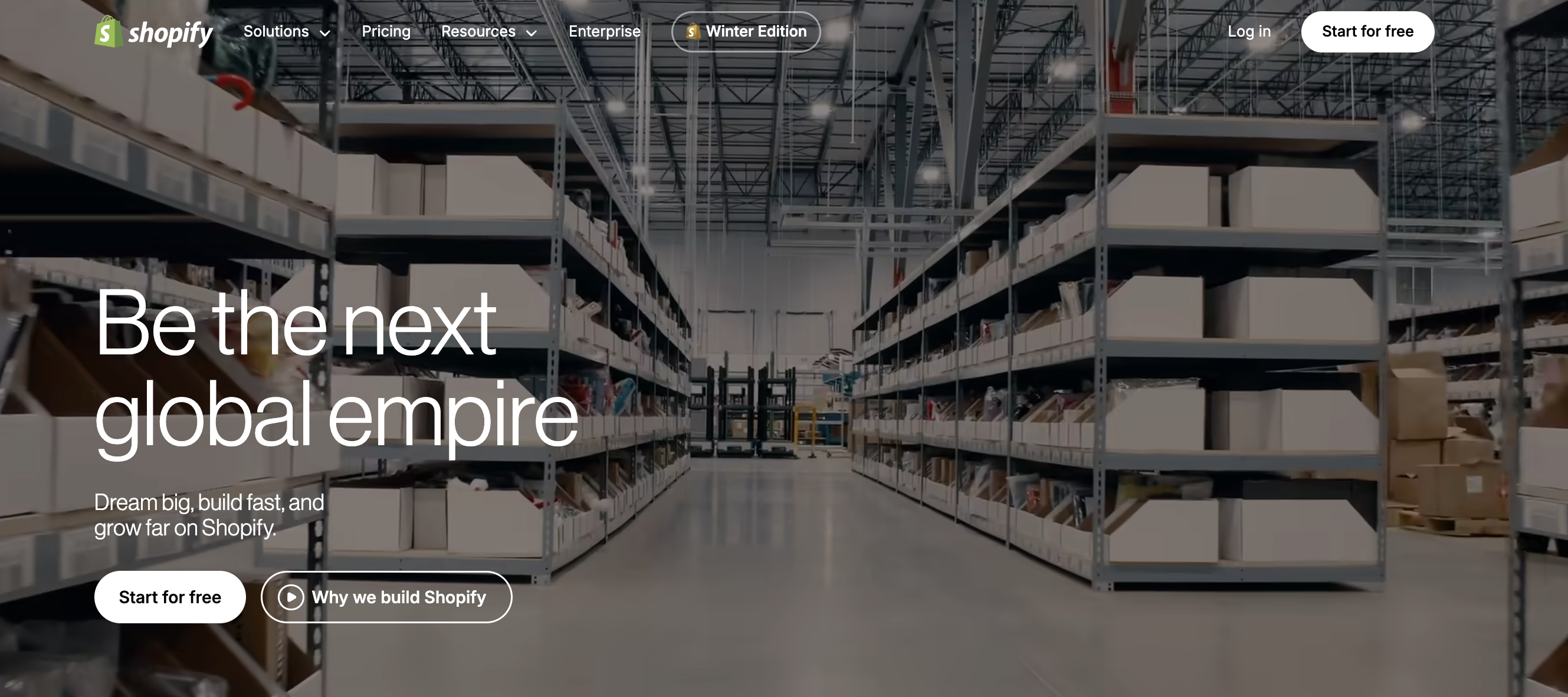
Shopify is the undisputed king of the "hosted" world. Since its 2006 debut in Ottawa, it has evolved into a global titan that powers everything from small boutiques to Tesla's gear shop. It's best for businesses that want a reliable, high-performance site without worrying about servers. In 2026, its focus is heavily on "Shopify Magic," an AI suite that writes your copy, edits your product photos, and even predicts your inventory needs.
Pros
-
Shop Pay Integration: One of the highest-converting checkouts on the planet. Studies show Shop Pay can increase checkout conversion by up to 50% compared to guest checkout and outperforms other accelerated checkouts by at least 10%.
-
Massive App Store: Access to over 8,000 plugins to customize nearly any function imaginable.
-
Multichannel Selling: Easily integrates with social media (Facebook, Instagram) and online marketplaces (Amazon).
-
AI Sidekick: Native AI tools that handle everything from email marketing to product descriptions.
-
Scalability: The Shopify Plus tier handles massive viral traffic spikes without breaking a sweat.
Cons
-
The "App Tax": Core features often require third-party apps. While the base price is fair, most essential features require paid monthly apps.
-
Limited Content and Blogging Tools: Compared to specialized CMS platforms like WordPress, Shopify's blogging features are not robust.
WooCommerce
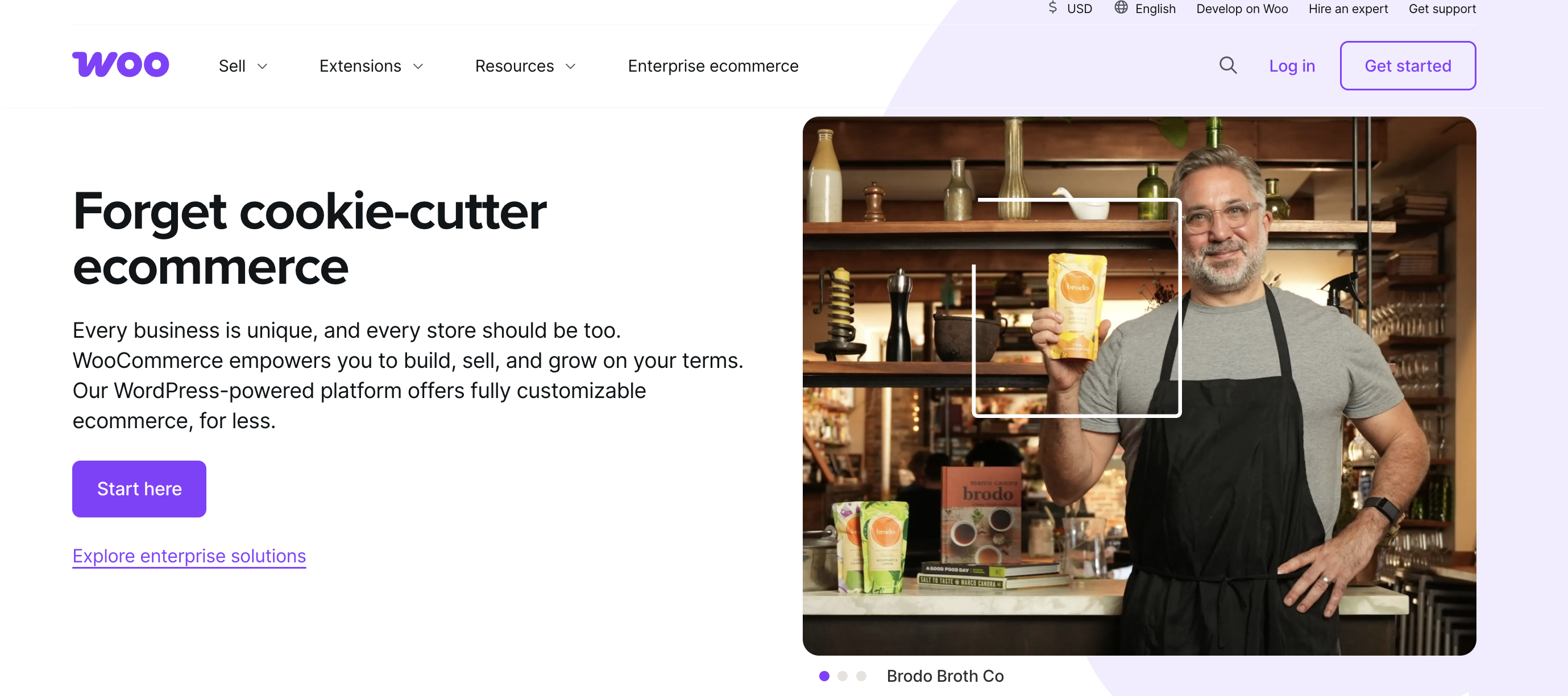
If you love WordPress, you'll love WooCommerce. It is an open-source plugin that turns any WordPress site into a powerhouse store. This is the best choice for content-heavy brands that want to sell products alongside deep editorial content. Because you host it yourself, you have 100% control over every line of code, making it the ultimate "ownership" platform.
Pros
-
Cost Efficiency: The plugin itself is free, and there are no transaction fees (other than your payment processor's).
-
Unmatched Flexibility: If you can dream it, you can build it; there are no "walled garden" restrictions.
-
SEO Power: Leverages the world-class SEO capabilities of WordPress to help you rank faster.
-
Data Ownership: You own your database entirely—no one can shut your store down.
Cons
-
Maintenance Burden: You are responsible for security, updates, and hosting speed.
-
Complexity: Not beginner-friendly; you'll likely need a developer for anything beyond basic settings.
Adobe Commerce (Magento)
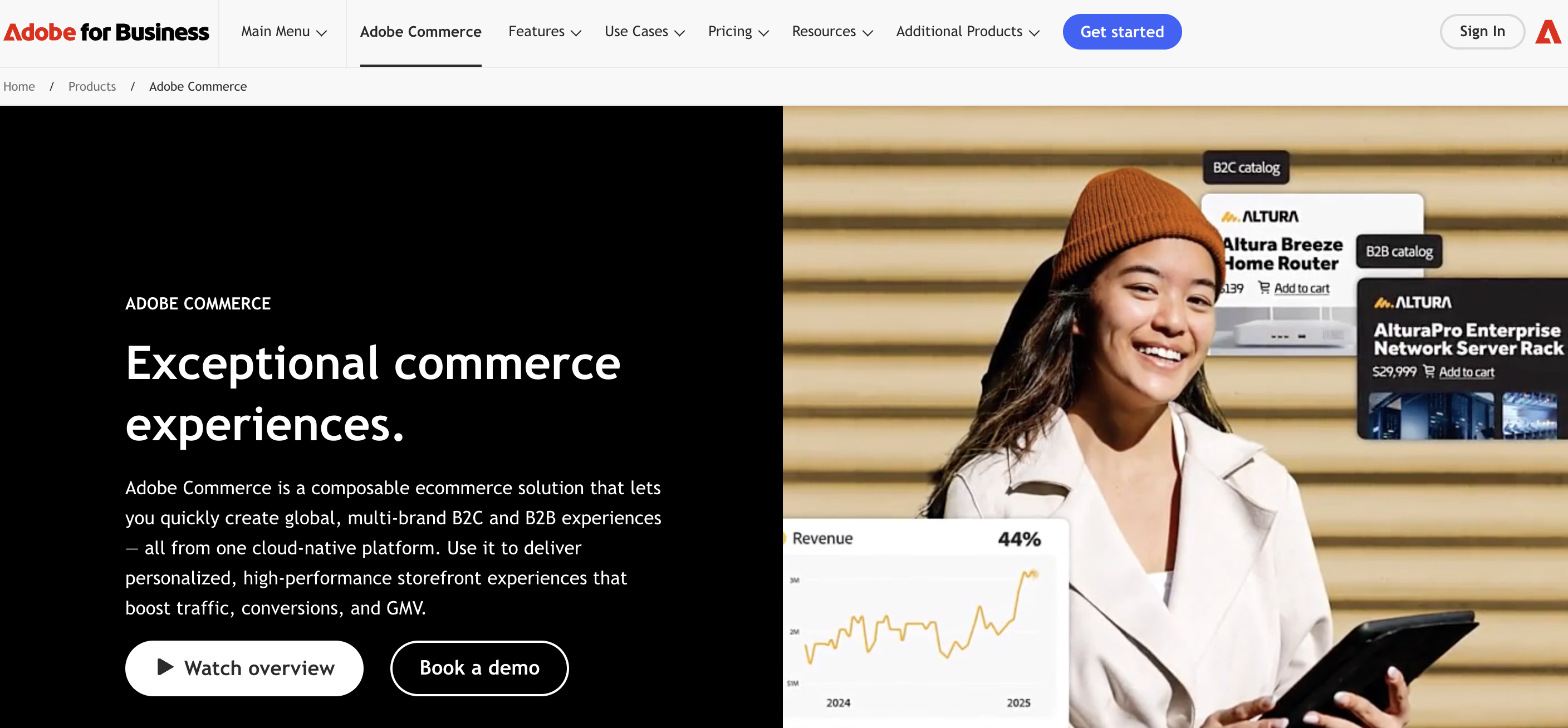
Adobe Commerce is the heavyweight champion of the enterprise world. Formerly known as Magento, this platform is designed for companies with massive catalogs and complex B2B requirements. It's best for large-scale retailers who need to manage multiple brands or international storefronts from a single, centralized backend. It isn't just a store; it's a full-scale digital commerce engine.
Pros
-
Enterprise Power: Capable of handling 200,000+ orders per hour during peak sales events.
-
Deep B2B Features: Native support for quotes, purchase orders, and volume-based pricing.
-
AI-Driven Analytics: Uses Adobe Sensei to provide deep customer insights and predictive purchasing data.
-
Global Multi-store: Manage hundreds of localized sites across different regions from one dashboard.
Cons
-
High Price Tag: Licensing and development costs easily run into the six-figure range.
-
Resource Intensive: Requires a dedicated server and an expert team of developers to keep it running smoothly.
The "smart alternative" rising star: Shoplazza
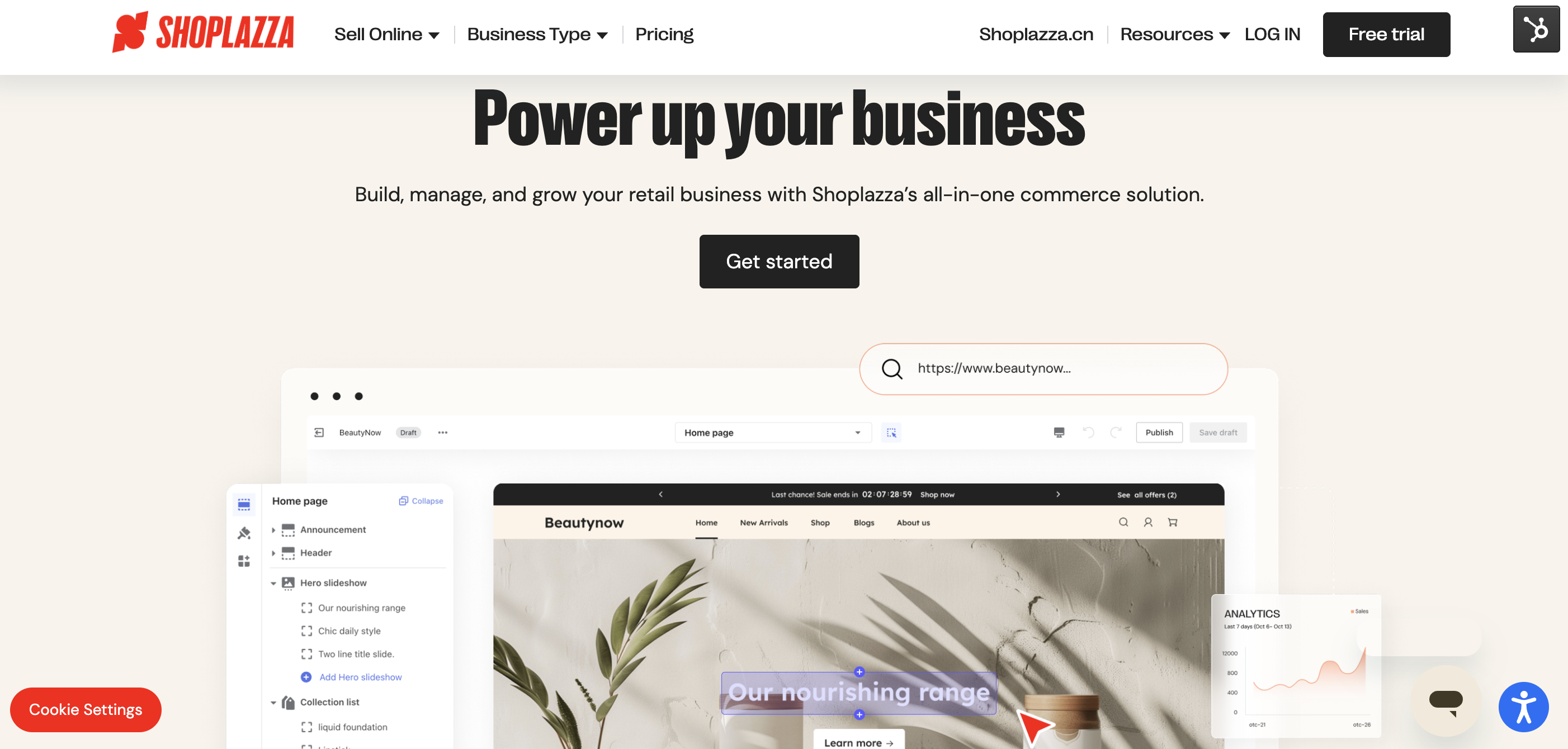
While the "Big Three" dominate industry headlines, Shoplazza has quietly become the go-to choice for a new generation of merchants. At the center of its appeal is a true zero-code page builder combined with an all-in-one CMS. It reshapes how stores are built and managed. Unlike traditional platforms where you might need a developer to tweak a layout, Shoplazza's drag-and-drop editor enables you to create, manage, and publish high-end content.
So why do many merchants now call Shoplazza the alternative? For global sellers, it comes down to operational efficiency. While Shopify provides a vast ecosystem, it often leads to "App Fatigue"—a cycle where you may pay for several different monthly subscriptions just to get basic features like Simple Discounts, an app for mix-and-match bundle discounts. Besides, WooCommerce and Adobe Commerce may need a professional designer or developer to manage and optimize.
Shoplazza takes a different approach by building essential global tools directly into the platform. Merchants can expand into multiple localized markets from a single store, with free language and currency switching included by default. This all-in-one approach is why merchants are increasingly migrating their operations. One high-volume merchant, for example, shifted 90% of their operations to Shoplazza after repeated account disruptions and limited transparency on their previous platform. What ultimately mattered more than a massive app marketplace was clear risk management, stable infrastructure, and a genuine long-term partnership.
Key features of Shoplazza
-
Global Readiness: Support for 100+ languages and 50+ localized markets out of the box.
-
Native App Ecosystem: Nearly 90% of their plugin library is free, keeping monthly operating costs lean.
-
Conversion-First Themes: Free, high-speed store themes and templates optimized for desk and mobile shopping behavior.
-
One-Click Migration: Seamlessly import your entire catalog from Amazon, Shopline, or Shopify without losing data.
-
Built-In Social Commerce: Centralized control of Google, Facebook, Pinterest, and TikTok traffic, ads, and sales channels.
-
Advanced Customization Tools: Full control over branding, layouts, content, and functionality via an intuitive Page Builder.
-
Dropshipping Support: Integrated supplier and order management access enables direct fulfillment, lower risk, and rapid product testing.
Pricing of Shoplazza
-
Free: 7-day free trial, no credit card needed.
-
Basic: $39/mo (or $29.25/mo billed annually), 2% transaction fee. Best for beginners and small businesses.
-
Advanced: $105/mo (or $78.75/mo billed annually), 1% transaction fee. Ideal for growing brands.
-
Pro: $399/mo (or $299.25/mo billed annually), 0.5% transaction fee. Built for high-volume sellers and B2B wholesale. Transaction fees waived with Shoplazza Payments.
Case studies: See how Shoplazza grows your business
Real-world success stories prove that Shoplazza's "native-first" approach delivers tangible results. For example, Real Silk Life successfully scaled its high-end silk products into North America by moving away from fragmented platforms to Shoplazza's DTC-focused ecosystem. By utilizing built-in customer operation tools, including automated membership systems and localized gift cards, they achieved a consistent brand narrative that drove their annual independent station sales past the million-dollar mark while maintaining premium profit margins.
Similarly, the fast-fashion brand ICOICE has dominated the global contact lens market by leveraging Shoplazza's robust marketing integrations and AI-powered product cards. By integrating Shoplazza Payments to provide a frictionless, localized checkout experience for Gen Z consumers, they were named "Merchant of the Year" in 2025.
These examples highlight how the platform's seamless synchronization with social channels like TikTok and Meta enables brands to focus on product innovation rather than managing technical plugins.
What are the major pain points when using ecommerce CMS platform?
Choosing a platform often uncovers hidden frustrations that surface only after you have invested significant time and capital. Navigating these obstacles requires moving beyond basic feature lists to understand the "on-the-ground" reality of managing a digital storefront.
App fatigue
"I spend more time updating plugins than selling." This is the most common complaint in recent years. High-maintenance stacks with over 5-10 third-party apps often break during platform updates. You may prioritize platforms with "native-first" features. Using a CMS like Shoplazza, which provides free multi-currency, order and fulfillment, and SEO tools, reduces technical debt and monthly subscription bloat.
SEO invisibility
AI Search (SGE) has replaced many "blue links" with direct summaries. If your CMS lacks an "AI-readable" schema, you effectively disappear from search results. You can regularly audit your schema. Ensure your platform supports rich snippets so AI can instantly pull accurate pricing and availability into generative snapshots.
Mobile abandonment
With mobile abandonment hitting 85% in 2026, friction-filled checkouts are conversion killers. One-click checkouts like Shop Pay or Shoplazza's 1-click are now mandatory. Simplify your flow by removing unnecessary form fields; every extra click on a small screen reduces your revenue by an estimated 7% per second of delay.
The payment trap
Many merchants face 21-day payout holds, crippling their cash flow during scaling phases. Avoid third-party gateways with restrictive terms. Integrated solutions like Shoplazza Payments or Shopify Payments offer faster, more transparent settlement cycles, allowing you to reinvest capital into inventory and marketing without waiting weeks for your funds.
Customer trust
Why "Rented Platforms" (social media) are probably failing and why your "Owned CMS" is your only safe asset. Now, accounts are easily banned, and "Rented Platforms" are a liability. Your "Owned CMS" is your only truly safe asset for long-term customer relationships. You can use your website as the primary data hub and treat social channels only as discovery engines to ensure you own your audience.
How to choose the right platform for your business?
-
The "Launch-Fast" Tier: If you want to start selling tonight with zero code, Shoplazza or Shopify Basic are your best bets. They prioritize speed and built-in tools.
-
The "Scale-Deep" Tier: If you are a high-volume merchant who needs thousands of niche integrations, Shoplazza Advanced or Shopify Plus is the industry standard for a reason.
-
The "Custom-Everything" Tier: If you have a unique business model that requires a bespoke checkout or full data ownership, look toward WooCommerce or a Headless setup.
Conclusion
The "perfect" platform doesn't exist, but the "perfect for you" platform definitely does. The successful merchant is the one who prioritizes a clean, fast, and native experience over a bloated site full of disconnected apps. Don't choose the platform with the most apps; choose the one with the most native capability to ensure your ecommerce CMS platforms actually work for you, not against you.
FAQs about ecommerce CMS platforms
Q1: What are ecommerce CMS platforms and why do they matter?
Ecommerce CMS platforms combine content management with online selling features, allowing you to manage products, pages, payments, and customers in one system. The right platform directly affects site speed, conversion rates, SEO visibility, and how easily your store can scale.
Q2: What are the best active ecommerce CMS options for small businesses?
Hosted, zero-code platforms like Shoplazza are usually the best choice for small businesses and beginners because they handle hosting, security, and updates automatically. These platforms let new merchants launch quickly without needing technical or development experience.
Q3: Are open-source ecommerce CMS platforms better for SEO?
Open-source platforms like WooCommerce offer deeper SEO control, but results depend heavily on proper configuration and maintenance. Many hosted platforms like Shoplazza now provide built-in SEO tools that are sufficient for most small and mid-sized stores.
Q4: Why do merchants struggle with "app fatigue"?
App fatigue happens when core features require multiple third-party plugins, each with its own cost and maintenance needs. Over time, this increases expenses, slows down sites, and creates technical conflicts during updates.
Q5: How do I choose the right ecommerce CMS platform for my business?
Start by defining your growth goals, technical resources, and budget. If speed and simplicity matter most, choose a platform with strong native features like Shoplazza. If full customization and data ownership are critical, an open or headless setup may be a better fit.