Dropshipping in the UK has become a genuinely accessible business model. With a high-spend online population, fast domestic logistics, and a growing range of supplier integrations, the market rewards sellers who choose their setup carefully. The question most newcomers ask is simple enough: which platform should I actually build on? The answer depends on what you are trying to achieve. This guide breaks down the best platforms for UK dropshipping in 2026, covering storefronts, marketplaces, and social commerce channels, with rough costs, supplier recommendations, and practical notes on VAT and post-Brexit considerations.
Quick comparison at a glance: 4 platforms for UK dropshipping
| Platform | Ease of use | Approx. cost | UK supplier match | Best for |
| Shoplazza | High | From $29.25/mo (annual) | CJdropshipping, EPROLO, some POD suppliers | DTC brands, dropshipping, POD |
| eBay UK | Very high | Free to list; 12.8% FVF + 40p per order | Avasam, CJdropshipping | Beginners, product testing |
| TikTok Shop | High | Free to list; 9% commission per sale | POD apps, FBT suppliers | Trend products, social sellers |
| WooCommerce | Low–Medium | Free plugin; hosting from ~£2.75/mo | AliDropship, WooDropship | SEO-focused, WordPress users |
The best platforms for UK dropshipping in 2026
Each of the platforms below suits a different type of seller. Some are purpose-built storefronts; others are established marketplaces or social commerce channels. Here is how they compare across the features that matter most for UK operations.
Shoplazza: best for building a standalone dropshipping brand
Shoplazza is an e-commerce platform built for cross-border sellers who are doing DTC brands, dropshipping, or POD businesses. Its AI store builder is the fastest way to get a fully structured store live, no coding, no lengthy setup. You describe your business in a short chat, the AI generates three store style designs to pick from, then builds out your homepage, product pages, policies, and checkout automatically.
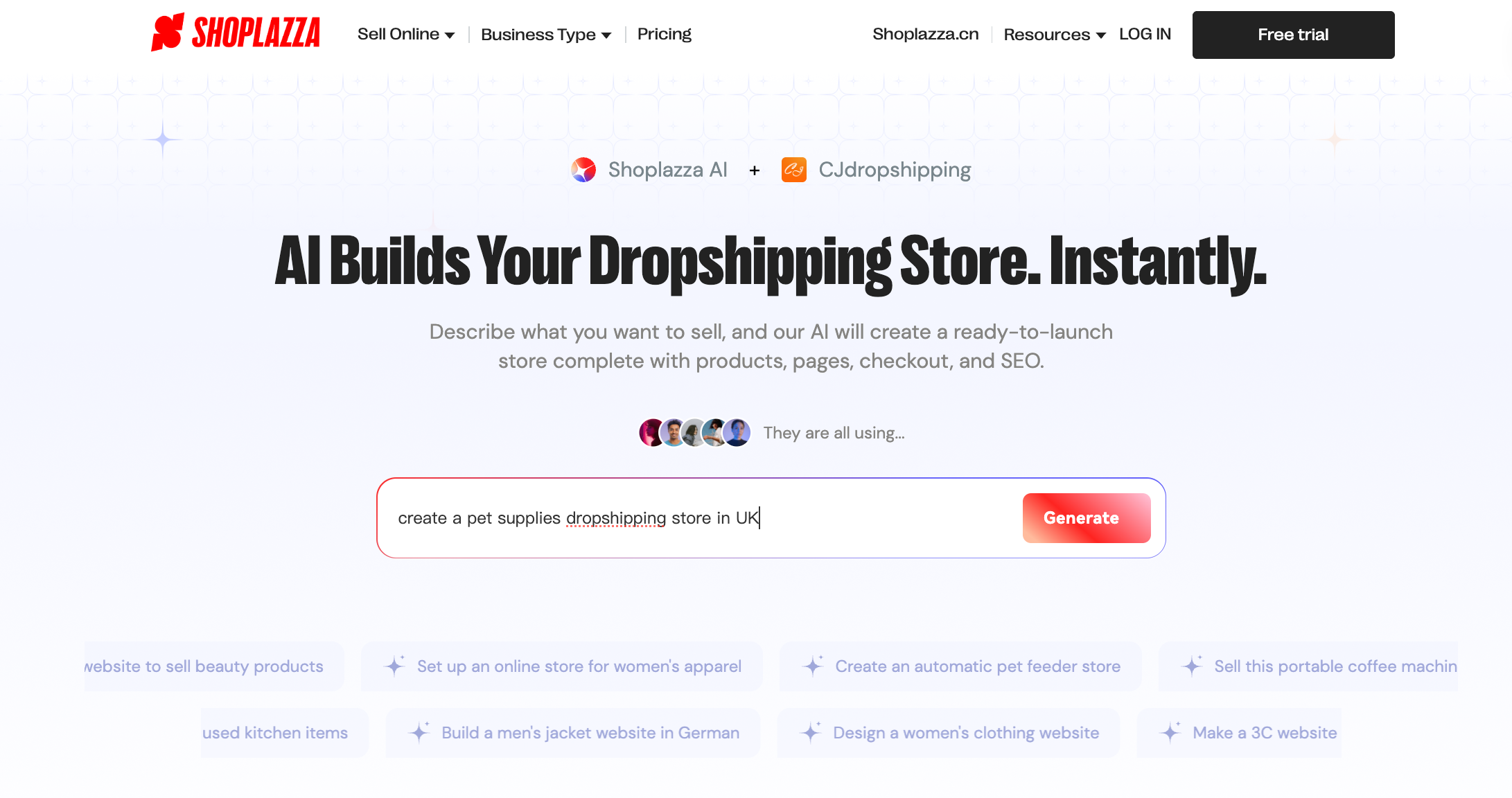
Once your store is live, dropshipping is ready to go. CJdropshipping and EPROLO are built directly into the platform, both with UK warehouse stock for 2–5 day domestic delivery. Want to sell custom products too? Shoplazza's app marketplace includes POD plugins, like Customily, CustoMeow, YMQ, and Customall, connected to Printful and Printify. T-shirts, mugs, phone cases, hats — production and fulfilment are handled automatically once an order comes in.
Key features:
- SEO Optimizer auto-generates ALT text, meta titles and descriptions, JSON-LD structured data, and real-time sitemap
- App marketplace covering email marketing, loyalty programmes, upselling, and ad pixel management — around 90% of apps are free
- Shipping and fulfilment managed in one dashboard, with automation available across orders, tracking, and logistics
- Shoplazza Payments integrates 180+ payment methods, including Klarna, Stripe, and PayPal, in one built-in solution, simplifying setup and helping maximise revenue
- Supports multiple languages and currencies, useful if you plan to sell beyond the UK
- No transaction fee on Pro plan when using Shoplazza Payments
- Free AI-generated store preview with no sign-up or credit card required
It may cost:
Shoplazza's Basic plan starts at $39 per month, or $29.25 per month on an annual plan. Even at this entry level, you get unlimited product listings, 180+ payment methods, Google, Meta, and TikTok integrations, up to 50 markets in one store, 3 staff accounts, and 24/7 live support. Higher plans unlock lower transaction fees, more staff accounts, B2B wholesale, and Avalara tax features.
eBay UK: best for zero-upfront-cost entry and built-in traffic
eBay is often the first platform UK sellers try, and for good reason. No website, no traffic strategy, no checkout setup needed. You create a seller account, list your products, and you are immediately visible to millions of active UK buyers.
It works particularly well for beginners who are still figuring out which products have genuine demand. Many dropshippers use eBay early on to validate ideas, then move their best-performing products to a branded store once they have real sales data. That migration path is common and intentional.
Where eBay falls short is brand building. Unlike Shoplazza, you have no control over your store's design, customer experience, or post-purchase journey. You are selling inside eBay's ecosystem, not building your own. For sellers at the testing stage, that is a reasonable tradeoff. For anyone thinking long-term, it becomes a ceiling.
Key features:
- No website or hosting required; your store is live as soon as you list
- Access to millions of active UK buyers with genuine purchase intent
- Free listings available each month for both private and business sellers
- Compatible with Avasam and AutoDS for automated stock syncing and order routing
- eBay Store subscriptions available for high-volume sellers to reduce per-listing costs
It may cost:
Free to start. For business sellers, the standard final value fee is 12.8% of the total sale amount (item price plus postage), plus a fixed per-order fee of 40p for orders over £10 (increased from 30p in February 2026). A regulatory operating fee of 0.32–0.42% also applies to all UK sales. Private sellers had final value fees removed across most categories from October 2024.
TikTok Shop: best for trend-driven and social commerce products
TikTok Shop suits a specific type of seller: one who creates short-form video content and wants to reach a younger, impulse-driven audience. Products are discovered through content rather than search, so your ability to produce engaging videos — or partner with creators who can — matters more than a polished product listing.
For the right category, it is a powerful channel. For slower-moving or considered-purchase products, it is less effective. It is also worth being realistic about dropshipping specifically. TikTok Shop penalises slow shipping with account health penalties, so overseas slow-fulfilment models do not work well here. UK-warehouse suppliers or Fulfilled by TikTok (FBT) are the safer route.
Compared to WooCommerce and Shoplazza, TikTok Shop also offers no branded storefront, little SEO value on Google, and no ownership of your customer data. It works best as a discovery and sales channel alongside an owned store, not as a standalone business foundation.
Key features:
- In-app purchasing removes friction between content discovery and checkout
- Strong organic reach potential through the TikTok algorithm, particularly for visual and trend-led products
- Creator affiliate programme allows you to partner with content creators on a commission-only basis, reducing upfront ad spend
- Fulfilled by TikTok (FBT) available for sellers who want managed warehousing and shipping
- Compatible with print-on-demand fulfilment apps for custom product sellers
- HMRC sales data reporting integrated from 2026, with direct monthly reporting under Model Reporting Rules
It may cost:
Free to set up a seller account. The standard commission rate for UK sellers is 9% per sale. New sellers receive a promotional rate of 3% for the first 30 days after their first sale. Certain categories, including Electronics and Beauty and Personal Care, may qualify for a reduced rate of 5–7%. An additional £0.50 per-order self-fulfilment fee applies if you are not using FBT.
WooCommerce: best for WordPress users who prioritise SEO control
WooCommerce is a free plugin that turns any WordPress site into a functioning e-commerce store. The main appeal is ownership — you control the code, the design, and every technical detail. That flexibility is genuinely valuable for SEO, where ranking on Google UK can drive meaningful organic traffic without ongoing ad spend.
That said, WooCommerce demands more technical involvement than any other platform on this list. You manage hosting, security, plugin updates, and performance yourself. For sellers with WordPress experience, that is manageable. For complete beginners, the setup and maintenance overhead can pull focus away from actually running the business.
Unlike the previous three platforms, there is no guided setup and no fully built-in dropshipping integrations. You are building from scratch. The payoff is maximum control and SEO flexibility, but it comes with a steeper learning curve and higher ongoing effort.
For a seller with WordPress experience or a developer on hand, this is manageable. For a complete beginner, the setup time and ongoing maintenance can be a distraction from actually running a dropshipping business.
Key features
- Full ownership of site data, code, and design with no platform lock-in
- Best-in-class SEO flexibility including full control over structured data, schema, and technical site configuration
- AliDropship and WooDropship plugins available for product sourcing and order management
- Large ecosystem of free and premium plugins for extending functionality
- Supports all major UK payment gateways including Klarna, Stripe, and PayPal
- Scales well for high-volume stores when paired with appropriate managed hosting
It may cost:
WooCommerce itself is free. You will need to pay separately for hosting and any premium plugins. SiteGround, a widely used option for WooCommerce stores in the UK, starts at introductory rates from around £2.75 per month, though renewal rates are significantly higher, with the GoGeek plan (recommended for WooCommerce) renewing at approximately £34.99 per month. Kinsta, a managed WordPress host built on Google Cloud infrastructure, starts at $30 per month (approximately £24) and is generally recommended for stores where site speed directly affects conversions.
Recommended dropshipping suppliers for UK stores
Choosing a platform is only half the equation. The suppliers you connect to will shape your delivery times, return rates, and margins. Here are five options that work well for UK-based operations.
- CJdropshipping has a UK warehouse stock, which means domestic orders typically arrive within two to five days, a meaningful advantage over Chinese-based fulfilment. It offers free product sourcing, customized services, and integrates directly with Shoplazza for automated order processing. A practical starting point for both testing and scaling.
- Avasam is built specifically for the UK market. It connects you with verified domestic suppliers, handling stock syncing and order routing automatically. Delivery is typically one to three days, and there are no customs complications. A free plan is available with no transaction fees. eBay sellers can also manage and list products directly to eBay through a paid add-on.
- Spocket focuses on UK and EU-based suppliers, giving you access to over seven million products with shorter delivery windows than global alternatives. The branded invoicing feature is useful for sellers who want their packaging to reflect their own store, not the supplier. Free plan available for up to 25 products; paid plans from $9 per month.
- Syncee connects you with UK suppliers and supports both automated and manual product imports. It works across multiple e-commerce platforms, making it a practical choice if you are selling on more than one storefront simultaneously.
- AutoDS aggregates multiple UK-warehouse suppliers into one dashboard and automates inventory monitoring, pricing adjustments, and order fulfilment. It is better suited to sellers managing a larger catalogue who want to reduce the manual workload as they scale.
UK-specific considerations before you launch
Running a dropshipping business in the UK involves a few regulatory and logistical details that are easy to overlook early on. Getting these right from the start saves time later.
- Delivery speed. UK customers increasingly expect orders within two to five days, and anything beyond that starts to show up in your reviews and refund rate. Platforms that integrate with suppliers holding UK warehouse stock give you a measurable advantage here.
- VAT registration. Registration is mandatory once your taxable turnover reaches £90,000. Set up your bookkeeping early so your data is clean and export-ready. Under Making Tax Digital (MTD), you will need to submit quarterly VAT updates digitally — tools like Xero or QuickBooks can automate this when connected to your store from day one.
- Post-Brexit customs. The UK government confirmed in the Autumn Budget 2025 that the £135 customs duty exemption on low-value imports will be removed by March 2029. Once in effect, all commercial imports under £135 will attract customs duty. Sellers relying on overseas fulfilment will face higher landed costs. Switching to UK-warehouse suppliers now is both a practical and strategic move.
- Returns handling. For low-cost products sourced internationally, a returnless refund policy often makes more financial sense than paying for reverse logistics. Offer a refund or replacement and let the customer keep the item.
- Payment trust signals. Klarna, Revolut, Apple Pay, and familiar card checkout flows all reduce cart abandonment for UK buyers. Ensure your platform like Shoplazza supports these before you go live.
- HMRC digital reporting. TikTok Shop reports seller data to HMRC monthly under 2026 Model Reporting Rules. eBay reports seller earnings to HMRC once you exceed 30 sales or £1,700 in a calendar year, a rule in effect since January 2024. Keep accurate records from your first sale.
Conclusion
There is no single platform that works for every UK dropshipping seller. Many start on eBay or TikTok Shop to test products with minimal upfront cost, then move to a branded store once they have real sales data. That is where Shoplazza fits well — its AI Store Builder gets you from zero to a fully structured dropshipping store quickly, with CJdropshipping and more dropshipping suppliers already integrated. For beginners who want to skip the trial-and-error phase entirely, it is also a practical place to start. Building your own store means owning your customers, your data, and your brand long-term.
Frequently asked questions about UK dropshipping
Q: Is dropshipping legal in the UK?
Yes. Dropshipping is a legal business model in the UK. You are required to comply with consumer protection laws, provide accurate product descriptions, handle returns in line with UK regulations, and register for VAT once your taxable turnover exceeds £90,000. Operating transparently and meeting your obligations to customers is what keeps the model sustainable.
Q: Do I need to register a business to start dropshipping in the UK?
You do not legally need to register a limited company to start. Many UK dropshippers begin as sole traders, which requires registering with HMRC for self-assessment but involves no company registration. As your revenue grows, registering as a limited company may offer tax and liability advantages worth exploring with an accountant.
Q: Which UK dropshipping suppliers offer the fastest delivery?
Suppliers with UK warehouse stock consistently deliver in one to three days. Avasam connects you with domestic UK suppliers across multiple categories. CJdropshipping's UK warehouse typically fulfils in two to five days.
Q: How does post-Brexit customs affect UK dropshippers in 2026?
Currently, goods valued under £135 imported into the UK are exempt from customs duty. The UK government has confirmed this exemption will be removed by March 2029. Once that happens, low-value goods imported from overseas will attract additional costs. Sellers who shift to UK-warehouse suppliers before that date will avoid the cost increase and maintain their delivery time advantage.
Q: What is the VAT threshold for UK dropshipping businesses?
VAT registration becomes mandatory once your taxable turnover exceeds £90,000 in a rolling 12-month period. You can register voluntarily below that threshold, which allows you to reclaim VAT on business expenses. Once registered, you will need to comply with Making Tax Digital requirements and submit quarterly returns digitally.