
Rising ad costs and slowing traffic growth are challenges most self-hosted ecommerce stores face today. With the same budget, some sellers consistently see 2–3 times returns, while others struggle at the margin. The issue isn't how much you spend—it's how you spend it. In this article, we'll explore practical ways on how to increase marketing ROI, focusing on three key areas: data, ad strategy, and customer lifecycle, so every dollar works harder for your store.
Quick Answer
To increase marketing ROI, focus on 10 key strategies: use data-driven decisions, optimize Pixel and tracking, run A/B tests, segment audiences, boost LTV, leverage marketing automation, improve CRO, prioritize high-ROI channels, repurpose content, and set clear KPIs. Free and built-in tools like OnePixel for multi-platform tracking, abandoned cart recovery for reclaiming lost sales, and MambaSMS for automated follow-ups make implementing these strategies easier, helping you turn every ad dollar into measurable results.
What is marketing ROI? Why is it getting harder to improve?
In ecommerce and digital marketing, ROI (Return on Investment) measures how much profit each dollar spent brings back. It's more than just a way to evaluate ad performance; it's a key indicator of whether your business can grow sustainably. Simply put, ROI answers one question: is your spending actually turning into profit?
In the early days of traffic growth, improving ROI was straightforward—you ran ads and got returns. But as competition intensifies, user attention fragments, and privacy rules tighten, improving ROI is no longer just about ad placement. It has become a system-wide challenge involving data, conversions, and customer management. That's why the same budget can yield very different results for different sellers.
The difference between ROI, ROAS, and CPA
To grasp ROI clearly, it helps to distinguish a few common metrics. These three are often used together but focus on different aspects:
- ROI looks at overall profitability, comparing profit to total costs.
- ROAS focuses on ad performance, measuring revenue generated per ad dollar. A high ROAS doesn't always mean profit—you still need to consider your cost structure.
- CPA measures how much it costs to acquire one customer.
Why ROI drops: Three main reasons
ROI usually declines due to multiple factors rather than a single cause. The most common reasons are:
- Rising traffic costs: Competition on major ad platforms drives up both click and impression costs, raising the bar for customer acquisition.
- Inaccurate data: Browser restrictions, iOS privacy updates, and new policies reduce user behavior data, making it harder for ad models to track conversions accurately.
- Broken conversion paths: Ads that don't match user intent, slow-loading pages, or weak trust signals all lower final conversion rates.
How to measure marketing ROI?
Measuring marketing ROI isn't the same for every business. Different industries have different costs and goals, so what counts as "good" ROI changes:
- For ecommerce, where traffic is scattered and conversions happen quickly, ROI focuses on short-term returns. Generally, an ROI of 4 or higher is healthy. When checking ROI, separate organic from paid traffic and consider return rates. If it's below 4, it's time to tweak your ads, channels, or product pricing to get more value from your budget.
- For apps, SaaS, and online services, immediate profit isn't the main goal. The focus is on long-term customer value. ROI of 2 or more is usually fine, as long as the cost to get a customer stays manageable. The real goal is growing your user base: when ROI is good and your users keep increasing, you can spend more on ads—bigger scale means more profit.
- For offline stores or businesses with high fixed costs, ROI should be 5 or higher. Marketing costs often don't include rent or staff, so lower ROI can easily lead to losses. Focus on how many visitors convert and come back. ROI here shows not just profit, but how accurate your marketing is.
These industry-specific benchmarks makes it easier to see if your marketing money is working and what to improve.
How to increase marketing ROI in business? 10 Strategies for ecommerce
After understanding the challenges, the next step is finding a clear system to increase marketing ROI. Here are 10 key strategies that cover the full chain, from data to conversions to repeat purchases.
Use data to drive decisions
Clicks alone no longer tell the full story. The real question is how much revenue each marketing dollar contributes. Key metrics like CPA (cost per acquisition), ROAS (return on ad spend), conversion rate, and customer lifetime value (CLV) help you see the quality of your traffic and the long-term impact of your campaigns.
For example, if your CPA keeps exceeding the value a customer brings, or ROAS is below your target, it's a signal to pause or adjust the campaign. On the flip side, when ROAS is steady and conversion rates are improving, it makes sense to gradually increase your budget and scale the highest-performing traffic.
Tools like Google Analytics or Facebook Ads Manager let you track these metrics in real time. Using this data loop helps you make smarter decisions and increase ROI with marketing analytics, turning raw numbers into actionable strategies rather than just reports.
Optimize pixel and tracking systems
Data accuracy directly affects campaign performance. Traditional client-side pixels rely on browsers to track user behavior. But with iOS privacy updates and stricter browser restrictions on third-party cookies, some user data is lost. This creates gaps in conversion tracking and prevents ad platforms from "learning real signals."
To solve this, many merchants are moving to server-side tracking. Unlike client-side pixels, server-side tracking sends data directly from your backend to ad platforms, making it more stable and less dependent on the user's device. When combined with Conversion APIs, key actions—such as add to cart or payment—can be synced automatically, improving data completeness.
Event standardization is another often-overlooked factor. Events such as Add to Cart, Initiate Checkout, or Purchase must be defined consistently and include all key parameters. Otherwise, ad platforms may misjudge user value, which can hurt campaign performance.
To manage pixels across multiple channels, you can use tools built into ecommerce platforms. For example, Shoplazza's OnePixel tool lets you centralize pixels for Facebook, Google, TikTok, Snapchat, and seven other major platforms. It comes with standard ecommerce event templates, so you can deploy tracking without any code.
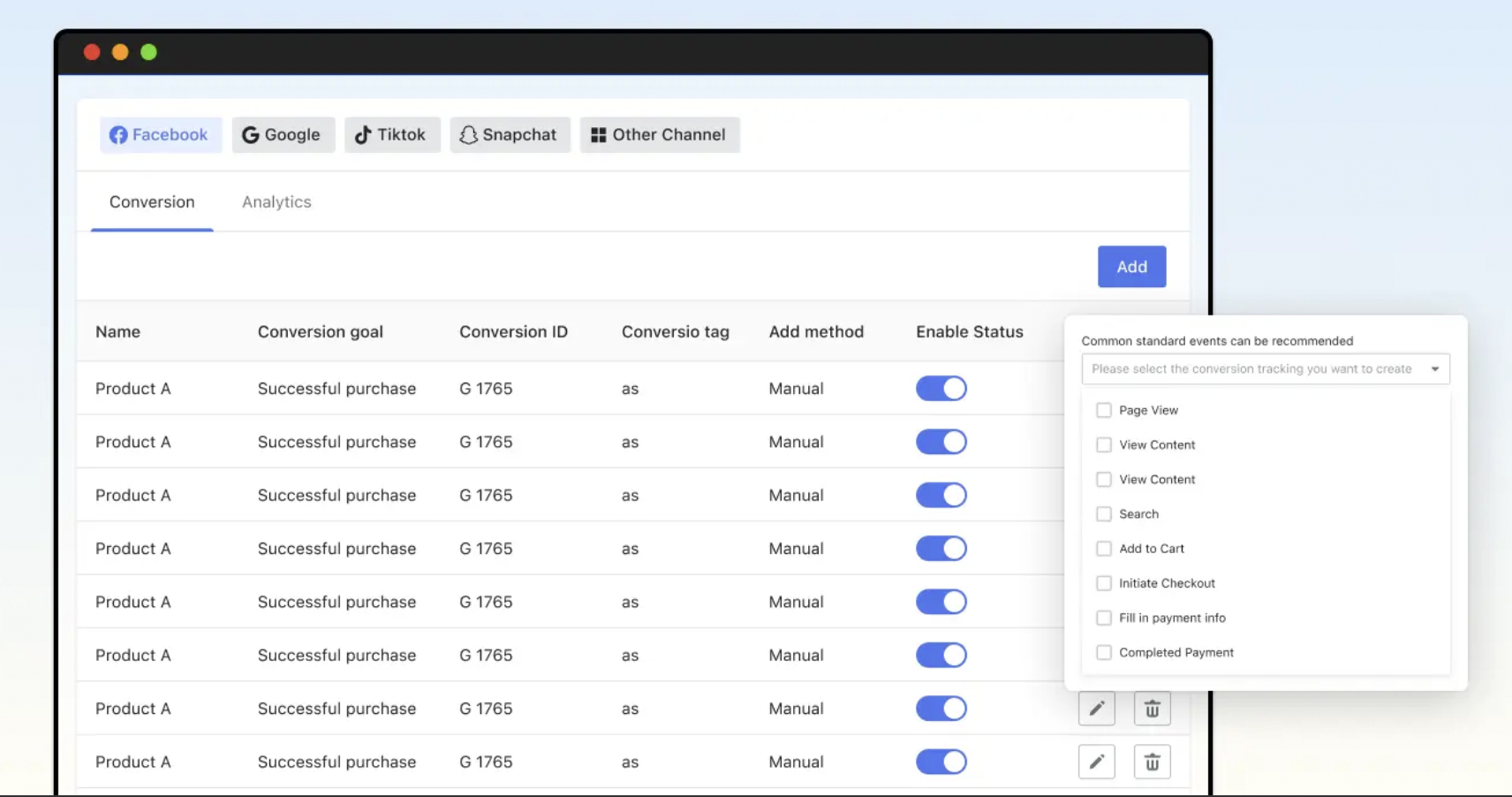
OnePixel also supports server-side data sync, reducing data loss caused by browser restrictions. If you run multiple stores or brands, its Multi-Pixel setup allows independent tracking for different accounts while keeping centralized management. Many sellers report:
- "Managing multiple channels is much easier, data accuracy improved, and we could optimize ads more precisely—ROAS increased by about 25%."
- "After server-side sync, data loss dropped significantly, and overall attribution became much more complete."
These results show that the real value of these tools is building a stable data foundation—not just adding extra features.
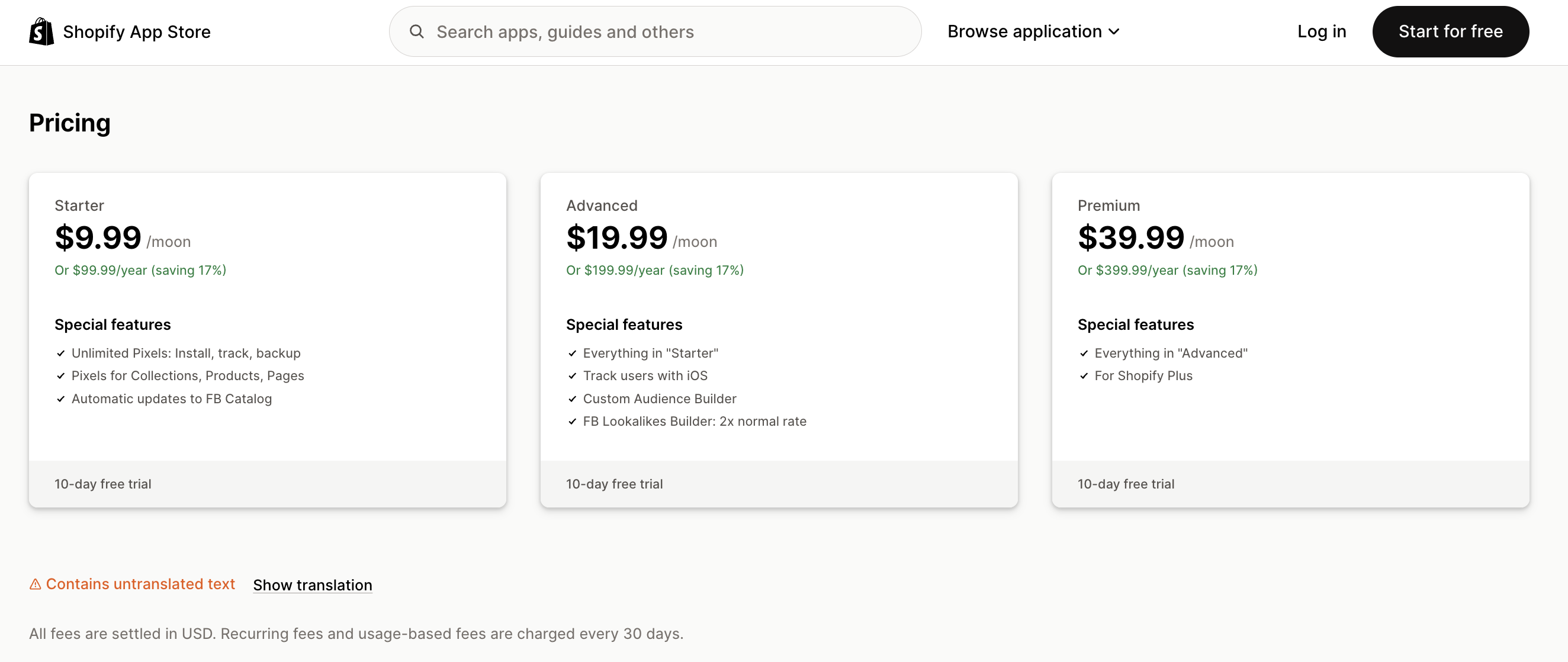
Source: Shopify's MultiPixels
In the Shopify ecosystem, MultiPixels offers similar functionality, supporting multiple platforms like Facebook and TikTok, with options for data backup and audience building. Pricing is tiered: Starter around $9.99/month, Advanced $19.99/month, and Premium $39.99/month (mainly for Shopify Plus users). Higher-tier plans usually include more robust iOS tracking and advanced audience building. Businesses need to weigh the features they need against the cost based on their size and goals.
Run continuous A/B tests
A/B testing is a fundamental way to improve ad and page conversion performance. The idea is simple: compare different variables to see which version performs better. Common things to test include images or videos, ad copy, CTA buttons, and landing page layouts. It's important to follow the single-variable principle, only change one key element at a time. Changing too many factors at once makes it impossible to know what caused the result.
Common mistakes include running tests for too short a period, before data stabilizes, or testing too many variables at once. Ideally, run each test for a full conversion cycle and make sure your sample size is statistically significant.
When evaluating results, don't focus only on clicks. Look at core metrics like conversion rate, CPA, or ROAS. If one version consistently drives better results over a stable period, it's worth scaling. The goal of A/B testing isn't just to experiment—it's to use data to gradually increase confidence and make decisions that reliably improve performance.
Refine audience segmentation
Users at different stages respond to information differently and have distinct motivations. Sending the same message to everyone usually lowers overall conversion efficiency. Common segments include:
- Cold users: people who haven't interacted with your brand yet
- Interested users: those who added items to cart or showed interest
- Loyal customers: users who already trust your brand
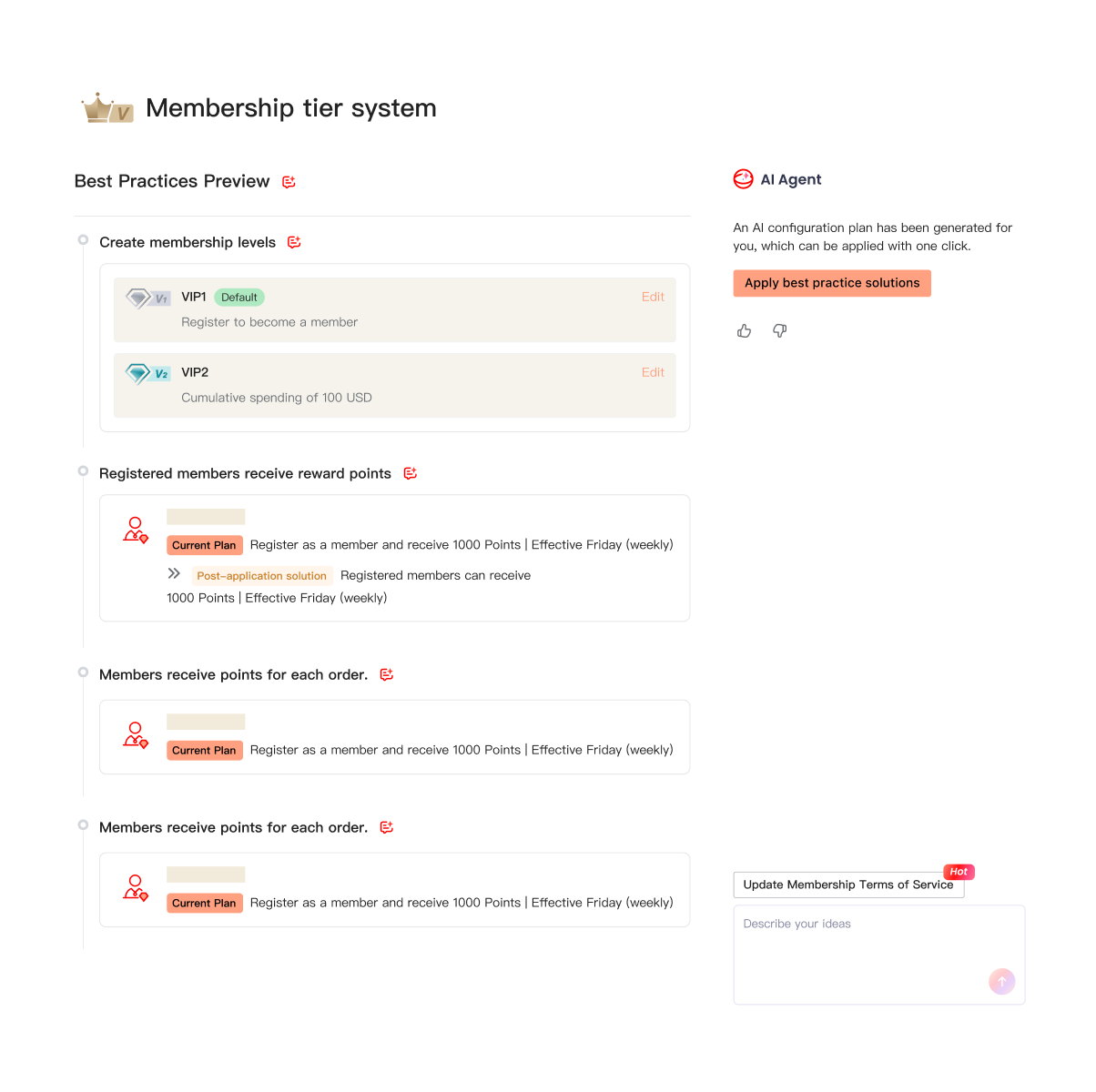
Each group requires a different communication focus.You can also use lookalike audiences to expand your reach to high-quality users. This approach identifies new users who behave similarly to your top customers, increasing the chance of conversion. Tools like Loyalty & Push make segmentation even easier. They can automatically suggest membership tiers based on purchase behavior, order value, and preferences, while still allowing manual segmentation. Built-in templates and custom rules let merchants quickly select target groups.
Once segments are defined, you can create targeted campaigns based on membership level, points, or spending capacity. For example, you could send exclusive emails or personalized discounts. This approach ensures your marketing reaches the right people and boosts overall ROI.
Increase customer lifetime value (LTV)
Customer lifetime value (LTV) measures long-term profitability and plays a key role in keeping ROI strong. Acquiring new customers usually costs more than retaining existing ones, so boosting repeat purchases is a more efficient and sustainable way to grow revenue.
Beyond membership programs and loyalty plans, tools like MambaSMS SMS & EDM Marketing help strengthen customer relationships. Automated workflows can send messages based on behavior—like first purchases or abandoned carts—using default templates or custom designs. The system also provides detailed reports showing the revenue contribution of each campaign, so you can see exactly what each marketing dollar delivers.
Pair these efforts with regular promotions, point systems, and personalized recommendations, and repeat purchase rates and customer loyalty steadily improve. Over time, optimizing LTV allows you to increase ROI on a stable cost foundation, rather than relying solely on higher ad spend.
Leverage marketing automation
Marketing automation is a key way to boost efficiency and conversions while reducing manual work. Common use cases include recovering abandoned carts, sending welcome emails, and re-engaging inactive users.
For example, many potential customers add items to their cart but never complete checkout. Timely follow-ups can help recover these lost orders. Platforms like Shoplazza offer built-in abandoned cart recovery without extra fees or third-party apps. Merchants can simply create a template in the backend, set the email name, discount code, and delay timing, then choose automatic or manual sending.
This ensures every potential customer is reached accurately, while keeping operations efficient and manageable. Paired with automated welcome emails and user reactivation campaigns, marketing automation helps steadily improve conversion rates and repeat purchases, strengthening overall ROI and supporting long-term growth.
Improve website conversion rate (CRO)
Conversion rate optimization (CRO) is one of the most effective ways to get more value from your existing traffic. Page load speed is critical—slow pages lose users before they even see your content. For example, Reformia's mobile-responsive theme automatically converts images to efficient WebP or AVIF formats, reducing file size by 30%–60%. First contentful paint (FCP) drops to 0.7 seconds, exceeding industry standards by 61%. The page is stable too, with CLS < 0.01 and negligible interaction delays (TBT ≈ 0 ms), providing a smooth browsing experience.
Mobile experience matters as well. Buttons, forms, and swipe interactions must work seamlessly across devices to reduce friction and make actions effortless. Trust signals also play a key role. Customer reviews, return policies, and secure payment badges can greatly boost buyer confidence. By improving load speed, mobile usability, and trust elements together, you can steadily increase your website's overall conversion rate and make the most of every visitor.
.png?width=1299&height=1200&name=Improve%20website%20conversion%20rate%20(CRO).png)
Prioritize high ROI channels
Not all advertising channels deliver the same return, so it's important to focus on those that drive the highest ROI. Evaluating channel performance goes beyond traffic volume—look at conversion rate, CPA, and ROAS to judge true effectiveness.
Channel mix matters too. Platforms like Meta, Google, and TikTok each reach different audiences, so combining them strategically can expand precise targeting. Avoid splitting budgets evenly across all channels—low-performing platforms drain funds without delivering meaningful returns. Instead, allocate more to high-performing channels and regularly review performance. Flexibly adjusting your budget based on results ensures you get the most value from every ad dollar and steadily improve overall ROI.
Use content repurposing strategies
Content repurposing is a smart way to lower acquisition costs and boost overall ROI. The idea is simple: one piece of content, multiple uses. For example, a well-written blog post can be broken down into short videos, social media posts, or even turned into ad creatives, reaching potential customers across different touchpoints without creating entirely new content.
This approach not only saves time and production costs but also keeps your messaging consistent, reinforcing brand recognition. You can make light adjustments to fit each platform and audience behavior, which can improve clicks and conversions. Over time, repurposing ensures every piece of content delivers measurable results, steadily increasing the overall ROI of both advertising and operations.
Set clear KPI
Clear KPIs are the foundation for improving marketing ROI. Vague goals like "increase brand awareness" are hard to measure and don't guide budget allocation or strategy effectively. Good KPIs should be specific, measurable, and tied directly to revenue. Different stages of marketing require different metrics:
- Acquisition stage: focus on CPA to ensure each dollar brings in new customers efficiently
- Conversion stage: track conversion rate (CVR) to see if pages and marketing content actually drive purchases
- Profitability stage: use ROAS or ROI to measure the overall return on your marketing investment
Regular performance reviews are essential. Weekly or monthly check-ins help identify what's working, what isn't, and allow you to adjust budget, creative assets, and ad strategies promptly. By setting clear goals, measuring the right metrics, and reviewing consistently, teams can focus on what truly matters and ensure every marketing dollar delivers measurable, sustainable results.
Improve your store's ROI
Improving store ROI is about getting the whole system right. From tracking data accurately and optimizing ads, to segmenting users, encouraging repeat purchases, and reusing content, every step counts. Instead of just spending more on ads, focus on clear goals, small process improvements, and automation to make every dollar work harder. By putting these pieces together, merchants can grow steadily, keep costs under control, and see real results. This is how to truly learn how to increase marketing ROI and make your efforts pay off.
FAQs about marketing ROI
Q1: Which is more important, ROI or ROAS?
ROI measures overall business profitability, showing how much net return you get from every dollar spent. ROAS focuses specifically on ad performance, tracking the efficiency of each campaign or channel. Both are important: use ROAS to optimize ad performance and ROI to monitor overall profitability. Together, they help balance ad efficiency with cost control for more stable, long-term results.
Q2: Why do I get lots of clicks but few conversions?
High clicks with low conversions usually point to landing page issues or audience mismatch. Common problems include slow loading, poor mobile experience, inconsistent messaging, or missing trust signals like reviews, guarantees, or return policies. Fixing these, and running A/B tests on pages and copy, helps users complete purchases smoothly and boosts conversion rates.
Q3: How do I know if a channel is worth investing in?
Don't judge channels by traffic alone. Focus on ROAS, conversion rates, and average order value. High-traffic but low-converting channels can waste budget, while high-ROI channels maximize returns per ad dollar. Look at how channels work together, adjust budgets accordingly, and avoid splitting spend evenly. Data-driven evaluation helps you decide which channels to scale, optimize, or pause.
Q4: What should new sellers optimize first?
New sellers should start with the data foundation and conversion points. Make sure tracking is accurate, key metrics are visible, and landing pages provide a smooth user experience. Once the basics are solid, gradually expand ad budgets and channels. This approach controls costs while maximizing returns and sets up a strong foundation for long-term ROI growth.


.png)