Alibaba and AliExpress are owned by the same parent company, but they were built for completely different buyers. For dropshippers, choosing between the two is not a question of which platform is better — it is a question of which one fits where you are right now. Get it wrong and you either overcommit capital before you have proven demand, or you leave significant margin on the table once you do. This article breaks down alibaba vs aliexpress for dropshipping across pricing, MOQs, supplier relationships, and private labeling, so you can make the right sourcing decision for your current business stage.
What is the core difference between Alibaba and AliExpress for dropshipping?
They share a parent company, but the two platforms serve fundamentally different purpose, and understanding that distinction upfront saves you from expensive sourcing mistakes.
Alibaba is a B2B wholesale platform built for bulk buying.
Alibaba is a Chinese-owned global wholesale marketplace with over 200 million products from more than 200,000 suppliers, generating roughly $137.3 billion in revenue in 2025. The platform connects buyers directly with manufacturers and factories. Prices are not fixed — they are negotiated. Suppliers expect purchase orders, trade terms like FOB or EXW, and buyers who understand how bulk manufacturing works. When you browse Alibaba, you are not shopping. You are entering a business negotiation.
Most listings include a Minimum Order Quantity. The smallest number of units a supplier will produce or sell in one order. Most Alibaba suppliers require 50 to 500-plus units per SKU. That is not a barrier for large retailers, but for a new dropshipper with an unproven product, it represents a significant capital commitment before you have made a single sale.
AliExpress is a B2C retail marketplace adopted by dropshippers.
AliExpress works more like a consumer shopping platform. Fixed prices, no negotiation, no MOQ. You browse, click, buy one unit, and the seller ships it — directly to your customer if you are dropshipping. Buyer protection runs through Alipay escrow, which holds your payment until delivery is confirmed. The platform was not built specifically for dropshipping, but the structure fits perfectly: zero inventory, order only after a customer pays, and the seller handles international shipping.
Importantly, AliExpress now has specific filters that make it more practical for dropshippers. You can filter product searches by "Ship from USA," "Ship from UK," or other local warehouse locations, which brings delivery times for those products down to 3–10 business days for local customers. You can also filter for specific product types like POD Products, which are items pre-configured for print-on-demand customization, and sort by seller performance metrics to reduce the risk of landing on an unreliable supplier.
Pricing structure for dropshipping: Alibaba vs AliExpress
Price is the most visible difference between the two platforms, but the number on the listing is rarely the number that matters most. Here is what the pricing actually looks like in practice.
How Alibaba prices work and what the listed price does not include?
Alibaba shows factory-level pricing, which can be 30 to 70% lower per unit than the equivalent product on AliExpress. By purchasing directly from manufacturers, dropshippers can access significantly lower prices compared to retail or small-scale suppliers. But that quoted price is typically FOB (Free On Board) or EXW (Ex Works), meaning it covers the product itself and getting it to the port of origin — nothing else. International freight, customs duties, insurance, and last-mile delivery are all additional costs you calculate and pay separately.
For small orders, that total landed cost can run 2–3x the quoted unit price. A $3.00 per-unit product on Alibaba might cost $7.00–$9.00 per unit by the time it reaches your 3PL warehouse in the US or EU, especially if you are air freighting rather than using sea freight. The economics only become clearly favorable at meaningful volume.
How AliExpress pricing works for dropshippers?
AliExpress pricing is all-inclusive at the listing level. What you see — including free or low-cost shipping — is what you pay. The seller handles the logistics, customs paperwork, and delivery. That simplicity has a cost: AliExpress prices are retail prices, not factory prices. You are paying for convenience and risk elimination, and that premium compresses your margin.
That said, the margin picture is not entirely straightforward. AliExpress Standard Shipping has become significantly more efficient in recent years, and with local warehouse filtering, you can find competitive per-order pricing for fast-shipping products without building any logistics infrastructure yourself.
Where your margin actually breaks even between the two platforms?
If you are selling fewer than 30–50 units of a product per week, the complexity and capital commitment of Alibaba sourcing rarely justifies the per-unit savings. Once you are consistently above that volume, and once you have a 3PL or fulfillment agent in place, Alibaba's factory pricing starts to materially improve your margins. The decision is not about which platform is cheaper — it is about which pricing structure fits your current order volume and operational capacity.
Minimum order quantities: can you actually dropship from Alibaba?
MOQ is the biggest practical barrier between Alibaba and dropshipping, but it is less of an absolute wall than most new sellers assume.
How Alibaba MOQs work in practice?
Most Alibaba suppliers list MOQs ranging from 50 to 500 units, but you can filter specifically for dropshipping-friendly listings using the "MOQ: 1 Piece" filter and the "Ready to Ship" section. These filters surface suppliers who have already opted into lower-volume or single-unit fulfillment. The "Ready to Ship" tag specifically means the product is already manufactured and in stock — no production lead time, faster dispatch.
Beyond filtering, published MOQs on Alibaba are negotiable. For a first order, factories often accept half the listed MOQ if you clearly explain that you are testing the product before scaling. Framing your request as a trial run before a larger commitment is a standard and accepted approach in supplier negotiations on the platform.
Three ways dropshippers use Alibaba without traditional bulk buying:
- Option one: use the "MOQ: 1 Piece" and "Verified Supplier" filters to find suppliers who explicitly support single-unit dropshipping, then negotiate shipping terms and turnaround time directly before listing the product.
- Option two: place a small bulk order, may 50 to 200 units, and store it with a third-party logistics (3PL) partner who ships individual orders to your customers. This is not zero-inventory dropshipping, but it gives you factory pricing with per-order fulfillment capability.
- Option three: use Alibaba purely as a sourcing and supplier relationship layer. You find and vet the manufacturer on Alibaba, negotiate pricing and product specifications, then route actual fulfillment through a dropshipping agent who holds the stock and ships per order on your behalf.
AliExpress remains the default for zero-inventory dropshipping
For true per-order, zero-inventory dropshipping, AliExpress is operationally simpler. No negotiation, no minimum commitment, no production lead time to manage. A growing number of Alibaba suppliers now accommodate low-MOQ and single-unit fulfillment, but it is not the default — you have to actively find and qualify those suppliers. For a seller who is still validating product ideas, that extra friction is a real cost, even if the unit economics look better on paper.
Supplier relationships and product quality: Alibaba vs AliExpress
Beyond price and MOQ, how each platform handles supplier quality and buyer protection shapes your day-to-day operational risk in ways that new sellers often underestimate.
How supplier relationships work on Alibaba?
Alibaba gives you direct access to the factory. That means you can request specific product specifications, custom packaging, logo placement, and material changes — things that are either impossible or impractical through AliExpress's seller model. Before any significant order, sampling is standard practice: you request one or a small batch of units, inspect them against your quality requirements, and only then commit to volume.
When evaluating suppliers on Alibaba, look for these signals in the platform's own filters: Verified Supplier status (the supplier has passed background checks), Trade Assurance coverage (payment protection and dispute support through Alibaba), and operational history of at least two to three years. Prioritizing suppliers with Verified Supplier status and Trade Assurance coverage provides a baseline level of platform-backed protection and indicates the supplier has undergone basic verification.
Private labeling: Alibaba's clearest advantage over AliExpress
This is where the two platforms diverge most sharply for sellers who want to build a real brand. Alibaba allows sellers to customize product designs, packaging, and branding, enabling them to create private-label products and build strong, recognizable brand identities. Custom boxes, branded inserts, logo embossing, and even product-level modifications are all negotiable with the right Alibaba manufacturer. AliExpress sellers, by contrast, are generally reselling existing products as-is. Some will add a basic custom label if you ask, but there is no standardized branding process and no consistency across multiple sellers.
How supplier reliability works on AliExpress?
On AliExpress, you are buying from individual retail sellers rather than factories directly. Seller ratings, review counts, and transaction volume give you a rough signal on reliability, but they do not guarantee product consistency across batches. Alipay escrow protects individual transactions — your payment is held until you confirm receipt — but it does not prevent the quality variation that comes from sourcing through middlemen rather than manufacturers.
How to use Alibaba and AliExpress together: a practical sourcing playbook
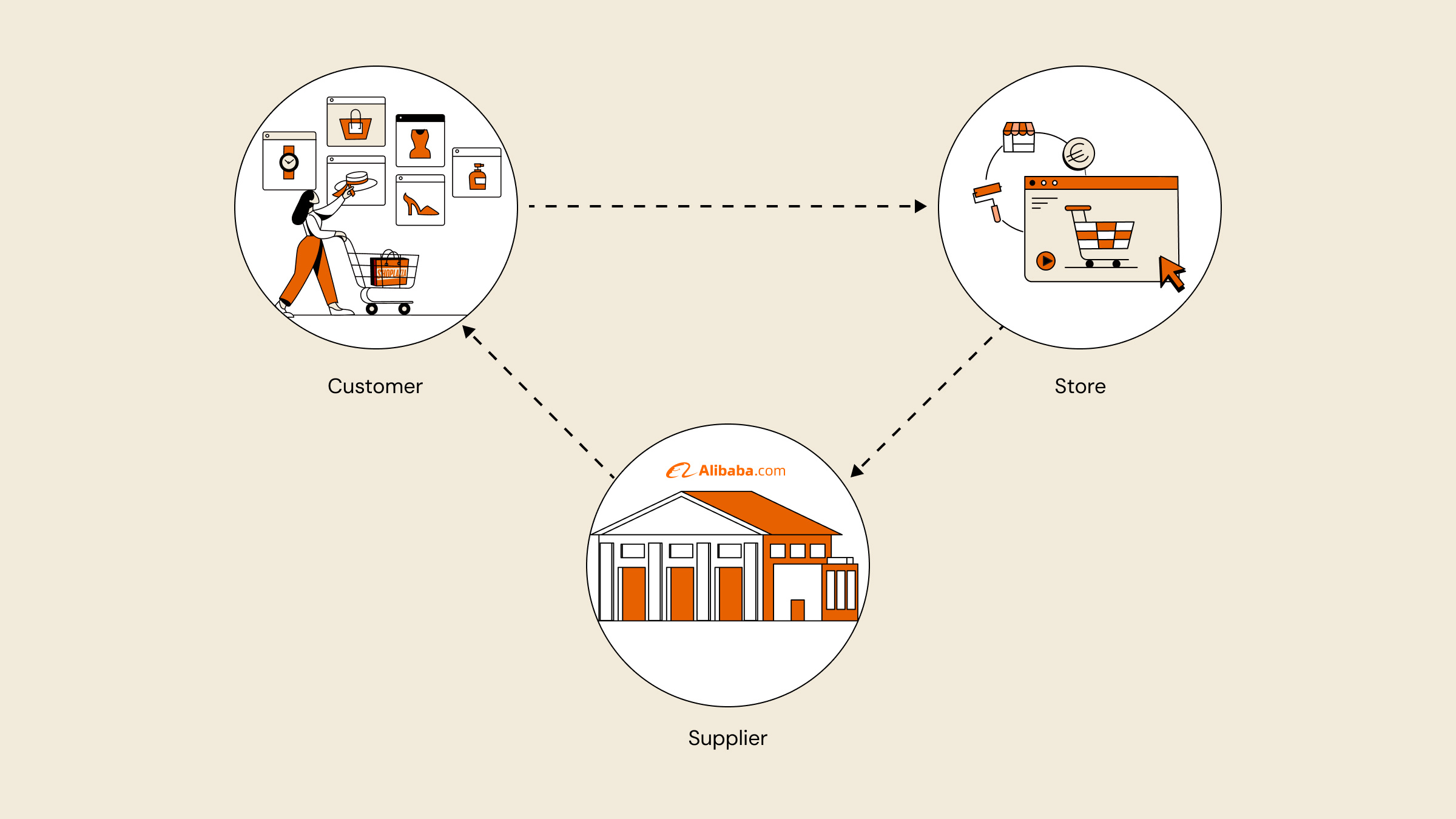
Most experienced dropshippers do not choose between Alibaba and AliExpress — they use both deliberately, at different stages of the same product's lifecycle.
Stage 1: Validate demand on AliExpress first
Source the product on AliExpress with zero inventory commitment. Use the "Ship from USA" or local warehouse filters where available to offer competitive delivery times during the testing phase. Run paid traffic or organic marketing, and track real customer behavior — conversion rate, return rate, repeat purchase rate. Target at least 30 to 50 consistent sales before considering a supplier switch. That number gives you enough signal to know whether the product has genuine demand rather than a one-off spike.
Stage 2: Source the equivalent product on Alibaba at factory pricing
Once demand is proven, search Alibaba for the same or equivalent product. Use the Verified Supplier and Trade Assurance filters as a baseline. Contact 5 to 10 manufacturers, not just one — pricing and minimum order flexibility vary significantly between suppliers for identical products. Request samples before committing to any volume. Compare sample quality directly against your current AliExpress product to verify it meets the same or higher standard before you transition customers to the new supply chain.
Stage 3: Set up fulfillment infrastructure for Alibaba-sourced products
Route bulk inventory through a 3PL partner or dropshipping agent for per-order fulfillment. This is the step that converts Alibaba's wholesale model into a dropshipping-compatible operation.
If you have not built your store yet, this is also a practical moment to think about your storefront foundation. Shoplazza's AI store builder is designed specifically for dropshipping use cases. It generates a full store including product pages, checkout, and policy pages through a guided setup process, with built-in global payment support and no technical background required.
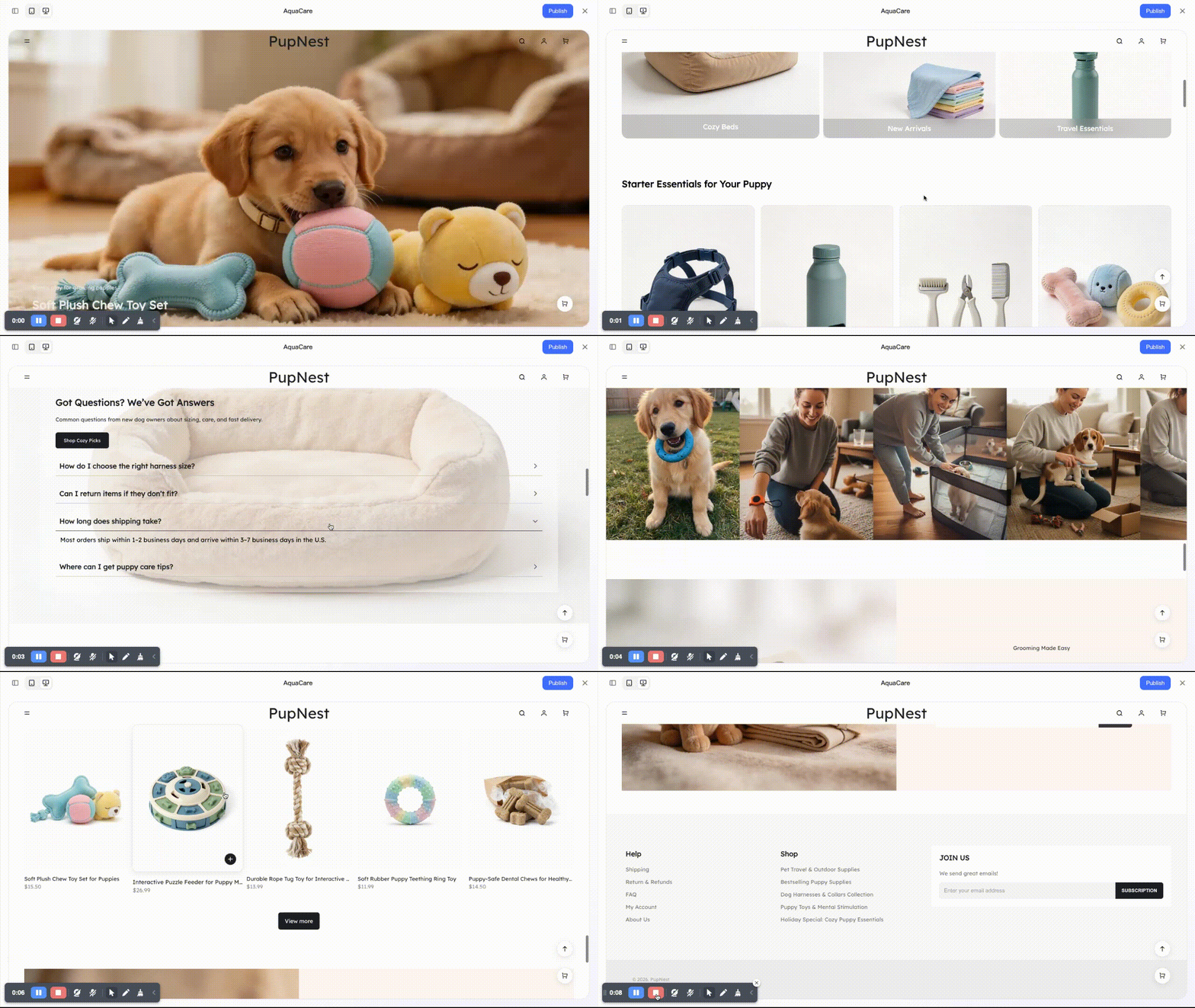
Once your store is live, both sourcing paths can be managed from the same backend: AliExpress products come in through tools like Skuowner available in the App Store, while your Alibaba-sourced inventory — once routed through a 3PL or fulfillment agent — connects through compatible ERP or fulfillment integrations. You do not need to rebuild your storefront as your sourcing strategy evolves; the infrastructure upgrades around a store that stays consistent for your customers.
Alibaba vs AliExpress for dropshipping: which one should you choose?
Having compared both platforms across price, MOQ, supplier quality, and fulfillment, the recommendation comes down to one factor: where you are in your business right now.
- Choose AliExpress if: You are still validating product ideas and cannot afford to commit capital before you know what sells. You want to go from product idea to live listing in a day, with no negotiation and no minimum order. You need local warehouse shipping options for US or EU customers without managing a 3PL relationship.
- Choose Alibaba if: You have a proven product with consistent weekly sales and margins that are being compressed by retail-level sourcing costs. You want to build a private label brand with custom packaging and product specifications. You have a 3PL or fulfillment agent relationship in place and are ready to manage a supply chain rather than just a supplier marketplace.
- The honest answer for most dropshippers: Start on AliExpress. Once a product has proven it can sell consistently, start supplier outreach on Alibaba in parallel — do not wait until your margins are already under pressure. If you are on Shoplazza, you can run both channels from the same store without switching platforms: AliExpress products via tools like Skuowner in the App Store, and Alibaba-sourced inventory routed through your fulfillment setup once you are ready to scale. That combination — zero-risk validation on AliExpress, factory-direct pricing on Alibaba — is how a dropshipping store grows from testing individual products into running a real supply chain.
Conclusion
Alibaba and AliExpress are not competitors for the same use case — they are sequential tools in the same sourcing strategy. AliExpress removes inventory risk when uncertainty is highest. Alibaba removes margin pressure when volume is consistent enough to justify the operational complexity. The sellers who treat them as either-or options tend to stay stuck at one stage: either testing forever with no margin, or overcommitting to inventory before they have validated demand. Use AliExpress to find what works. Use Alibaba to build something that lasts.
FAQ about Alibaba vs AliExpress for dropshipping
Q:Can you dropship directly from Alibaba without holding inventory?
Yes, but it requires finding the right suppliers. Use the "MOQ: 1 Piece" filter and "Ready to Ship" section on Alibaba to identify suppliers who support single-unit or low-MOQ fulfillment. Alternatively, you can route bulk Alibaba inventory through a 3PL or dropshipping agent who ships individual orders to your customers on your behalf.
Q:Is AliExpress cheaper than Alibaba for dropshipping?
AliExpress prices are higher per unit than Alibaba's factory-level pricing, but AliExpress pricing includes shipping and requires no minimum order. Alibaba's lower unit cost only becomes a clear advantage once you factor in freight, duties, and logistics costs — and once your order volume is high enough to absorb those fixed costs across enough units.
Q:How do I find dropshipping-friendly suppliers on Alibaba?
Filter by "MOQ: 1 Piece," "Ready to Ship," "Verified Supplier," and "Trade Assurance" in the Alibaba search interface. These filters surface suppliers who have undergone platform verification and are open to lower-volume or single-unit orders. Always message the supplier directly before listing their products to confirm they support dropshipping fulfillment and ask about their typical processing and shipping times.
Q:How do I connect AliExpress or Alibaba products to my Shoplazza store?
For AliExpress, you can use tools like Skuowner available in the Shoplazza App Store to import products and manage orders. For Alibaba-sourced inventory, once you have bulk stock routed through a 3PL or fulfillment agent, you can connect that fulfillment operation to your Shoplazza store through compatible ERP or fulfillment integrations available in the App Store.
Q:When should I switch from AliExpress to Alibaba sourcing?
A practical threshold is 30 to 50 consistent sales per week on a single product. At that volume, the per-unit savings from Alibaba's factory pricing start to outweigh the added complexity of supplier negotiation, MOQ management, and 3PL setup. Below that volume, AliExpress's simplicity and zero capital risk are usually the more operationally sensible choice.