You've got a product ready to sell. Three tabs are open: Etsy, Amazon, maybe eBay too. Setting up a shop on any of them takes less than an hour, no coding, no domain, no payment gateway to configure. Building your own site, by comparison, feels like a much bigger commitment before you've even sold a single unit.
That's exactly why most sellers never seriously weigh the two options against each other. They start on a marketplace because it's the path of least resistance, and they stay there because switching feels risky once orders start coming in. The tension usually shows up later: after a few months of steady sales, when the fees on every single order start adding up, or when a policy change or a suspended listing reminds you how little control you actually have.
This isn't an argument for abandoning marketplaces. It's a breakdown of what each path actually costs, what you get in exchange, and how to tell which one fits where you are right now.
Marketplaces get you sales fast. They don't get you a business.
Within an afternoon, you can have a live Etsy shop, an Amazon listing, or an eBay store front, complete with checkout, payment processing, and a built-in audience that already trusts the platform enough to type in their card details. That speed is real, and it's the reason so many people's very first online sale happens on a marketplace rather than a site they built themselves.
It's also not free. Etsy charges a $0.20 listing fee per item, a 6.5% transaction fee on the full sale amount including shipping, and a payment processing fee of roughly 3% plus $0.25 per order, based on Etsy's published fee schedule. Amazon's referral fee runs 8% to 15% depending on category, most commonly landing at 15%, and that's before any Fulfillment by Amazon costs if you use FBA. Amazon confirmed in its own 2026 seller fee update that FBA fees are rising again this year on top of that referral cut. eBay lands in a similar range, with a final value fee around 13.6% plus a small per-order charge.
None of this makes the platforms unreasonable. You're paying for instant access to buyers who already showed up. But it's worth being clear-eyed about what that access costs: a fee on every transaction, for as long as you sell there, plus a set of rules you didn't write and can't negotiate. A suspended listing or a policy change can undo months of momentum in a day. That's the part that doesn't show up on the fee schedule.
The real difference between renting traffic and owning it
Here's the mechanism underneath all of this. Marketplaces work because they've already aggregated an audience that defaults to shopping there first. A Marketplace Shopping Behavior Report from ChannelEngine, based on a survey of 4,500 shoppers across France, Germany, the Netherlands, the UK, and the US, found that 63% of consumers prefer buying on marketplaces over brand-owned websites, and that 47% of product discovery now starts on a marketplace rather than a search engine like Google, which only accounts for 24%. The same report found shoppers visit an average of 2 to 3 marketplaces before making a purchase.
That's exactly the asset you're renting when you list on Etsy or Amazon: an audience that already showed up there, ready to buy, without you having to convince them to trust a new site. The tradeoff is that you don't own the relationship once the sale happens. The platform holds the checkout, the buyer's contact details, and most of the post-purchase touchpoints. If that same customer wants to buy from you again next month, you're paying the platform's fee again, and often paying to be seen by them again too, through ads or search placement.
On your own brand store, the checkout, the customer's email, and every future touchpoint belong to you, at no renegotiation cost. The first sale might cost more to earn. Every sale after that doesn't have to.
Where does the money actually go, and who feels it most?
| Marketplace (Etsy / Amazon / eBay) | Your own store | |
| Per-sale cost | 10%-20%+ combined fees, every single sale | platform commission 0.5%-2% |
| Repeat customer cost | Same fee again, every time | Marginal cost drops as retention channels (email, seo, social media, and direct traffic) kick in |
| Setup cost | Near zero | Store subscription |
| Who controls pricing, promotions, policy | The platform | You |
The pattern that matters most here isn't the headline percentage. It's who feels it. Thin-margin, price-sensitive categories, items under $20 to $30 where every point of fee eats directly into what's left after cost of goods, feel marketplace fees hardest, because there's little room left to absorb a 15% cut before you've spent a cent on marketing.
Sellers with genuine repeat-purchase potential feel a different kind of cost: the absence of owned customer data, and more specifically, the absence of any system to act on it. Industry-reported DTC benchmarks from Eevy put the average repeat purchase rate for independent stores somewhere between 20% and 40% depending on category, and that repeat business is what makes an initial acquisition cost worth paying, because the second and third sale to the same customer cost far less to earn.
A brand-owned store is what makes that math work in practice rather than just in theory. It can run a customer management system that ties loyalty tiers, points, and rewards directly to each buyer's purchase history. Shoplazza's Loyalty & Push, for example, groups customers into tiers based on spend and points, then applies those points automatically at checkout instead of requiring a separate redemption step, so the second purchase takes less convincing than the first.
On a marketplace, none of that exists. There's no tier to place a repeat buyer into, and no equivalent discount for loyalty. You pay the same referral or transaction fee on a customer's tenth order as you did on their first. That's not a one-time cost. It compounds for as long as you keep selling there.
The sellers who win long-term run both channels, not one
The strongest position isn't picking a side. It's using each channel for what it's actually good at. A marketplace is the fastest, cheapest way to find out if a product sells at all, because the audience and the trust already exist there. An owned store is where that same product turns into a business, because it's the only place where a customer you've already earned once doesn't cost you a fee to sell to again.
In practice, that means keeping the marketplace listings running for discovery and first-time buyers, while syncing that same product catalog, along with orders and inventory, into a store you control. This is exactly the gap AI Store Builder is built to close for sellers coming from a marketplace background: describe what you're already selling, and it generates a working storefront around it rather than asking you to start from a blank page. It only takes 5-10 minutes as fast as the way you build on marketplace. From there, the marketing spend that used to go entirely toward Offsite Ads or Sponsored Products can start shifting toward retention, email, direct traffic, anything that reaches a customer you've already sold to once without paying a various fee to reach them again.
Your next move depends on where you're starting from
If you haven't made a single sale yet, the right move is to stay on the marketplace. Don't build a store before you know whether the product itself sells. The one thing worth tracking from day one is which items generate repeat buyers, direct messages, or requests outside the platform. That's the signal that tells you when it's time to move.
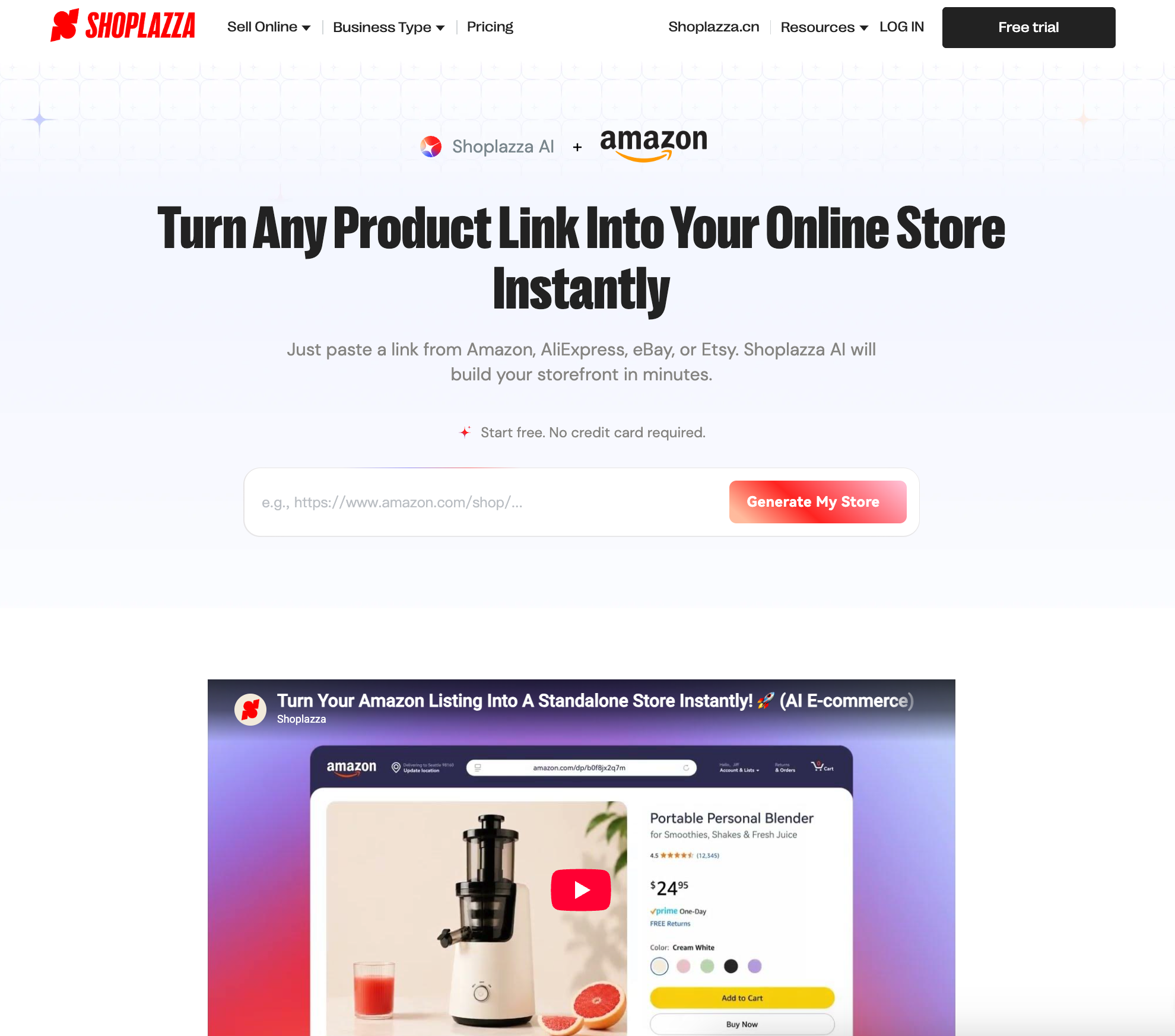
If you're already seeing repeat orders or return customers on Etsy, Amazon, or eBay, the next step is smaller than it sounds. It doesn't mean pulling everything off the marketplace and rebuilding from scratch. Tools like Shoplazza's AI store builder for Amazon, eBay, and Etsy links can take a product link you're already selling and turn it into a working storefront, complete with checkout, in a matter of minutes, which is a reasonable place to start rather than a full rebuild. From there, it means aiming that a brand store specifically at your existing repeat buyers, the customers you've already paid once to acquire and shouldn't have to pay for again. Let the marketplace keep doing what it's good at: finding new buyers. Let the store do what the marketplace can't: keep the ones you've already earned.
Questions sellers ask before making the switch
Q: Can I sell on Etsy or Amazon and run my own store at the same time?
Yes, and for most sellers this is the right setup rather than a temporary phase. Keep the marketplace listings for discovery and new-customer volume, and use your own store for repeat buyers and higher-margin sales. The two aren't competing for the same job.
Q: Am I ready to build my own store, or is it too early?
If you haven't validated that the product sells, it's too early. Wait until you have consistent orders and, ideally, signs of repeat buyers. Building a store before that point adds cost and complexity without solving the actual problem you have, which is proving demand.
Q: What happens to my marketplace reviews and sales history if I add a store?
Nothing happens to them. Your marketplace shop, its reviews, and its sales history stay exactly as they are. Adding a separate store doesn't require closing or migrating anything on the marketplace side.
Q: Should I move all my products to my own store at once, or start with just a few?
Start with a few, not the whole catalog. Pick the SKUs that already have repeat buyers, reviews, or direct messages, since those are the ones a new store doesn't have to prove itself for. You don't need a full rebuild to test this either: tools that turn an existing Amazon, eBay, or Etsy listing into a working store can get a small batch live in minutes. Migrating everything at once just spreads your attention and budget across products that haven't earned that investment yet. If something hasn't sold well on the marketplace, a new site won't fix that on its own.