You put out an ad. It gets clicks. But no one buys. Sound familiar? Here is what is probably happening: your ad is reaching people who are not all the same. Some are price shoppers. Some care about quality. Some are buying for themselves, and some are buying as a gift. But your message treats them all like they are one person with one need. That is why it falls flat.
According to a Forbes report, 81% of consumers prefer a personalized shopping experience. Yet most businesses — especially smaller ones — still run the same campaign to their entire audience and hope something sticks. Multi-segment marketing is how you fix that. Instead of one message for everyone, you send the right message to the right group of people. In this guide, you will learn exactly what multi segment marketing strategy is, why it matters more than ever, and how to create it from scratch, with real examples and practical tools to get you started.
What is a multi-segment marketing strategy?
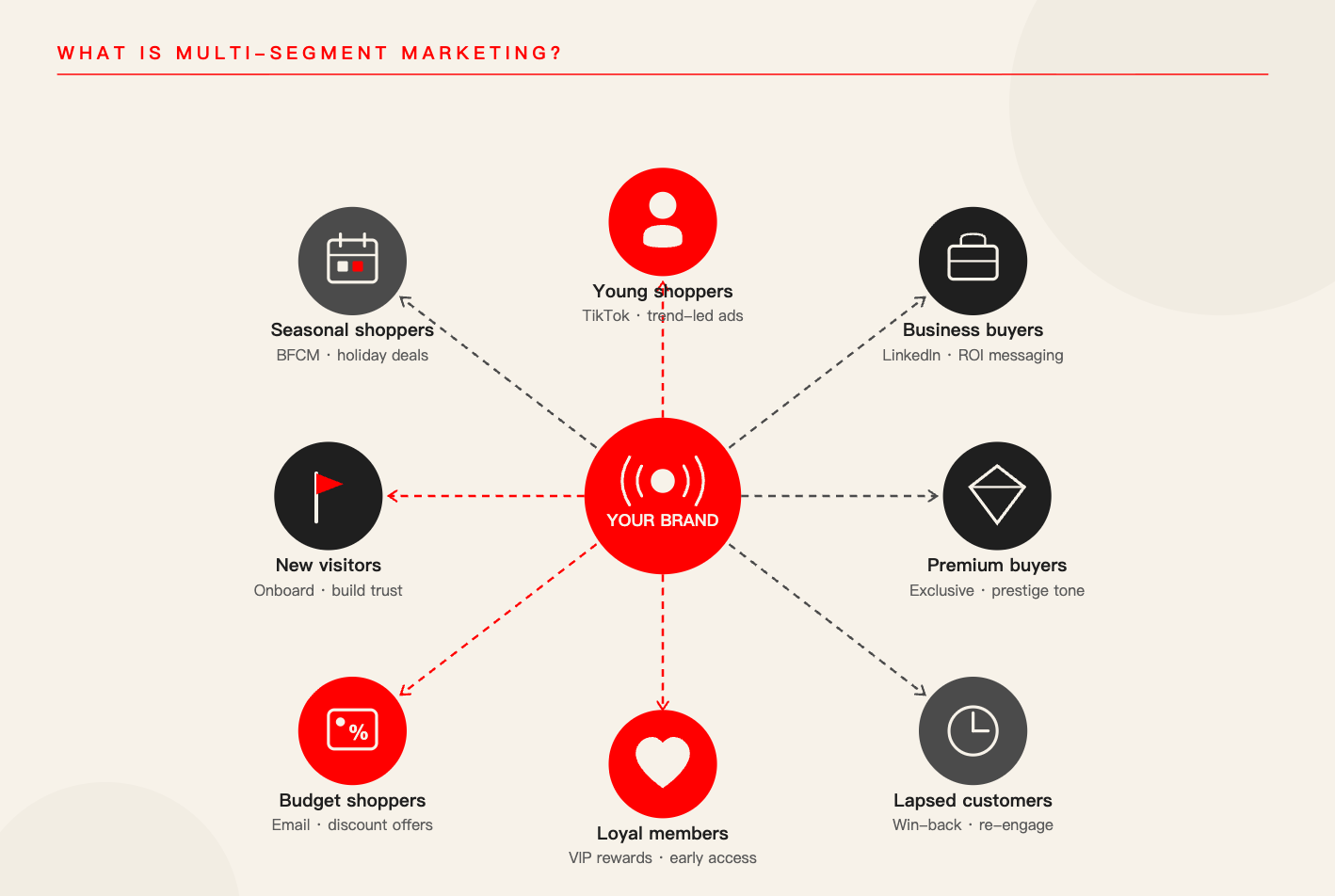
At its core, multi-segment marketing means dividing your total audience into smaller, distinct groups — called segments — and crafting different marketing messages or campaigns for each one. Rather than broadcasting a single message to everyone, you speak directly to the specific needs, preferences, or behaviors of each group.
Think of it like a fast food menu. McDonald's does not show the same ad to every person. They show Happy Meal promotions to parents with young kids and highlight salads or protein-based items to health-conscious adults. The product range overlaps, but the message is completely different depending on who is watching.
This is different from mass marketing, where one message goes to everyone. It is also different from single-segment marketing, where you pick just one group and focus everything on them. Multi-segment marketing says: there are several valuable groups in your market, and each one deserves a tailored approach.
When does single-segment marketing make sense? If you are a very early-stage business with limited resources and a tightly defined product, starting with one segment is perfectly reasonable. But as your customer base grows and diversifies, sticking with one message for everyone will start costing you sales.
Why multi-segment marketing matters more than ever?
Personalization is no longer a nice-to-have. Customers have come to expect it. When they receive a generic, untargeted message, they notice — and they move on. Brands that understand this are winning. Those still sending one-size-fits-all campaigns are falling behind.
At the same time, third-party cookies — the technology that allowed marketers to track users across websites and serve them targeted ads — are being phased out. With that data source disappearing, businesses need to rely more heavily on first-party data: information they collect directly from their own customers through purchases, sign-ups, surveys, and browsing behavior on their own platforms. Segmentation is what makes that first-party data useful.
AI tools have also made segmentation more accessible than ever before. What once required a data science team can now be done with marketing platforms that most mid-sized businesses already use. There is no technical barrier left as an excuse.
The numbers support the shift. According to HubSpot, marketing segmentation increases ROI by around 20%. A report by IDC commissioned by a leading commerce platform found that 74% of retailers said developing a better understanding of customer preferences and behaviors is a top priority for the coming year.
There is also a B2B angle that most marketing specialists overlook. According to Forrester's 2025 research, 92% of B2B buyers finalize their shortlist of vendors before ever visiting a vendor's website. They are doing research on their own — reading content, checking community forums, comparing options — before a single sales conversation happens. That means your segment-specific content needs to do its job before your sales team ever gets involved. If your messaging is too generic, you have already been filtered out.
Benefits of multi-segment marketing strategy
The benefits go beyond just better conversion rates. Here is what businesses consistently gain from a well-built multi-segment approach.
- Larger market reach. Targeting multiple segments means you are not leaving money on the table by ignoring groups of buyers who could benefit from your product. Running separate campaigns for both doubles the addressable audience without requiring a fundamentally different product.
- Higher customer loyalty. When people feel like a brand understands them, they stick around. Research cited by Exploding Topics shows that three-quarters of Americans say they are more likely to remain loyal to a brand that feels personal and relevant to them.
- Better return on marketing spend. When you know which segment is converting and at what cost, you can shift budget toward what works. Instead of spreading your entire marketing budget across a vague audience, you allocate resources based on which segments deliver the best results.
- Reduced business risk. Depending entirely on one type of customer is a fragile strategy. If that segment's behavior changes — because of economic conditions, a new competitor, or shifting preferences — your whole business feels it. Multi-segment marketing spreads that risk across different groups.
- Smarter product and pricing decisions. When you understand distinct customer segments, you can also make better decisions about what to build, how to price it, and where to sell it. Segmentation is not just a marketing tool — it informs the whole business.
How to build a multi-segment marketing strategy: step by step
Here are six key steps about how to create multi-segment marketing strategy properly.
Collect and clean your data first
You cannot segment what you cannot see. Before anything else, get a clear picture of your existing customers. Pull data from your customer relationship management(CRM) system, your website data analytics, your email platform, and your sales history. Look at who is buying, how often, how much they spend, and what they looked at before they converted.
Zero-party data, information that customers give you directly through quizzes, preference surveys, or sign-up forms, is especially valuable because it removes guesswork. When a customer tells you they are shopping for a gift or that they are a beginner looking for entry-level products, you can segment them accurately from the start.
The catch is that this data only helps when it is centralized. One of the most consistent complaints from marketing teams is that their data is scattered across multiple tools with no single view of the customer. A 2024 report from the Customer Marketing Alliance identified this as the biggest operational pain point for marketing teams. If your CRM, email tool, and analytics platform are not sharing data with each other, fix that before building any segments.
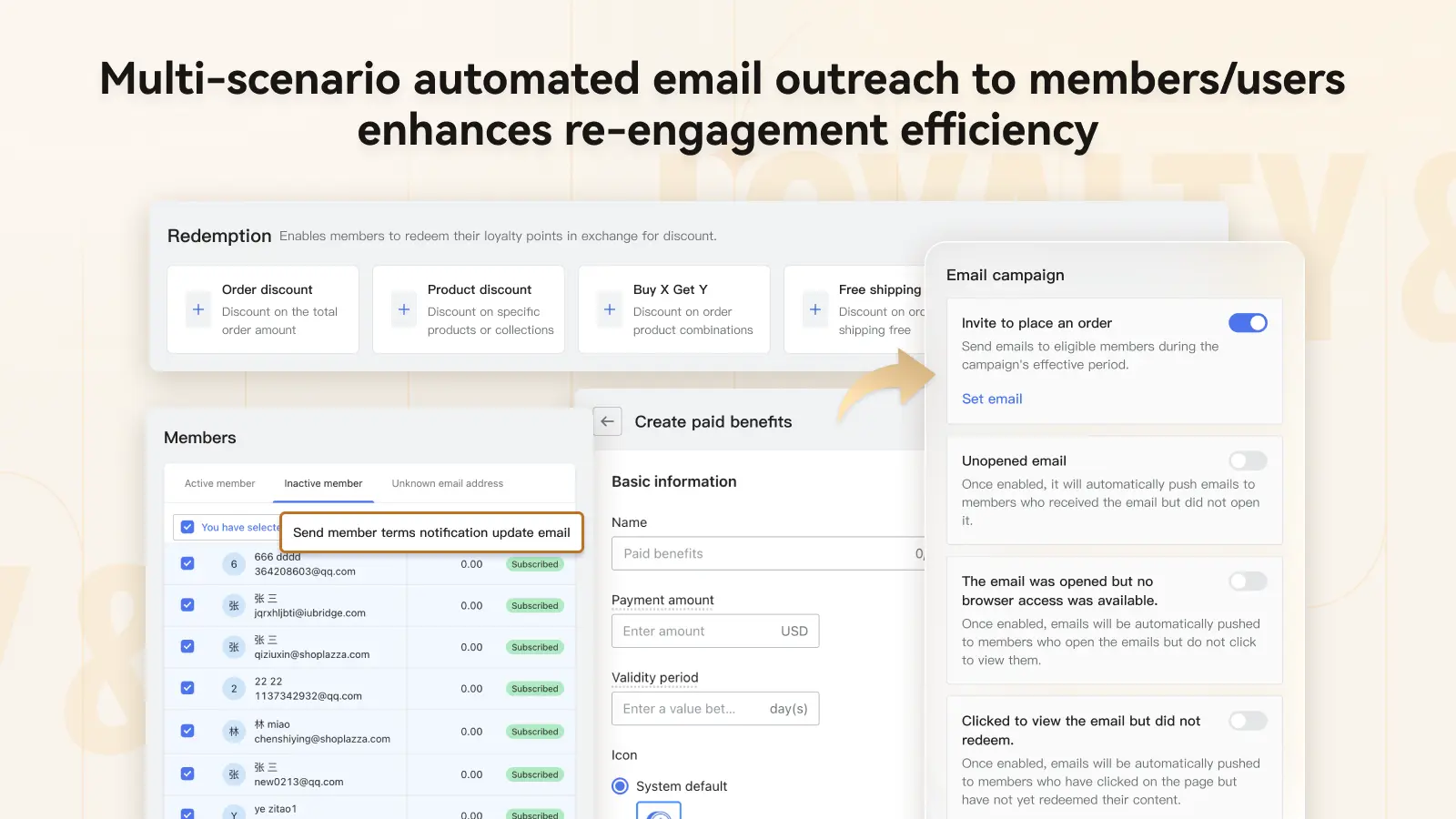
Tools like Shoplazza's Loyalty and Push are built specifically for this. It centralizes customer data and turns it into actionable segments without manual stitching. Once a customer registers through your store, it gets to work:
- Automatically collects contact details, purchase history, browsing behavior, and spending patterns in one place
- Uses AI to recommend member tiers based on average order value, buying habits, and preferences — or lets you classify members manually
- Lets you build targeted campaigns by membership level, loyalty points, or spending power
- Sends dedicated emails to each group directly from the platform
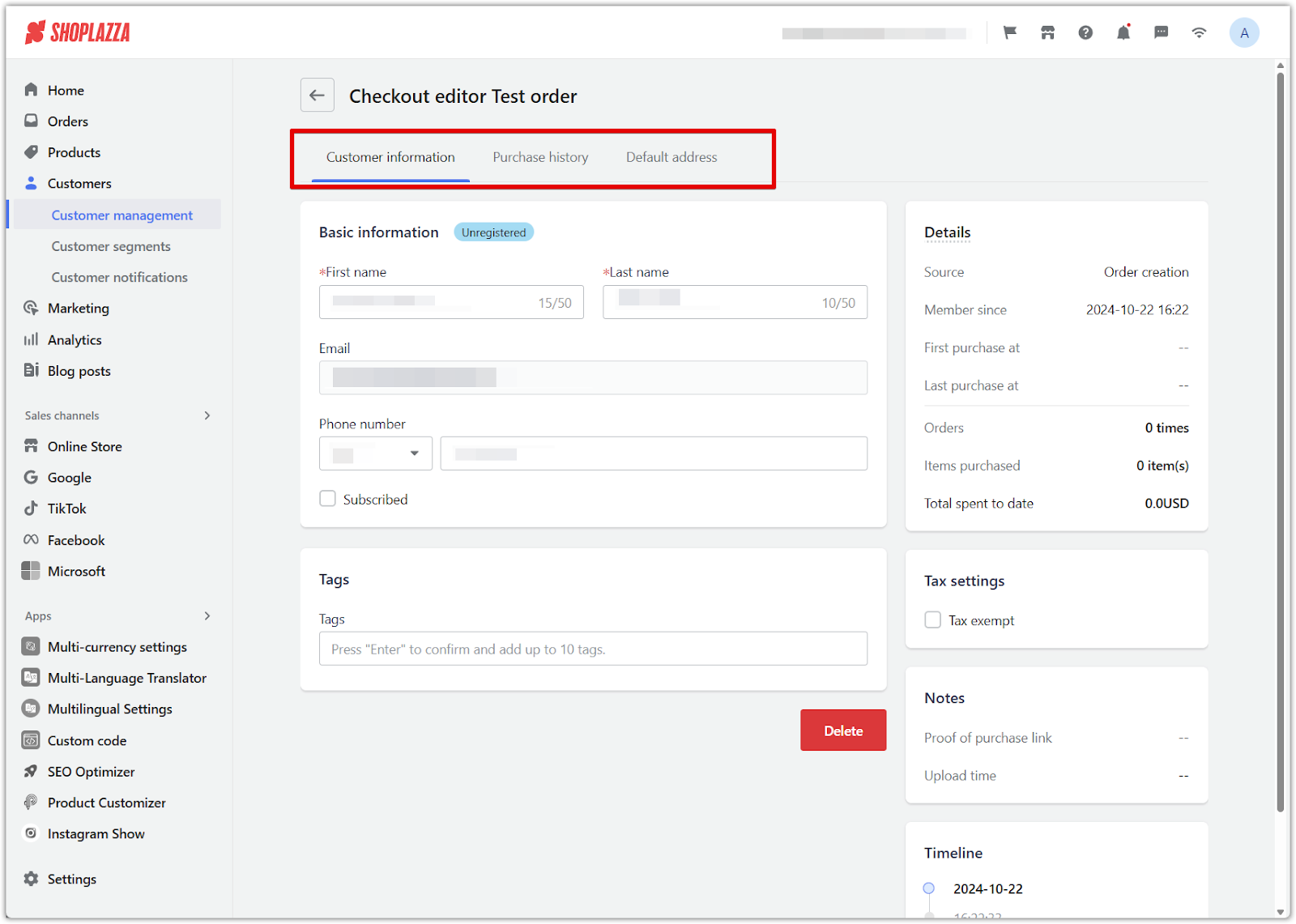
Besides, some platforms designed specifically for online merchants — like Shoplazza — include built-in customer management dashboards that display subscriber lists, first-time buyers, and repeat purchasers in one place. You can create custom customer segments using filters and conditions, apply those segments to targeted discount codes or coupons, and manage each group independently. This kind of built-in segmentation infrastructure is particularly useful for cross-border ecommerce brands that need to identify target customers quickly and run precise promotional campaigns without relying on external tools.
Find your natural segments, do not force them
Start with your best customers. What do they have in common? Look for natural clusters in the data: similar buying patterns, similar product preferences, similar traffic sources. These clusters are your first segments. Do not build segments based on what you assume about your customers. Build them from what the data actually shows.
A useful rule of thumb: if two groups of customers would respond the same way to the same message, they are probably the same segment. If they would respond differently, that difference is worth exploring.
Prioritize, you cannot market to everyone at once
Once you have identified several potential segments, rank them. Consider three things for each:
- The revenue potential
- How easy it is to reach them with channels you already have
- How well they align with your brand.
If you are new to multi-segment marketing, start with two or three segments at most. A common mistake is trying to launch six campaigns at once with a small team. One marketer on Reddit described exactly this situation: "We tried six segments at once and produced mediocre content for all of them. Should have started with two." Focused execution on fewer segments beats scattered effort across many.
Create segment-specific messaging, not just different images
Most brands make the mistake of swapping out a product image and calling it "personalized." Genuine segment-specific messaging goes deeper. For each segment, you need to answer three questions:
- What specific problem are you solving for this group?
- What outcome do they want from your product?
- What objection are they most likely to have before they buy?
Once you have answered those questions, the messaging writes itself:
- A first-time buyer needs reassurance and social proof.
- A VIP customer needs to feel recognized and rewarded.
- A lapsed customer needs a reason to come back that speaks to why they left.
Before writing a single ad, build a one-page brief for each segment that summarizes the audience, the message, the offer, and the desired action. This saves time and keeps messaging consistent across channels.
Pick the right channel for each segment
Do not assume your customers are all in the same place. Platform behavior varies significantly by age, industry, and intent. For example:
- Gen Z audiences are primarily active on TikTok and Instagram.
- Millennials skew toward Instagram, Facebook, and email.
- B2B decision-makers respond better to LinkedIn and industry-specific newsletters.
- Customers who have lapsed respond best to retargeting ads, SMS, or personalized win-back email sequences.
A practical example from a CRO agency (ConvertCart, 2025) illustrates this well: a sustainable e-commerce brand was treating Gen-Z and Millennial customers as one segment because they appeared similar demographically. But Gen Z and Millennial shoppers responded to different platforms. Once the brand separated the two and tailored both the channel and the creative, results improved significantly.
Automate and monitor the change over time
Customer behavior is not static. Someone who was a seasonal shopper six months ago might now be one of your most loyal buyers. Your segmentation system should reflect that. Most modern CRM and email platforms allow you to set rules that automatically move customers between segments based on behavior triggers — a customer who makes three purchases in 90 days gets moved into a VIP segment and receives a different email sequence accordingly.For each segment, track the metrics that matter: conversion rate, average order value, customer lifetime value, and email engagement rate. Review your segments at least every six months. If a segment has shrunk, shifted in behavior, or stopped responding to your campaigns, it is time to update your approach.
Multi segment marketing strategy examples that show it working
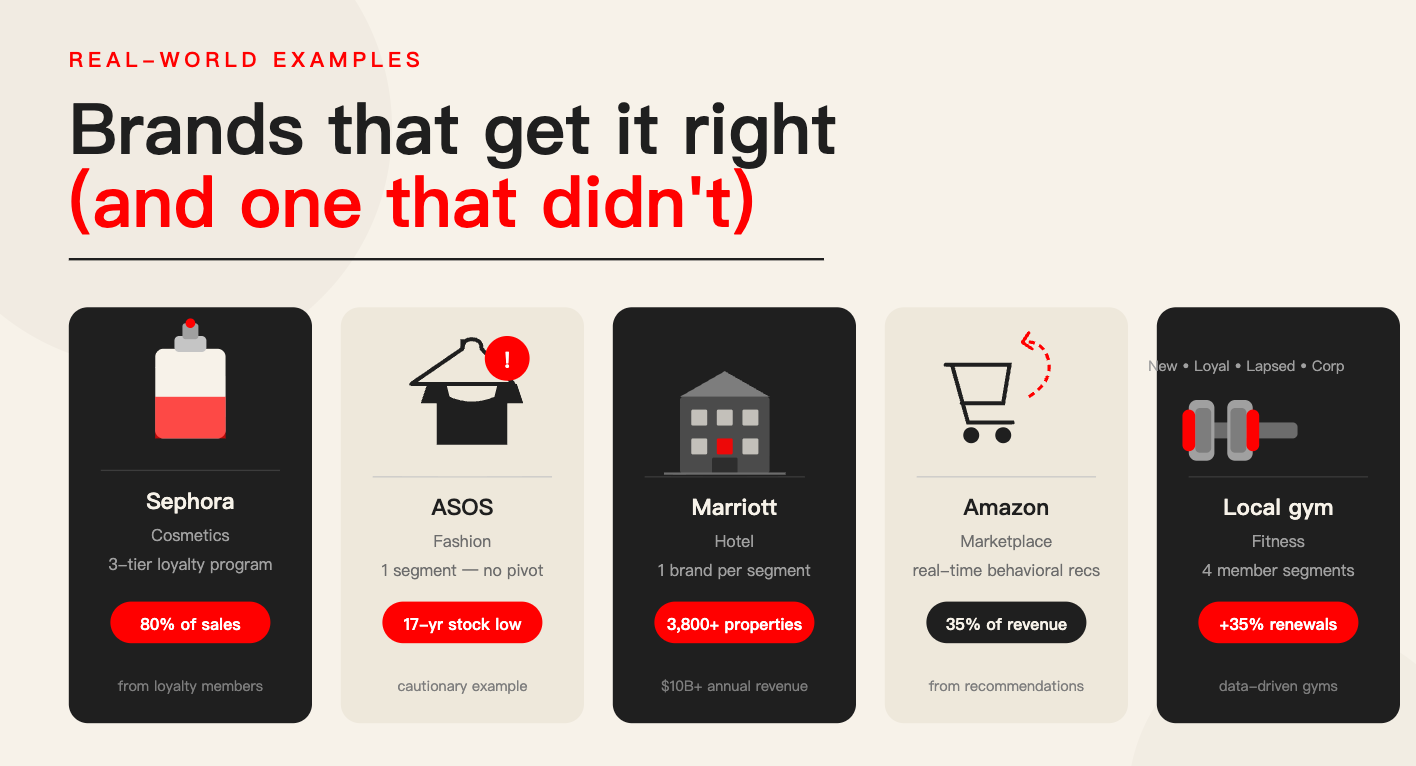
The best way to understand multi-segment marketing is to see it working across businesses of different sizes. Here are five examples, each showing what they did and what they gained from it.
Sephora
Sephora's Beauty Insider program is one of the clearest e-commerce segmentation examples in retail. Rather than treating all buyers the same, Sephora divides its customer base into three spending-based tiers — Insider (free), VIB ($350 annual spend), and Rouge ($1,000 annual spend) — each receiving distinct pricing, access, and messaging. The results are concrete: the program has grown to over 34 million members, collectively accounting for 80% of Sephora's total sales. Segmented loyalty emails drive a 22% increase in cross-sell conversion and up to 51% increase in upsell revenue compared to non-segmented outreach. Same products, same store — but three completely different customer experiences based on behavior and spend.
ASOS
ASOS offers a useful lesson from the other direction. The brand built its entire e-commerce strategy around a single segment: fashion-conscious 16 to 30-year-olds. For years it worked — ASOS reached net online sales of over £3.5 billion in 2023. But when ultra-low-cost competitors like Shein and Temu entered targeting that exact demographic, ASOS had no secondary customer base to fall back on. As one industry analysis noted, the business was entirely tethered to one segment with nowhere to pivot, and its stock fell to a 17-year low. The lesson: multi-segment marketing is not just a growth strategy — it is also a risk management strategy. Brands that rely on a single segment are one market shift away from serious trouble.
Marriott International
In 1985, Marriott managed 67,034 rooms across 160 properties. Rather than growing with a single brand, the company deliberately built distinct brands for distinct traveler types: Courtyard for budget business travelers, Residence Inn for extended stays, Ritz-Carlton for luxury seekers, and W Hotels for younger, design-focused guests. Each brand carries its own pricing, service language, and loyalty positioning with zero messaging overlap between them. The result of that disciplined segmentation strategy: Marriott grew to managing over 600,000 rooms across 3,800 properties, generating more than $10 billion in annual revenue. As of 2023, its Marriott Bonvoy loyalty program reached 196 million members globally.
Amazon
Amazon's approach to segmentation is behavioral and real-time. Its recommendation engine continuously reads what you browse, buy, and skip, then adjusts what you see next. Someone who bought running shoes sees a completely different homepage from someone who just ordered cookbooks. That dynamic segmentation is not incidental — it is a core revenue driver. According to McKinsey, Amazon's recommendation engine generates approximately 35% of the company's total revenue. For businesses without Amazon's infrastructure, a simpler version of this works through behavioral email flows and retargeting campaigns tied to browsing and purchase history.
A local gym, a small business illustration
Gyms face one of the highest churn rates of any subscription business: research shows 50% of members abandon their membership within 90 days, and dropout rates range from 40 to 65% in the first six months. The fix is segmentation. A gym has at least four natural groups: new members who need habit-building encouragement, long-term members who respond to community and advanced programming, lapsed members who need a personal re-engagement offer, and corporate members who respond to a productivity and wellness framing. According to IHRSA data cited by Promotion Vault, 72% of fitness businesses that adopted data-driven segmentation reported increased retention rates, and gyms using data analytics saw 35% more membership renewals than those that did not. Same facility, same equipment — four different conversations, measurably better outcomes.
The real costs and challenges of multi-segment marketing
Here is what actually trips businesses up — and how to handle each one.
- It costs more to run: More segments mean more campaigns, more copy, and more creative assets. The fix is not to cut corners — it is to start focused. You can begin with 2 to 3 segments only; repurpose core content by changing the message and offer, not rebuilding from scratch; or strong execution on fewer segments beats weak execution on many, every time.
- Your brand can feel scattered: Different messages to different audiences can blur your identity. You may keep your core brand promise consistent. Change how you say it, not what you stand for.
- Premium positioning can erode: If a high-end brand chases budget buyers to grow volume, existing premium customers notice — and leave. The fix: keep value-tier extensions structurally separate. Different product line, different branding, different channels.
- Product cannibalization is a real risk: Marketing a cheaper version of your product can pull buyers away from your higher-margin option. Separate your segments deliberately — by channel, product tier, geography, or timing. The goal is to grow your total market, not shuffle buyers between your own products.
- Bad data creates bad segments: Incomplete, outdated, or duplicated data leads directly to unreliable segments. Audit your data before you build anything. One clean, trusted source beats five messy ones.
- Segments are not permanent: This is the most common mistake: building segments once and never revisiting them. Markets shift. Buying behavior changes. A segment that performed well 18 months ago may be stagnant today. You should review your segments every 6 months, and tie the review to your regular business planning cycle.
Multi-segment marketing in the age of AI
Modern tools like Klaviyo AI, Meta Advantage+, and Google Smart Campaigns can now auto-segment your audience in real time based on behavior, without you manually defining every rule. The marketer's job has shifted: your main input is clean data and clear goals. The AI handles the matching. The most valuable application is predictive segmentation:
- AI identifies customers showing early signs of churning — before they stop buying
- You get a window to act with a retention offer, a personal check-in, or a timely reminder
- This used to require a data team. Now it is built into platforms most businesses already use
One important caution: AI segmentation is not hands-off. Poor data or vague goals produce tone-deaf targeting. Review results regularly, spot-check who is actually being reached, and adjust based on real customer feedback. Automation amplifies your strategy — it does not replace your judgment.
Start small, get smarter
You do not need a big budget to start. A multi-segment marketing strategy comes down to one simple idea: say the right thing to the right person. Pick your two most distinct customer types, write different messages for each, and measure what happens. Look at your last 100 customers. What do your best ones have in common? That gap is where segmentation begins. Shoplazza makes it easy — built-in segmentation, member tiering, and targeted campaigns, all in one place.
Common questions about multi segment marketing strategy
Q1: What is the multi-segmented strategy in marketing?
A multi-segment marketing strategy means dividing your total audience into distinct groups and delivering a different message or offer to each one. Rather than sending one campaign to everyone, you target each group based on their specific needs, behaviors, or preferences, making your marketing more relevant and more effective.
Q2: What is the difference between multi-segment marketing and niche marketing?
Niche marketing focuses all resources on one very specific, well-defined group of customers. Multi-segment marketing, by contrast, targets several distinct groups simultaneously, with tailored messaging for each. Niche marketing works well when a business has a highly specialized product and limited resources. Multi-segment marketing is better suited to businesses with a broader product range or a diverse customer base that has meaningfully different needs.
Q3: How many segments should a business start with?
For most businesses that are new to segmentation, two to three segments are the right starting point. This is enough to see the difference in results between targeted and generic campaigns without stretching your team too thin. Once you have validated which segments perform best and built repeatable processes for managing them, you can expand. There is no universal ideal number.
Q4: Can small businesses use multi-segment marketing effectively?
Yes, and often more effectively than large ones because they can move faster and communicate in a more personal way. A small business with 500 customers can identify two or three distinct buyer types, write genuinely different emails for each group, and see results within weeks. The tools required, a basic email platform with segmentation, a simple CRM, and Google Analytics, are affordable and widely available.
Q5: How do you know when a segment is no longer working?
Watch for declining engagement metrics: open rates, click-through rates, and conversion rates that consistently drop over several months. If a segment that used to convert well has gone quiet, there are a few possible reasons — the messaging has become stale, the segment's behavior has changed, or the offer is no longer relevant. A segment audit every six months helps you catch these issues before they become expensive. Update your segment criteria, refresh the messaging, and if a segment has genuinely shrunk or merged with another group, adjust your structure accordingly.
Q6: What is the biggest mistake businesses make with segmentation?
The most damaging mistake is building segments once and never revisiting them. Markets change. Customers evolve. A segment that was accurate and profitable 18 months ago may no longer reflect reality. The second most common mistake is segmenting only by demographics — age, gender, income — without looking at behavioral data. Demographic segments tell you who your customers are on paper. Behavioral segments tell you how they actually act, which is a far more reliable predictor of what they will do next.