Most people who want to start a beauty brand online in Australia come in with one question: which niche makes the most money? That is a fair starting point. But it is not the only question that matters. The more useful question is: which niche can you actually build a brand around, source product for, and launch without a warehouse or a photography studio? This guide answers both. It covers:
- how to choose a beauty sub-category with real demand in Australia;
- which business model fits your situation, where to find suppliers;
- how to create the brand photos with low cost;
- how to get a brand identity without starting from a blank page.
Is beauty a good niche to sell online in Australia in 2026?
The short answer is yes — but the more useful answer is that beauty rewards sellers who go narrow, not broad. Here is what the numbers say, and where the actual opportunity sits.
What the Australian beauty market looks like right now?
The Australian cosmetics market is projected to grow from USD 8.8 billion in 2025 to USD 12.9 billion by 2034. The skincare segment alone was valued at USD 3.0 billion in 2025, growing at a CAGR of 4.09%, with consumers leaning toward natural, vegan, and chemical-free products with sustainable packaging.
The market is real and growing. The challenge is that it is dominated by established players — Mecca, Sephora, Adore Beauty, and Priceline control the bulk of online beauty traffic in Australia. A new independent brand cannot compete on range or price recognition. It can compete on specificity, story, and a tighter product focus than any of those platforms can offer.
Which beauty sub-categories have room for a new brand in Australia?
Cruelty-free SPF skincare is growing at a CAGR of 8.4% in Australia in 2026, making it one of the fastest-growing beauty segments in Australian ecommerce. Beyond SPF, several sub-categories are genuinely underserved by independent brands:
- Clean skincare with Australian botanicals. Ingredients like kakadu plum, tea tree, and macadamia have strong market recognition and a clear "made-in-Australia" story that resonates with local and international buyers alike.
- Men's grooming and hairloss. Men's grooming and anti-aging solutions are among the fastest-growing segments in the Australian skincare market. Competition is far lower than in women's skincare, and the average order value is higher.
- Affordable fragrance. The demand for designer-inspired fragrances at accessible price points is strong among Australian women aged 18-30. This is a high-repeat-purchase category with low regulatory complexity.
- Nail care. Low barrier to entry, consistent demand, and strong repeat purchase behaviour. A practical starting point for sellers with no prior beauty experience.
- SPF-compliant sun care. In August 2025, several sunscreen products were withdrawn from Australian sale for failing to meet SPF claims, triggering industry-wide testing and reinforcing demand for transparent, compliant alternatives. That regulatory pressure creates a real opening for brands that can demonstrate compliance clearly.
How do I choose a beauty niche that actually sells in Australia?
Knowing which categories are growing tells you where demand exists. The next step is narrowing to one sub-category you can actually execute on. Here is how to do that with data rather than intuition.
Find beauty products Australians are already buying online regularly
Before committing to a niche, validate it with real signals.
Search the product on Google Trends
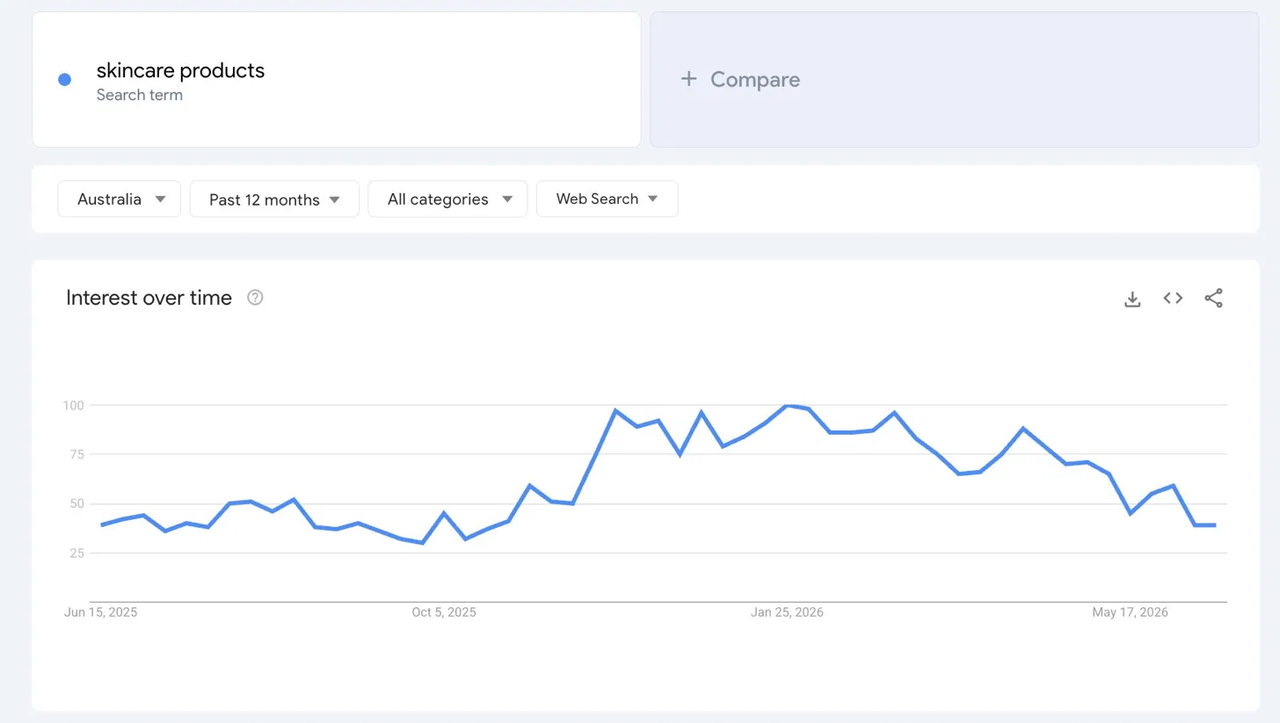
Search interest for "skincare products" in Australia has grown significantly over the past 12 months, rising from a baseline of around 40 in mid-2025 to peak values near 100 between January and February 2026, according to Google Trends data. Interest has pulled back slightly since then but remains well above where it started — a sign of structural demand growth rather than a short-lived spike.
The rising queries underneath that trend tell you what Australian buyers are specifically looking for right now:
- "Skincare products for sensitive skin" and "skincare products for oily skin" are both up 110%, pointing to skin-concern-specific positioning as a strong entry angle.
- "Korean skincare products" and "Japanese skincare products" are rising at 50%, confirming that K-beauty and J-beauty have real traction in the Australian market.
- "Kora Organics" and "antipodes skincare" are both breakout searches, which signals that Australian buyers are actively discovering local clean beauty brands.
- "Buy skincare products" is up 40%, meaning purchase-intent searches are growing alongside general interest.
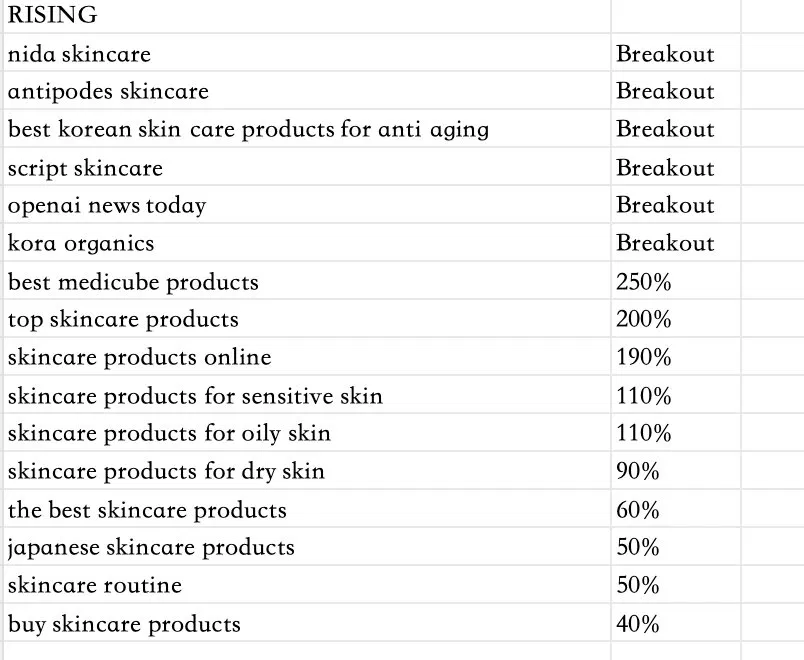
For a new seller, this data does two things. It confirms that skincare is a category with genuine and growing demand in Australia. And it tells you which angles have the least competition — skin-concern-specific products and locally made or clean-label brands are outpacing generic skincare searches, which means a tightly positioned brand has a better shot than a broad one.
Check bestseller lists on local beauty platforms
Adore Beauty is Australia's largest dedicated online beauty retailer and one of the most reliable sources of validated local demand. Rather than guessing what sells, you can query its built-in Adore AI directly — ask "give me 10 best sellers for moisturisers" and it surfaces the store's actual top-performing products in that category.
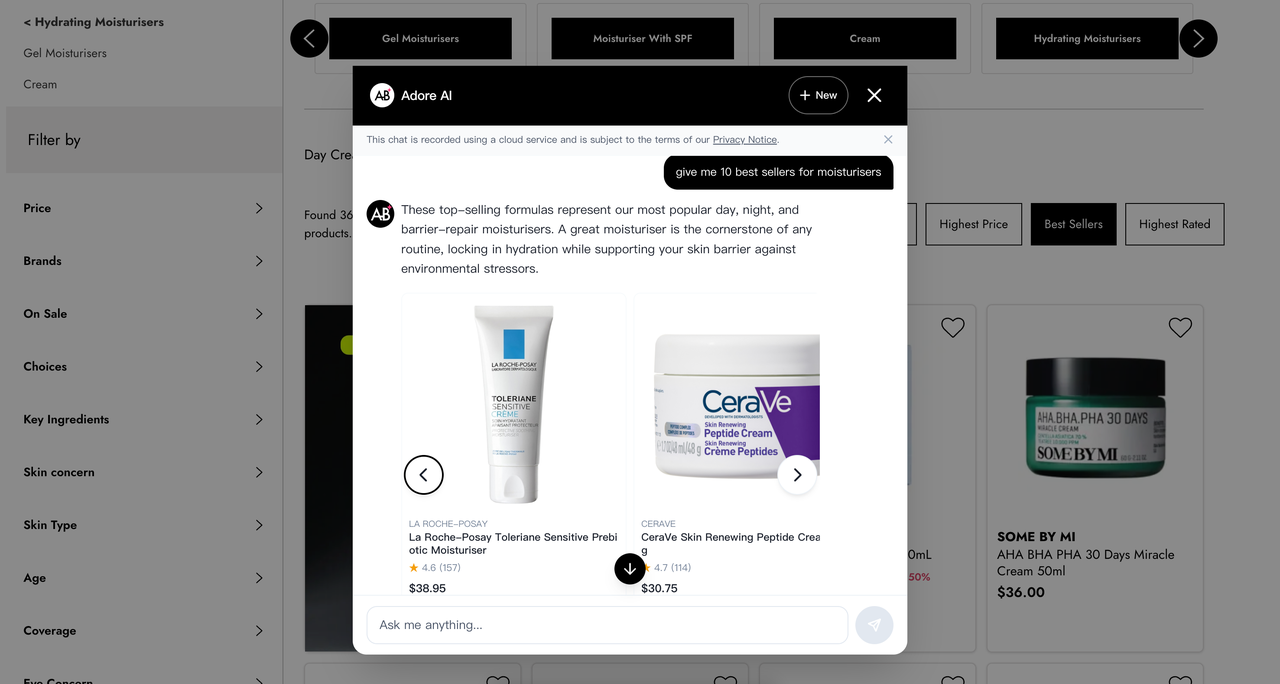
The screenshot above shows what comes back. For example, CeraVe Skin Renewing Peptide Cream at $30.75. These are not aspirational picks, and they are what Australian buyers are actually purchasing.
You are not looking at these to source the same branded products. Most of these require authorised distributor status to resell. What you are extracting is more useful:
- Price range: Australian buyers in the moisturiser category are comfortable spending $30 to $45 for a mid-tier product, and $200+ for high-teir one. That is your target retail price window for a comparable white label product.
- Skin concerns: Sensitive skin, peptide formulas, and chemical exfoliation (AHA/BHA) are the functional angles driving purchases — not generic hydration claims.
- Review volume: Products with 100-plus reviews at 4.6+ ratings tell you what a satisfied Australian buyer looks like in this category. Read those reviews to understand what they praise and what they complain about.
You can also do the same exercise manually by filtering any Adore Beauty category to "Best Sellers." The same approach works on Amazon Australia. What you end up with is a clear picture of the price point, the functional positioning, and the customer expectations you need to match — before you source a single unit.
Watch what is going viral on TikTok Australia
TikTok has become the primary search engine for beauty shoppers, with 65% of Gen Z and 55% of Millennials now using the platform to discover products before they buy. For a new seller, that makes TikTok one of the most reliable early signals of where demand is heading — often six to twelve months before a product peaks in conventional search.The categories getting consistent traction on TikTok Australia in 2025 and 2026:
- Skin longevity and barrier repair, like ceramides, lipids, and barrier-repair complexes, are the dominant ingredient trend, driven by a shift from aggressive correction to long-term skin health.
- Hypochlorous acid skincare is up 132% year on year in search growth, and lash serums are up 35% following the mascara-free makeup trend.
- Overnight scalp serums, pimple patches, and at-home LED therapy masks are all generating consistent organic content in Australia.
You are not trying to source these exact branded products. What TikTok tells you is which ingredients, formats, and functional claims are building buyer familiarity right now. A white label scalp serum or a barrier-repair moisturiser with ceramides is not competing with a viral brand — it is entering a category that TikTok has already warmed up for you.
Check order volumes on CJDropshipping and AliExpress
Both platforms show real order data at the product level. Search your intended category, sort by orders, and look at what has accumulated significant volume — particularly from buyers shipping to Australia or Oceania. High order volume is not proof of profitability, but it is confirmation that real buyers are purchasing this product type at that price point. Combine this with your Google Trends and Adore Beauty research, and you have three independent signals pointing at the same category. That convergence is what you are looking for before committing to a niche.
Practical tips for choosing your beauty sub-category
Once you have validated demand, use these three filters to make a final decision:
- Shipping complexity. Liquid skincare products are classified as dangerous goods for air freight in certain concentrations, which limits your carrier options and increases shipping costs. Solid products (face masks, scrubs, soaps) and beauty tools (jade rollers, gua sha, lash curlers) ship without restriction and are generally easier for a first-time seller to manage.
- Regulatory risk. Products that claim to treat a medical condition — "reduces acne," "treats eczema," or "SPF 50+ sun protection" — may fall under Therapeutic Goods Administration (TGA) jurisdiction in Australia. First-time sellers are better served by categories without therapeutic claims: fragrance, nail care, beauty tools, and general skincare without specific treatment claims.
- Margin and repeat purchase rate. Skincare has high repeat purchase rates but faces aggressive price competition. Beauty tools have higher margins but lower repeat frequency. Fragrance sits in between — reasonable margins, decent repeat purchase, and relatively low regulatory complexity. Match the model to your operational capacity.
Which business model works best for selling beauty products online?
Your niche determines what you sell. Your business model determines how you source and fulfil it. These are separate decisions, and mixing them up is one of the most common reasons new beauty sellers get stuck.
Dropshipping beauty products: what works and what to avoid
Dropshipping removes the upfront inventory cost entirely. For beauty, it works best with specific product types and comes with specific risks.
Well-suited for dropshipping:
- Beauty tools (jade rollers, gua sha, facial massagers, lash curlers)
- Solid fragrance and home scent products (reed diffusers, wax melts, solid perfume)
- Nail care (nail polish, press-on sets, nail tools)
- Hair accessories (clips, headbands, silk scrunchies)
Avoid or approach carefully:
- Liquid skincare products shipped internationally by air (dangerous goods classification)
- Products with therapeutic claims (TGA compliance falls on you as the seller)
- Branded products from known labels like CeraVe or La Roche-Posay (these require authorised distributor status — you cannot simply dropship them without a licensing agreement)
White label and private label for brands that want their own product identity
White label and private label are not the same thing, and the distinction matters for planning purposes.
| White label | Private label | |
| What it is | Factory's existing formula, your branding | Custom formula and packaging |
| Minimum order | 50-200 units | 200-500+ units |
| Upfront cost | Low-moderate | Moderate-high |
| Brand differentiation | Moderate | High |
| Best for | Testing a validated concept | Building a long-term brand asset |
The practical path: use dropshipping to identify which product type sells in your niche. Once you have a product with consistent sales and repeat buyers, that is the product worth taking to white label or private label. Australia's government is actively supporting the development of cosmetic manufacturing hubs in Victoria and New South Wales, fostering collaboration between local producers, research institutions, and packaging companies. That means local white label options are increasingly accessible for Australian-based founders.
How do I find reliable beauty product suppliers in Australia?
Getting the supplier decision right before you launch prevents the most painful post-launch problems — returns, compliance issues, and delivery complaints.
Local Australian suppliers vs. overseas suppliers for beauty products
Local Australian suppliers offer one to five day delivery and generally carry products that already meet Australian labelling standards. Two worth knowing:
- Dropshipzone is one of Australia's largest domestic dropshipping platforms, carrying beauty and personal care products with local warehouse fulfilment. Orders ship within Australia, which keeps delivery windows competitive with retail.
- Modalyst lists a number of Australian-based beauty suppliers with domestic fulfilment, useful if you want to filter specifically for local stock.
The trade-off is a narrower product range and higher per-unit cost compared to overseas sourcing. Local suppliers work best when your niche is tight and delivery speed is a key part of your brand promise.
Overseas suppliers give you access to a far wider beauty catalog at lower cost, with shipping typically running seven to twenty days to Australian addresses. Two of the most commonly used:
- CJdropshipping has a broad beauty and personal care catalog including skincare tools, nail care, and hair accessories, with warehouse options in multiple countries.
- EPROLO specialises in fashion and beauty dropshipping with a dedicated beauty product range. You can browse beauty dropshipping products from EPROLO to get a sense of the category depth and pricing before committing to a supplier.
With overseas suppliers, you take on the responsibility of verifying ingredient label compliance before listing — the supplier's packaging may not meet Australian INCI requirements. Shoplazza integrates easily with both CJdropshipping and EPROLO, so order routing is automated regardless of which supplier you use.
What to check before you commit to a beauty supplier?
Beauty has higher compliance stakes than most other categories. Run through this checklist before listing any product:
- Does the supplier provide a full INCI ingredient list for each product?
- Is there a skin safety or allergy testing report available on request?
- For liquid products: does the supplier have a Safety Data Sheet (SDS) confirming air freight eligibility?
- Does the supplier have documented experience fulfilling orders to Australian addresses, including customs clearance?
- If the product claims to be "natural" or "organic," can the supplier provide third-party certification to support that claim?
If a supplier cannot answer yes to the first two questions, move on. The ACCC does not distinguish between your supplier's mistake and yours.
How do I make my beauty store look professional?
Beauty is one of the most visual categories in ecommerce. What your product imagery looks like is often the difference between a sale and a bounce. However, Australian advertising law draws a clear line between what is permitted and what is not in beauty product imagery — and it applies to every image you publish, whether AI-generated or photographed.
What Australian law prohibits in beauty product imagery
- Before-and-after photos that imply a treatment result must reflect genuine, typical outcomes. The ACCC considers exaggerated or unrepresentative results to be misleading conduct under the Australian Consumer Law.
- Fabricated skin results. Showing visibly clearer, smoother, or younger-looking skin in an "after" image that was created or enhanced artificially — including through AI — is not permitted if it misrepresents what the product actually delivers.
- False ingredient or efficacy claims embedded in imagery, such as overlay text claiming "clinically proven" results without substantiation.
What is permitted and where LazzaStudio fits
AI-generated product imagery is entirely legal in Australia when it is used to present the product itself accurately, rather than to fabricate results. Changing the background, improving lighting, adding lifestyle context, and applying consistent brand styling to a real product image are all legitimate uses.
That is exactly what LazzaStudio does. It takes a real product image — a supplier white-background photo, an unedited sample shot, or a rough reference image — and generates commercial-quality variations with clean beauty styling: marble surfaces, soft natural light, botanical props, and brand-consistent color treatment. The product is real. The presentation is elevated.
Specific capabilities:
- Transforms plain product images into commercial-quality beauty visuals without altering the product itself.
- Generates multiple background and styling variations for A/B testing across product pages and ads.
- Produces 2K or 4K output that meets the creative specs for Meta and TikTok ad placements.
New users receive 100 free credits if sign up now, which is enough to build an initial product image library before committing to a paid plan.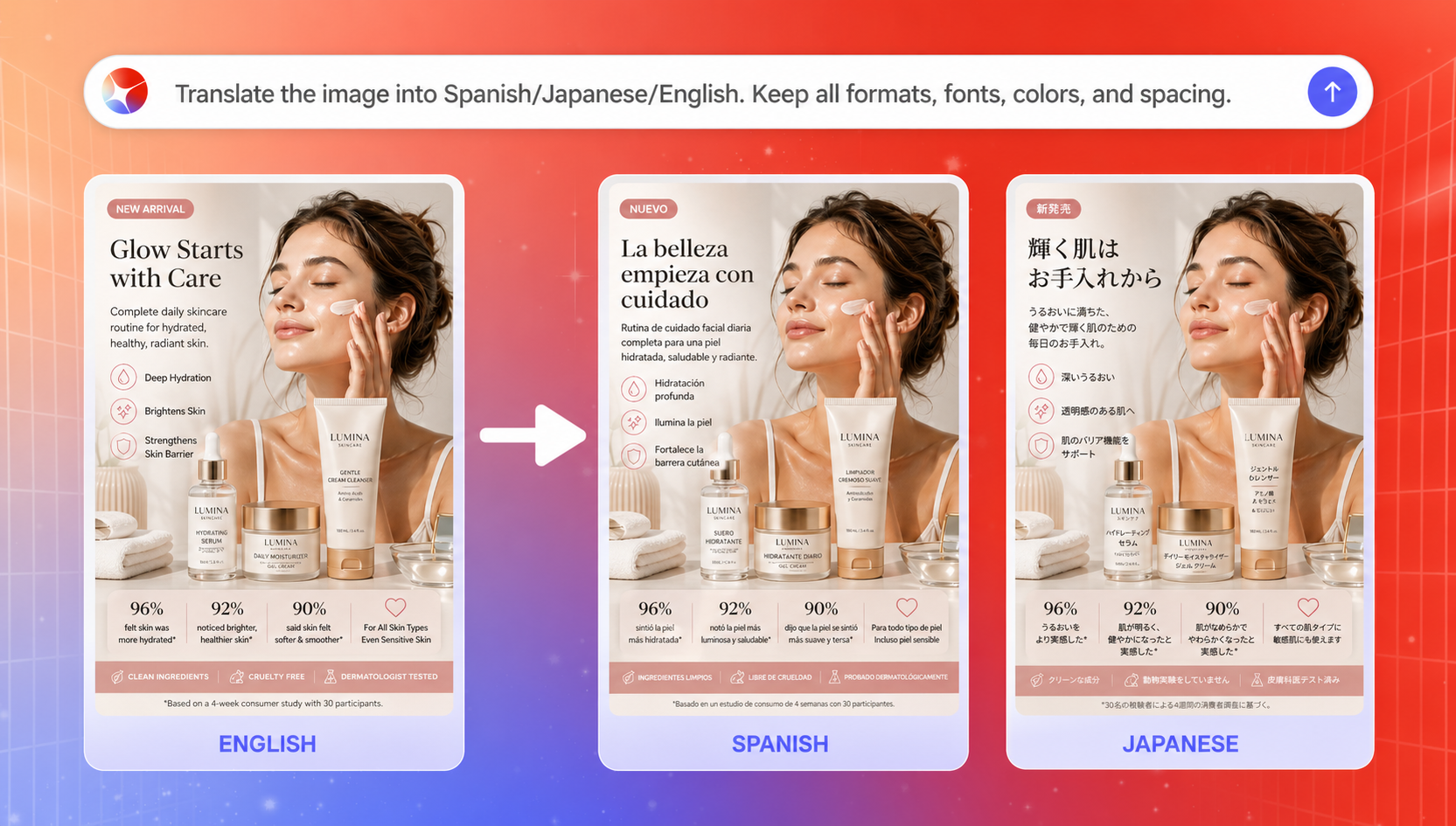
Three ways to get product images when you have nothing ready
- Supplier image plus LazzaStudio upgrade. Import your supplier's base image and use LazzaStudio to apply a consistent clean beauty visual treatment across your product range. This is the fastest path from zero to a professional-looking catalog.
- Order samples and shoot on your phone. Spend AU$50-100 on three to five product samples. Natural light, a white or linen surface, and a phone camera produce images that convert well — particularly on TikTok and Instagram Reels, where authenticity reads better than studio polish. By the way, you can check the materials and functions of the product you want to sell.
- White label product with brand packaging. Once your branded packaging arrives, photograph the product alongside it. This is the lowest-cost path to building a brand-consistent visual identity that competitors cannot replicate.
How do I build a beauty brand identity from scratch?
In beauty, your brand name and visual identity are often the first trust signal a new visitor evaluates. Getting them right does not require a branding agency or a design background.
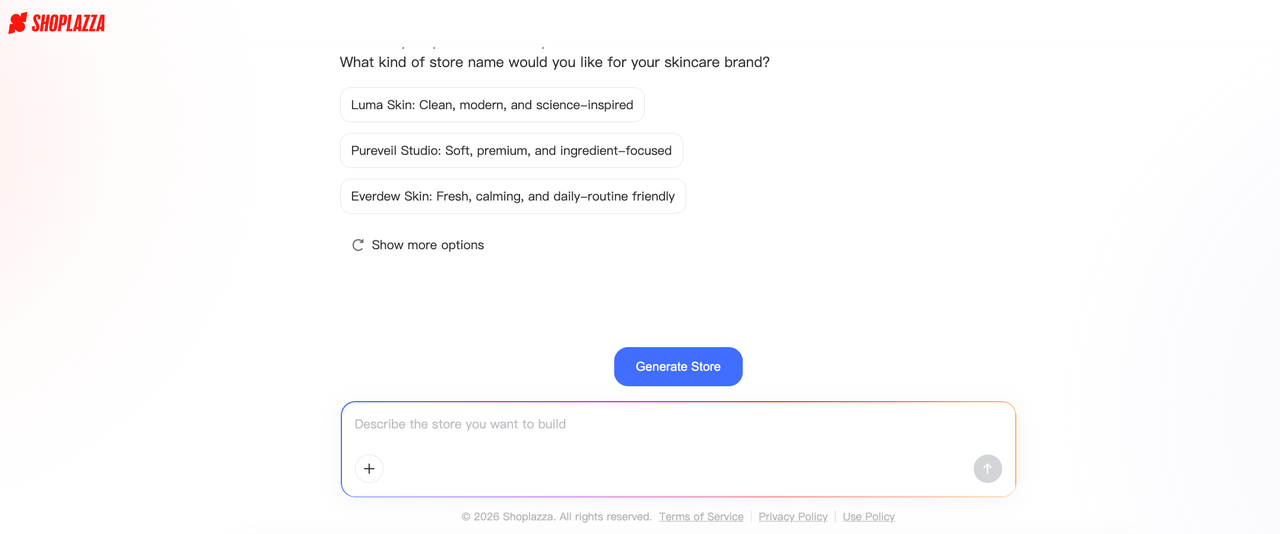
Shoplazza's AI Store Builder is designed to guide you through brand decisions as part of the store setup process. You do not need to arrive with answers already formed:
- Describe your product category, target audience, and sales market in plain language.
- The AI asks about your brand name. If you have one, enter it directly. If you do not, the AI generates three brand name options, each paired with a distinct visual direction.
- If none of the three options feel right, hit the refresh button — the AI generates a new set.
- Once you select a brand name, the AI produces three complete store design previews, each with its own color treatment, style, and banner layout.
- Select the design that fits your direction, and the AI builds out the full store: homepage, product pages, About page, Contact page, policy pages, and checkout — ready to populate with products.
- If you change your mind later, the brand name and logo can be updated directly in the backend without rebuilding the store.
Beauty brand identity needs before you go live
- Brand name and color palette aligned to your sub-category: earth tones for clean beauty, high-saturation for colour cosmetics, neutral minimalism for men's grooming.
- Full ingredient list on every product page, presented clearly.
- An About page with a genuine brand story — in beauty, founder narrative has a measurable effect on first-time buyer conversion.
- Any SPF or functional claims reviewed for TGA compliance before publishing.
- Mobile-optimised checkout — beauty buyers in Australia shop primarily on mobile.
What Australian regulations apply to beauty products sold online?
Australia's regulatory environment for beauty products has specific rules that most new sellers discover after launch, not before. Knowing them upfront is considerably cheaper.
- TGA classification. Products that claim to diagnose, prevent, treat, or cure a condition are regulated as therapeutic goods and require TGA registration or listing before they can be sold in Australia. "Reduces acne," "treats eczema," and "SPF 50+ sun protection" all fall into this category. In March 2026, the TGA proposed stricter sunscreen regulations including simplified labelling and improved testing standards following investigations that revealed many products failed to meet their claimed SPF levels. If your supplier makes these claims, they become your claims the moment you list the product.
- INCI ingredient labelling. All cosmetics sold in Australia must list ingredients using INCI names in descending order of concentration. Dropshipping sellers are responsible for ensuring this information appears on their product pages, regardless of what the supplier's packaging shows.
- "Natural" and "organic" claims. Australia has no unified certification standard for cosmetic organic claims, but ACCC guidance requires that any such claim be substantiated with evidence. Vague organic language without documentation constitutes misleading conduct under Australian Consumer Law.
- Greenwashing. Terms like "eco-friendly," "sustainable," and "zero waste" carry the same substantiation requirement. The ACCC has been actively enforcing greenwashing claims since 2024.
- ABN and GST. Register for an ABN at abr.gov.au before your first sale. GST registration is mandatory once annual turnover reaches AU$75,000.
Conclusion
Starting a beauty brand online in Australia does not require a full product range or a studio budget. It requires a clear sub-category, the right sourcing model, and a willingness to test before you scale. Shoplazza's AI Store Builder handles your brand identity and store setup, LazzaStudio handles your product imagery within the bounds of Australian advertising law, and native supplier integrations handle fulfilment. The judgment call — which niche, which audience, which model — is yours. Make it, then start building.
Frequently asked questions about selling beauty products in Australia
Q: What beauty products sell best online in Australia?
The strongest-performing beauty categories in Australian ecommerce in 2026 are cruelty-free SPF skincare (8.4% CAGR), clean and natural formulations, and men's grooming products. Nail care and affordable fragrance also show consistent repeat purchase behaviour. Avoid broad categories and focus on one specific product type to build initial traction.
Q: Can I sell beauty products in Australia without a TGA licence?
Yes, for most standard cosmetics. Products that make no therapeutic claims — general moisturisers, perfumes, nail polish, beauty tools — are not regulated by the TGA. The moment a product claims to treat, prevent, or cure a condition, TGA registration is likely required. When in doubt, review the TGA's cosmetics vs therapeutic goods guidance at tga.gov.au before listing.
Q: Can I dropship branded beauty products like CeraVe in Australia?
No. Selling branded products without an authorised distributor agreement constitutes trademark infringement. The alternative is to source white label products with similar active ingredients and position them on their merits rather than by comparison to a named brand. This also keeps you clear of any ACL issues around implied endorsement.
Q: How many products do I need to launch a beauty store in Australia?
Five to ten SKUs is a practical starting point. A focused range within one sub-category converts better than a broad catalog that signals no clear brand identity. Once you have data on which products sell and which generate returns, expand from a position of evidence rather than assumption.
Q: Do I need to list ingredients on beauty products I sell online in Australia?
Yes. Australian cosmetics regulations require full INCI ingredient disclosure in descending order of concentration. If you are dropshipping from an overseas supplier, you are responsible for ensuring this information appears on your product page — even if the supplier's own packaging is non-compliant. Request the full ingredient list from your supplier before listing any product.