You set up your online store. You know your product. But when it comes to marketing, two terms keep showing up — target market and target audience. Most people use them interchangeably. That's a mistake. Mixing up these two concepts leads to vague campaigns, wasted ad spend, and messaging that resonates with nobody. Understanding the difference between the target market and the target audience is one of the most practical things you can do to sharpen your marketing strategy. In this guide, you'll learn exactly what each term means, how they differ, and how to use both to grow your ecommerce business.
Quick answer
A target market is the broad group of people most likely to buy your product. It's defined by shared characteristics like age, income, location, or interests, and it shapes your overall business strategy. A target audience is a smaller, more specific group within that market. It's who you speak to in a particular campaign, ad, or piece of content. Think of it this way: your target market is everyone who might buy your running shoes. Your target audience for a summer Instagram campaign is men aged 22–30 who run half-marathons. Both matter. Both serve different purposes.
What is a target market?
A target market is the broad group of people most likely to buy your product or use your service. It's not everyone. It's the people who have the need, the means, and the motivation to choose what you offer. You may think it as the foundation of your business strategy. Your target market shapes which products you develop, how you price them, which platforms you show up on, and how you position your brand. It doesn't change often. And when it does, it usually means your business has evolved significantly.
Businesses with a wide product range tend to have broader target markets. A general sports retailer might serve athletes of all kinds. But a store that sells only competitive powerlifting equipment has a much narrower market — and that's perfectly fine. Clarity beats size every time.
Market segmentation
Defining a target market means looking at shared characteristics across your potential customers. These characteristics fall into four segments:
- Demographics: It covers age, gender, income, education, occupation. These traits are relatively stable and easy to measure. A luxury skincare brand might target women aged 35–55 with household incomes above $80K.
- Geographic: It covers country, region, city, or whether customers shop locally or globally. Geography also influences shipping costs, seasonal demand, and language. All of which affect your marketing decisions.
- Psychographic: It covers values, lifestyle, attitudes, and personality. Two people with the same age and income can have completely different buying motivations. One might buy running shoes to stay healthy. Another buys them as a fashion statement. Psychographic segmentation helps you understand why people buy, not just who they are.
- Behavioral: It covers buying habits, brand loyalty, how often they purchase, what motivates them. For example, how often do they buy? Are they loyal to one brand or always switching? Do they shop during sales or pay full price? Do they research extensively before buying, or decide on impulse? Behavioral data is especially powerful for ecommerce, where every click and purchase is trackable.
You don't need all four to get started. But the more dimensions you use, the sharper your market definition becomes, and the more effective everything downstream will be.
Target market example: Nike
Nike demonstrates how a clearly defined target market scales globally:
- Demographically, it targets consumers aged 15–45, with a strong skew toward Gen Z and Millennials. Core buyers typically earn $50,000–$150,000 annually, with in-store median income rising to $82,326 in 2024—evidence of gradual premium positioning.
- Geographically, Nike operates in 190+ countries but prioritizes urban centers. North America remains its largest revenue driver, with city-based, active consumers forming the backbone.
- Psychographically, Nike segments precisely. Key groups include “weekend runners” and “style shoppers,” unified by aspirational mindsets—fitness-driven, trend-aware, and status-conscious.
- Behaviorally, early loyalty is critical. Ranked the top footwear brand among U.S. teens in 2024 by Piper Sandler, Nike builds lifetime customers from a young age.
The result: a target market broad enough for $51B scale, yet specific enough to guide product, pricing, and channel strategy.
What is a target audience?
A target audience is a subset of your target market. It's the specific group you're trying to reach with one particular campaign, ad, or message. While your target market stays relatively stable, your target audience shifts depending on what you're promoting, what platform you're using, and what time of year it is. Your target audience is narrower and more detailed. It often goes beyond demographics into specific behaviors, preferences, and even the exact platform they use.
Audience segmentation
Audience segmentation is how you move from your broad target market to a specific, actionable audience for each campaign. Unlike market segmentation, which identifies who your customers broadly are, audience segmentation zooms in on where they are in relation to your brand today. It factors in:
- Purchase stage: A first-time buyer needs education and reassurance. A repeat buyer responds to loyalty rewards. A lapsed buyer needs a re-engagement offer. Same product, three different messages, three different audiences.
- Spending level: A customer who spends $200 per order monthly is a VIP. One who bought once for $20 needs a different offer, a different tone, and a different campaign trigger entirely.
- Engagement recency: Someone who opened your last five emails is primed for a direct conversion offer. Someone who hasn't engaged in 90 days needs a softer reactivation message first.
- Product affinity: What they bought last, what they browsed, and what they abandoned in their cart all signal exactly what to say next.
- Traffic source: A visitor from a TikTok ad is in discovery mode. A visitor from a branded Google search is close to buying. Context shapes receptiveness entirely.
For ecommerce store owners, doing this manually across a growing customer base is slow and prone to gaps. That's where Shoplazza's Loyalty & Push makes a real difference. Its AI-powered engine automatically segments your customers into membership levels — based on actual purchase frequency, spend history, and engagement patterns. Instead of building audience groups from scratch before every campaign, you get always-updated segments — VIPs, at-risk buyers, new members — ready to activate immediately. You spend less time building lists and more time marketing to the right people.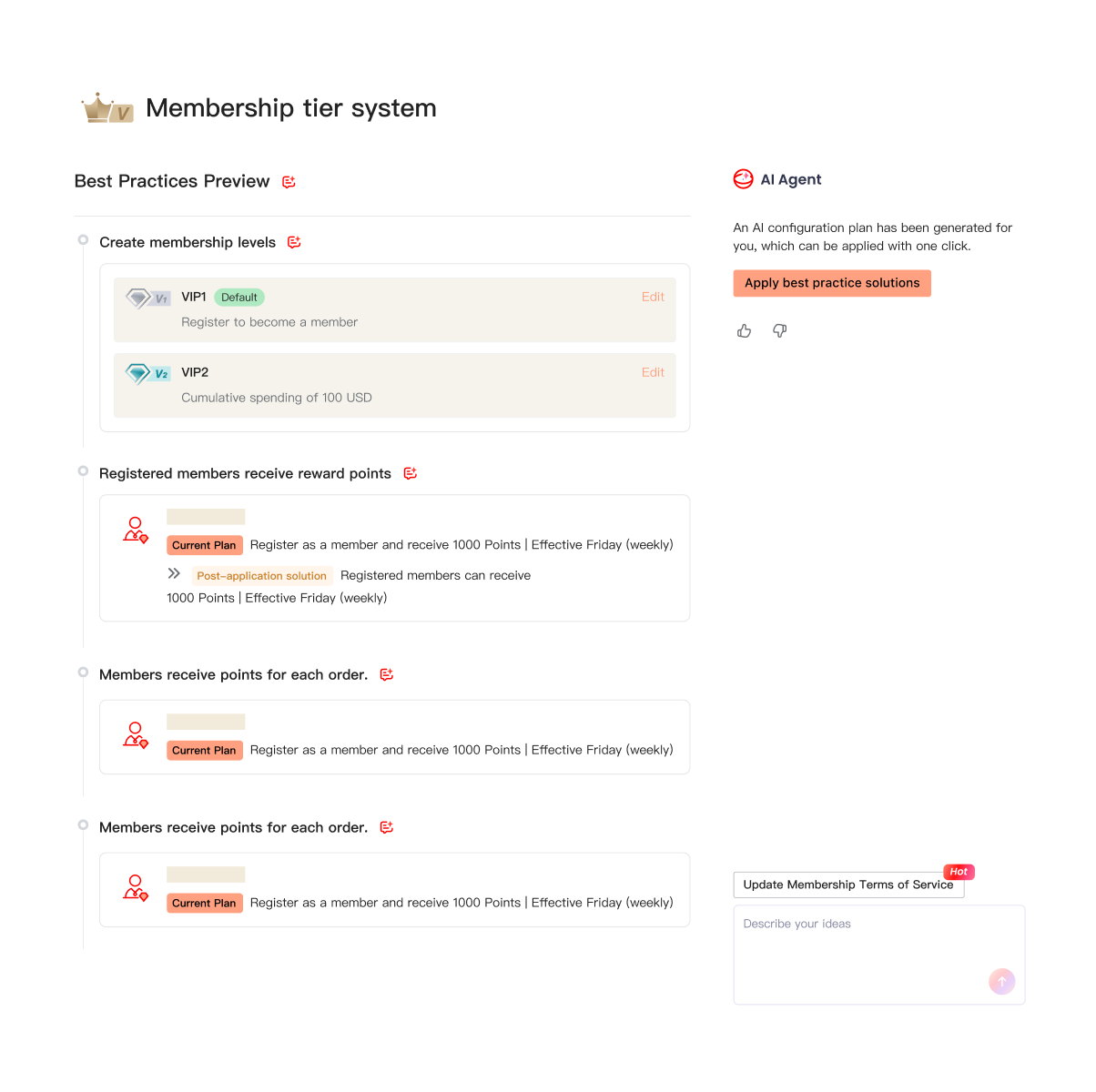
Target audience example: Spotify Wrapped
Spotify's overall market is broad—global listeners aged 18–34 who stream music and podcasts, reaching 675 million monthly active users by Q4 2024. Yet its flagship campaign, Spotify Wrapped, targets a far narrower segment. Rather than addressing all users, Wrapped focuses on highly active listeners—those with consistent, year-long engagement and a strong inclination to share. The campaign taps into identity expression, turning personal listening data into visually engaging summaries of top artists, songs, and genres, designed for social visibility.
This precision drives outsized results. The 2024 launch reached 200 million users within 24 hours, up 19% year over year, and generated over 500 million shares, a 41% increase. Spotify did not pursue new or inactive users. It activated an emotionally invested cohort with rich behavioral data and intrinsic motivation to share. Same brand. Same product. One precisely defined audience. 500 million organic shares.
Target market vs target audience: Side-by-side comparison
Your target market stays stable; your target audience shifts with context. One defines the business foundation, the other directs campaign execution. Both are essential and alignment between them determines how efficiently strategy turns into results.
The contrast becomes clearer when viewed side by side. The table below breaks down the differences between target market vs target audience that matter most to ecommerce marketers:
| Dimension | Target market | Target audience |
| Scope | Broad | Narrow |
| Purpose | Shapes overall business strategy | Guides individual campaigns |
| Who defines it | Founders, product teams, strategists | Marketing and growth teams |
| How often it changes | Rarely — evolves with the business | Frequently — shifts per campaign |
| Defined by | Demographics, geography, psychographics, behavior | Specific traits + platform + intent |
| Example | Adults 25–45 who care about sustainability | Women 28–34 on Instagram who follow eco-influencers |
What happens when you confuse the two?
Treating your target market and target audience as the same thing is one of the most common ecommerce marketing mistakes. Here's what it actually costs you.
Your ad copy becomes too vague to convert
When you write for your entire market instead of a specific audience, you end up saying something like: "High-quality fitness gear for everyone who loves working out." That speaks to no one. Effective ad copy speaks directly to one type of person in one specific situation. " Too busy for the gym? These resistance bands set up in 30 seconds" converts. "Great gear for fitness lovers" doesn't.
Your email campaigns lose relevance
Sending the same email to your entire customer list is easy. It's also ineffective. A first-time buyer and a loyal customer who's purchased five times need completely different messages. When you don't distinguish between audience segments, your open rates drop, unsubscribes rise, and revenue from email stays flat. Email marketing tool lets you segment by customer behavior — purchase history, engagement, and spend — so you can send the right email to the right person automatically, not manually.
Your budget gets wasted on the wrong people
If you run paid ads without a defined audience, you're paying to reach people who will never buy. A broad, unfiltered campaign might get impressions — but low-quality ones. Narrowing to a specific audience reduces wasted spend and raises your return on ad spend (ROAS).
How do the target market and target audience work together?
Your target market is the map, and it shows you the full territory of possible customers. Your target audience is the GPS route, and it gives you the specific path to take for this trip. You can't navigate well without both. This dynamic allows brands to stay consistent at the strategic level while remaining precise in execution.
In practice, the transition from market to audience follows a clear logic:
- Define your target market: Who broadly needs what you sell
- Look at the data: Who is actually buying, how often, and from which channel
- Identify segments within the market: By behavior, demographics, or purchase stage
- Pick the right segment for your campaign goal: That's your target audience
- Write specifically for them: Language, visuals, offer, timing
Execution depends on data integrity. Tools like OnePixel bridge strategy and performance by consolidating tracking across platforms such as Meta, Google, TikTok, and Snapchat. With centralized, server-side tracking and unified event data—purchases, sign-ups, add-to-cart—you gain a reliable view of which audience segments actually convert. Clean data sharpens targeting, reduces guesswork, and enables decisions grounded in measurable outcomes rather than assumptions.
How to define your target market and target audience: Step-by-step guide
Once the distinction is clear, the next step is operational. Here’s how to define your target market and turn it into actionable target audiences step by step.
Step 1: Start with your product and the problem it solves
Ask yourself: what specific problem does this product solve, and who has that problem? Be honest and specific. "Everyone with stress" is not a target market. "Remote workers aged 25–40 who struggle to stay active during the workday" is.
Step 2: Research who already buys from you
Your existing customers are your best data source. Look at who's buying — their location, age range, what they searched before landing on your store, and what they bought together. Patterns here reveal your real market, not just the assumed one.
Step 3: Segment by demographics, behavior, and psychographics
Once you know your broader market, break it into segments. Group customers by:
- Age and income bracket
- Buying frequency (first-time vs. repeat)
- Product category preference
- Geographic location
- Engagement level (email openers vs. non-openers)
Each segment is a potential target audience for a future campaign.
Step 4: Build your target audience from each segment
Choose the segment most relevant to your current campaign goal. If you're launching a new product, target your most engaged customers first. If you're trying to win back lapsed buyers, build an audience around people who haven't purchased in 60–90 days. Write a one-sentence audience definition for each campaign before you create any content: "This campaign is for [specific group] who want [specific outcome] and are [specific context]."
Step 5: Validate with data from your store
Run the campaign, check the numbers, adjust. Your data analysis dashboard shows you conversion rates, traffic sources, customer behavior, and revenue by segment — so you can see which audience actually responded and refine from there. Targeting is never a one-time decision. It improves with every campaign you run.
Conclusion
The difference between target market and target audience is simple, but the impact of understanding it is significant. Your target market defines who your business exists to serve. Your target audience defines who you're speaking to right now. Confusing the two leads to generic messaging, wasted budgets, and campaigns that fall flat. When you keep the two distinct — using your market as your strategic foundation and your audience as your campaign compass — every piece of content, every ad, and every email gets sharper.
FAQs about target market vs target audience
Is target market and target audience the same thing?
No. A target market is the broad group of people your business serves. A target audience is a specific subset of that group that you're targeting with a particular campaign or message. They're related but not interchangeable.
Which one should I define first?
Always define your target market first. It gives you the strategic foundation. Once you know your market, you can identify specific audiences within it for each campaign you run.
Can a business have multiple target audiences?
Yes — and most businesses should. A single target market often contains several distinct segments with different needs, behaviors, and motivations. Each segment can become a separate target audience for a different campaign, channel, or message.
How do I identify my target market for an online store?
Start with your product: who has the problem it solves, and who can afford it? Then look at your existing customer data — purchase history, location, device type, traffic source. Platforms like Shoplazza include built-in data analysis and CRM tools that surface this automatically as your store grows, so your market definition gets more accurate over time.
How often should I update my target audience?
Your target audience should be reviewed before every major campaign. As your product range grows, your customer base shifts, and platform behavior changes, your audience segments will evolve too. Your target market might stay stable for years — but your target audience should be revisited every time you plan a new campaign or enter a new channel.