
If you sell e-cigarettes or vape products online, you already know the pattern. Stripe, PayPal, and Square treat this category as high-risk or outright ban it. Even when you find a processor willing to take you on, accounts can get frozen months later, with funds locked up in the meantime. Account shut down without warning, money stuck for months — sound familiar? This guide covers four payment methods that actually hold up, plus a few workarounds you'll see floating around that aren't worth the risk.
Compliant payment processing for vape products means three things:
- You declare the category honestly.
- You use a processor that explicitly supports it.
- You handle age verification the way your target market and card networks require.
Some sellers try to get around this by hiding the category, redirecting traffic through a second site, opening accounts under someone else's business, or splitting transactions across multiple accounts to dodge risk scoring. These tricks might get you through approval in the short term, but getting caught usually costs far more than doing it right from the start.
What counts as compliant vape payment processing?
The line between compliant and non-compliant comes down to one thing: does your paperwork match your actual business. A compliant setup declares the real product category, uses a processor built to handle it, and follows age-verification rules for the market you're selling into.
A few workarounds show up often enough that they're worth naming directly, along with why they tend to backfire:
- Hiding the category. Listing vape products as consumer electronics or phone accessories might pass an initial review, but your product pages, ad landing pages, refund requests, and chargeback disputes all leave a trail. Processors eventually connect the dots, and once they do, it usually triggers an account review, a fund freeze, or termination.
- Running two sites (A/B site cloaking or payment rotation). A "clean" storefront that funnels traffic to a second site actually selling vape products creates a mismatch between what a cardholder sees advertised and what shows up on their statement. That mismatch is exactly what triggers the most common chargeback dispute codes.
- Borrowing someone else's business entity. Opening a merchant account under another company, or a shell entity, might get you past an approval gate, but once the real operator and the account holder don't match, you're into contract and liability questions that most people haven't thought through until something goes wrong.
- Splitting transactions across accounts. Spreading transactions across multiple merchant IDs just to keep each account's chargeback ratio under threshold isn't the same as holding backup processors for redundancy. Visa and Mastercard combine risk metrics across merchant accounts tied to the same underlying business, so splitting accounts doesn't actually avoid the scrutiny — it tends to make accounts look like they're deliberately dodging review.
Getting flagged for any of these can mean a frozen account at minimum. At worst, you end up on Mastercard's MATCH list or Visa's VMSS, which are terminated-merchant databases. Once you're on one, it's typically hard to open a new account anywhere for five years, and the record follows the business and its owner, not just one processor. The processors covered below work through honest ENDS-category declarations — a different path entirely from the workarounds above.
Four compliant ways to accept vape payments
There are four payment methods that actually work in practice, and each one fits a different scenario. Here's how they compare:
| Payment method | Best for | Advantages | What to watch for |
| High-risk credit card merchant account | Markets where card payments dominate and conversion matters | Customers pay directly with Visa, Mastercard, etc., connected straight to your checkout | Requires a processor that explicitly accepts the vape category; rates and reserves run higher |
| Vertical-specific payment gateway | Sellers who already have a high-risk merchant account and need the checkout tech layer | Better built for routing and risk management on high-risk transactions | The gateway alone doesn't provide a merchant account — you still need one paired with it |
| Local payment methods | Markets with low card penetration where local wallets or transfers are more common | Can meaningfully lift local payment success rates | Each method needs its own confirmation on whether it allows nicotine products |
| Bank transfer / wire | B2B, bulk wholesale, repeat customers | Lower chargeback risk, clear fund trail | Poor fit for instant B2C conversion; still requires a compliant entity and clean records |
Here's how each of these actually works.
High-risk merchant accounts that accept vape
This is the layer that carries the actual risk — the institution that agrees to open an account for a vape merchant in the first place. A handful of providers have built up real experience here.
| Provider | Target market | Notes | Restricted categories supported |
| UseePay | Global | Holds a Hong Kong MSO license and a US MSB license, PCI-DSS Level 1 certified, focused on cross-border store payments | Vape |
| Authorize.net | Global | Long-standing gateway under Visa's CyberSource, serves small-to-mid ecommerce and some high-risk merchants | Vape |
| Wintopay | Global, strong in European local payments | Focused on international card acquiring and cross-border settlement, mainly for ecommerce retail, digital entertainment and gaming, online travel and hospitality, and IDC/digital services | Vape |
| PaymentCloud | US | Covers multiple high-risk categories, with a fairly mature vape approval process | Vape and other high-risk categories |
| Soar Payments | US | Similar positioning to PaymentCloud, long-time high-risk specialist | Vape and other high-risk categories |
| Durango Merchant Services | US, international | Long track record, broad high-risk category coverage | Vape and other high-risk categories |
| Host Merchant Services | US | Has a dedicated vape merchant application page, markets faster approval | Vape, CBD, adult products |
| Easy Pay Direct | US | Also serves CBD and other adjacent high-risk categories | Vape, CBD, subscription businesses |
| Instabill | Merchants registered outside the US | Tobacco regulation varies by state, so this fits non-US-registered tobacco merchants better | Vape, traditional tobacco |
Shoplazza sellers running a store in this category can connect UseePay, Authorize.net, and Wintopay directly from the backend. All three support standard card payments plus Apple Pay and Google Pay. The merchant account itself still needs its own application and approval through the relevant processor — the platform can't replace that step.
👉 Read more: Where to Sell Vape Products Online in 2026: Platforms, Payments, and Traffic
Vertical payment gateways
A merchant account answers who's willing to open an account for you. A payment gateway answers a different question: how transaction data gets from your checkout to the processor. Gateways don't issue merchant accounts on their own. You need a high-risk merchant account first, then pair a gateway to it. A few names come up often in this space:
| Gateway | Notes |
| NMI | Common in high-risk categories like vape and CBD, supports features like multi-merchant balance allocation |
| ePN | Also frequently paired with high-risk merchant accounts |
| FluidPay | Relatively easy to deploy, compatible with several high-risk acquirers |
Local payment methods
In markets where card penetration is low, local wallets and bank transfers can meaningfully improve payment success rates. Shoplazza's global local payments connect with providers like GoAllPay and Payssion, covering European methods such as iDEAL, Sofort, Giropay, and Bancontact, along with bank-transfer options like Poli. These bank-transfer-style local methods aren't the same as buy-now-pay-later options like Klarna or Afterpay, which typically list vape explicitly as a prohibited category in their terms. Bank-transfer-based local methods tend to have fewer restrictions, and some vape retailers already use them — but that doesn't mean every local method is open to this category. Confirm with each provider individually before assuming nicotine or tobacco products are allowed.
Bank transfer or wire
This method fits B2B, large wholesale orders, or repeat customers better than one-off retail sales. Chargeback risk is low and the money trail is clear, but you still need a compliant business entity and complete invoice and transaction records. For direct-to-consumer sales, it's not a great fit — the buyer has to manually initiate the transfer, there's a gap before the bank confirms funds, and the order and payment don't happen at the same time. Customers tend to abandon the purchase during that wait, so conversion runs well below what you'd see with cards or local instant-payment methods. If you're selling to consumers, bank transfer works better as a backup option at checkout for customers who don't trust or can't use cards online, not as your primary payment method.
How do you set up compliant vape payment processing?
Once you know the direction, there are a few steps to actually get it running.
Confirm the terms in writing before you sign
Before you agree to work with a processor, get clear answers to these — and get them written into the contract, not just discussed verbally.
- Category acceptance. Does the processor explicitly accept the vape category with real MCC (merchant category code) declaration, rather than approving you first and leaving the risk for later?
- Fee structure. Ask about transaction rates, monthly fees, reserve requirements, and chargeback penalties line by line, so nothing shows up as a surprise deduction later.
- Settlement and freeze terms. How long is the settlement cycle, what triggers a fund freeze, and how long can a freeze last? All of this needs to be in the contract.
- Chargeback handling and risk tools. Does the processor offer chargeback alerts, order risk screening, or dispute support?
- Compatibility with your store platform. Confirm the processor connects cleanly with your ecommerce system and supports the currencies and regions you need.
- Backup channels. Line up at least two processors, and manage fund consolidation across them centrally.
Understand the processor's actual business before signing on
This step is about verifying the processor's own capability and willingness — different from the contract terms above.
- Do they explicitly accept your specific products — nicotine vapes, zero-nicotine products, pods, e-liquid, vaporizer hardware, disposables — each confirmed individually?
- Which countries, states, or provinces can you sell and ship to? Is cross-border direct shipping allowed?
- Which card networks and currencies do they support, and do they support 3D Secure 2?
- Beyond the base rate, are there setup fees, monthly fees, cross-border fees, rolling reserves, fixed reserves, chargeback fees, refund fees, or withdrawal fees?
- What's the settlement cycle (T+how many days), which country or region does the money land in, and what type of business account do you need?
- What documents will they require for review — company registration, beneficial owner information, bank statements, website link, product list, compliance certificates, tax documents, supply chain and logistics proof?
- What's their chargeback rate threshold, what's the early-warning process, what triggers an account suspension, and what evidence do you need for an appeal?
- Will they put vape-related business in writing in the contract, the merchant application, and the MCC classification?
If a processor won't put "yes, vape is allowed" in writing — in the approval, an email, or the contract — that's a sign not to go live with them.
Keep your website and your application consistent
The category on your MCC application, the product descriptions on your site, and the content in your ad creative all need to match. As mentioned earlier, processors often catch category mismatches by comparing your product pages and ad landing pages against your declared business. This doesn't only happen when someone deliberately hides the category — forgetting to update your application after a site change, or running ads that describe the product differently than your main site, causes the same problem. Checking these three things line up before launch saves a lot of trouble down the line.
Check whether your store platform already supports this
If you already have a store, check your platform's payment settings or help center for a compatible processor, or just ask support directly. If you haven't built your store yet, picking a platform that already has a working payment setup for this category saves you a lot of back-and-forth later.
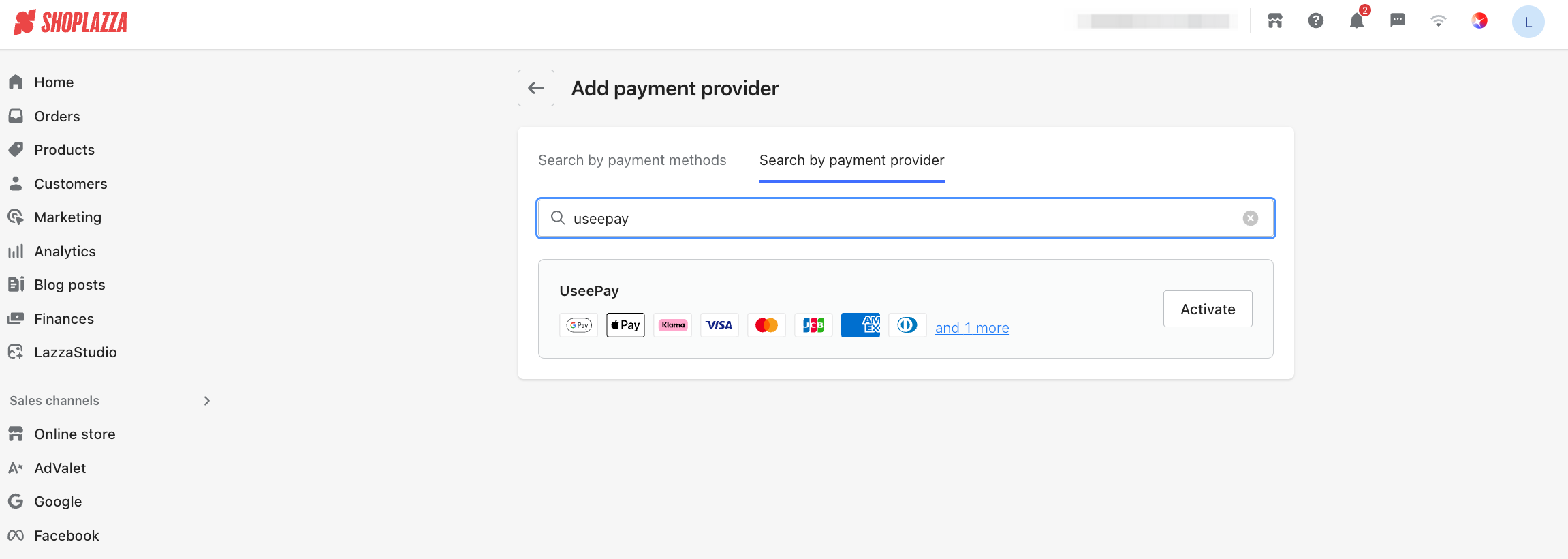
On Shoplazza, for example, the payment settings let you search either by payment method or by provider name. Searching directly for UseePay, Authorize.net, or Wintopay brings up the matching provider card — click to enable it, and that's the first step done without any development work.
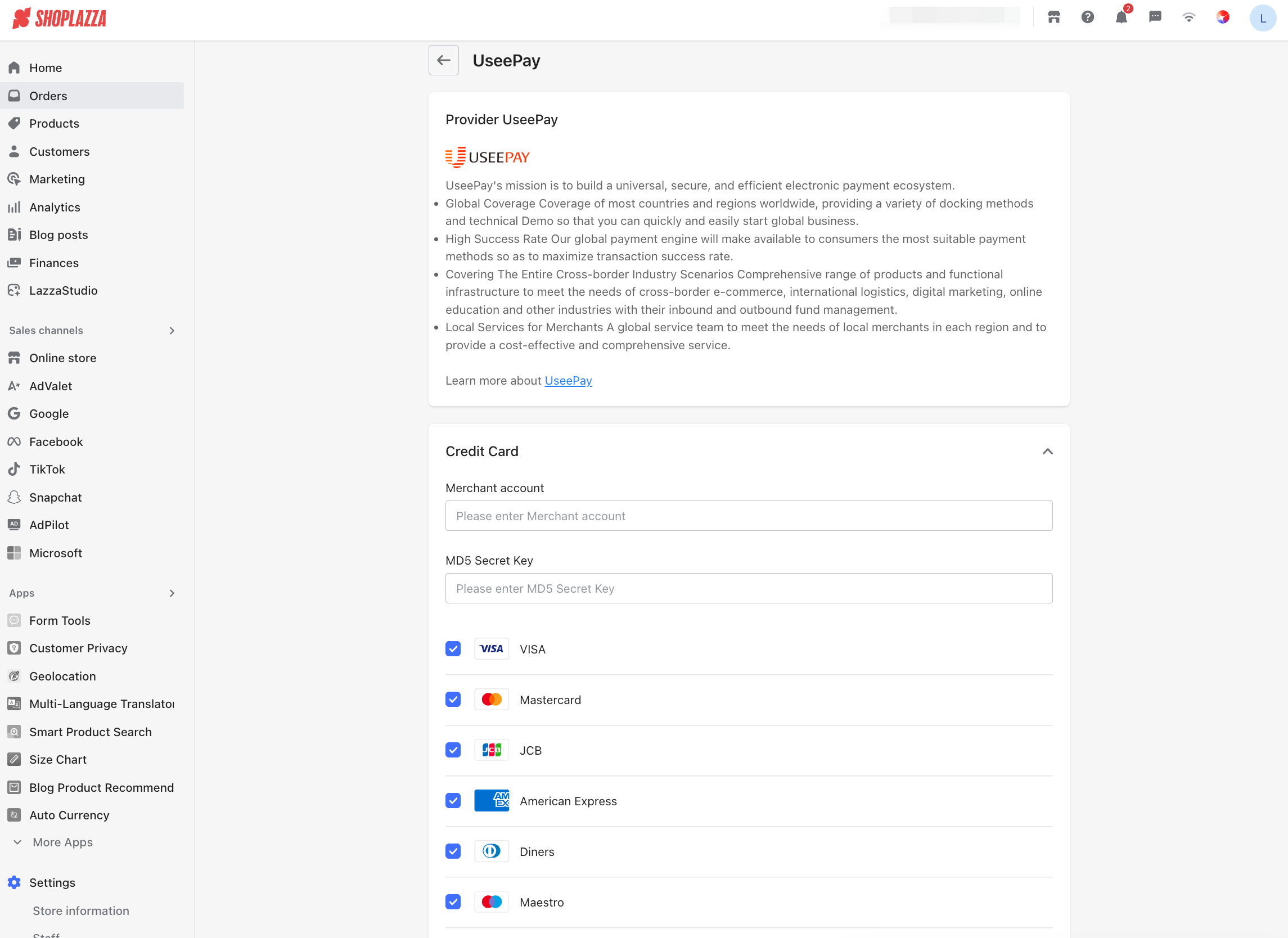
Take UseePay as an example: the search result shows the payment method icons that provider currently supports, including Google Pay, Apple Pay, Visa, Mastercard, JCB, American Express, and Diners. Those icons only show what that specific provider can route in general — whether a given payment method actually works for vape products depends on that method's own category policy, so don't assume something's usable just because the icon shows up in the list. After enabling it, fill in your API Login ID and Transaction Key as described earlier to activate the connection. If you hit an error during setup, check UseePay's common error and troubleshooting reference.
Common pitfalls and risks to watch for
- Fund freezes are an industry norm. PayPal and Stripe regularly clear out high-risk merchants in batches, and once flagged, funds can stay frozen for months. Don't keep all your funds in one account — withdraw on a regular schedule.
- Chargeback thresholds are a hard line. Most processors set a fixed chargeback rate ceiling. Cross it repeatedly and you land under stricter monitoring, so invest in order risk screening and customer service upfront.
- Relying on a single channel is risky. It's not uncommon for one channel getting shut down to take your entire store's payments down with it. Build in multiple backup channels from the start.
- Misdeclaring your category has legal consequences, not just account ones. Falsifying product categories or claiming improper tax refunds has already led to criminal charges in some cases. Honest declaration is the only path that holds up long-term.
- Why do accounts get frozen without warning? Usually it comes down to one of two things: your chargeback rate crossed the processor's threshold, or the processor is doing a batch clearout of an entire high-risk category — which happens periodically regardless of your individual track record.
Build payment processing that holds up
Compliance is the baseline for keeping a vape store able to accept payments long-term. High-risk credit card merchant accounts, vertical payment gateways, local payment methods, and bank transfers each fit a different stage or scenario, and most sellers end up combining more than one rather than betting everything on hiding the category or splitting accounts. Shoplazza already connects with UseePay, Authorize.net, and Wintopay — three processors that explicitly support the vape category — so getting this piece set up is mostly a matter of configuring it in the backend.
Frequently asked questions about vape ecommerce payments
Q: What's the difference between finding a high-risk processor myself versus using a platform that's already connected to one?
Doing it yourself means handling provider research, contract review, and technical integration on your own, which usually takes longer. A platform with a processor already connected skips the technical integration step — you configure it directly in the backend — but you still have to apply for and get approved for the merchant account yourself. The platform can't do that part for you.
Q: Can splitting transactions across multiple accounts actually avoid risk scrutiny?
No. Visa and Mastercard combine chargeback rates and other risk metrics across merchant accounts tied to the same underlying business owner. Splitting accounts doesn't get around that monitoring — it tends to make an account look like it's deliberately dodging review instead.
Q: Can bank transfer fully replace credit card payments?
Not entirely. Bank transfer has low chargeback risk and a clear money trail, which makes it a good fit for B2B or large repeat orders. But the checkout experience isn't friendly for regular consumers, so conversion runs well below what you'd see with card payments in a retail, direct-to-consumer setting.
Q: Do local payment methods fully bypass card network restrictions on high-risk categories?
Not exactly. Local payment methods don't run through the card networks' direct restrictions on high-risk categories, but each local payment provider has its own product category policy. You still need to confirm individually whether nicotine or tobacco-related products are allowed — connecting a local method doesn't automatically mean there are no restrictions.
Q: What should I confirm in writing when choosing a payment processor?
At minimum, confirm whether they support real MCC-based category acceptance, get every fee in the rate structure spelled out, nail down the specific conditions for settlement and fund freezes, check what chargeback handling and risk tools they offer, and make sure they'll put your vape business in writing in the contract and merchant application. Verbal assurances don't hold up in place of contract terms.
Q: Does Shopify allow vape sales?
No. Shopify notified merchants in June 2026 that it no longer supports the sale of Electronic Nicotine Delivery Systems, giving sellers until July 8, 2026 to remove all vape products or face account suspension. The policy covers e-cigarettes, e-liquids, vaporizers, parts, and refills, with no exception for zero-nicotine or FDA-authorized products. This is one of the reasons more vape sellers have been looking at other platforms to migrate their stores to.
