Amazon is one of the largest ecommerce platforms in the world. High traffic, strong buyer trust, and a massive customer base make it an obvious starting point for new sellers. And yes — you can dropship on Amazon. The platform officially allows it. But there are rules you can't ignore, and not knowing them is one of the fastest ways to get your account suspended. This guide covers Amazon's dropshipping policy, how to actually run the operation step by step, and what to do when platform limitations start getting in the way of growth.
What is Amazon dropshipping?
Dropshipping is a fulfillment model where you sell products without holding any inventory. You list a product on Amazon, a customer places an order, and your supplier ships directly to that customer. You never touch the product.
Amazon's official policy allows this, as long as you follow their dropshipping rules and applicable regulations. For new sellers, the appeal is clear: low startup costs, no warehousing, no packing and shipping, and more time to focus on product selection and store management.
Amazon dropshipping vs FBA: what's the difference?
A lot of beginners confuse dropshipping with FBA. They're completely different models.
| Dropshipping | FBA (Fulfillment by Amazon) | |
| Inventory | No stock needed — supplier holds inventory | You pre-ship inventory to Amazon's warehouses |
| Startup cost | Low | Higher (includes storage fees and inbound shipping) |
| Fulfillment control | Depends on your supplier | Handled entirely by Amazon |
| Prime eligibility | Generally not available | Eligible for Prime badge |
| Best for | Testing products, low-cost entry | Proven products with consistent sales volume |
What are Amazon's dropshipping rules?
Amazon allows dropshipping, but with clear conditions. The platform's priority is protecting the buyer experience. Customers need to know exactly who they're buying from, and that seller has to take full responsibility.
Specifically, there are three core requirements:
- You must be the seller of record. The package, invoice, and packing slip the customer receives can only show your store information. No supplier names, no third-party branding.
- Remove all third-party information before shipment. Any packing slip, invoice, or packaging that identifies another seller must be removed before the order ships.
- Handle returns and customer service yourself. You're responsible for accepting returns and providing customer service that meets or exceeds Amazon's standards.
Violating these rules can get your listings removed. In serious cases, your selling privileges get suspended — and reinstatement is not easy.
What do you need to start Amazon dropshipping?
Setting up an Amazon seller account isn't complicated, but missing a few basics upfront can stall the whole process. Before you start, make sure you have these in place:
- Register an Amazon seller account. An Individual account charges a per-item fee and works for low-volume testing. A Professional account costs $39.99 per month with no per-item fees, which makes more sense once you expect consistent sales. Amazon's new seller incentive program currently offers up to $50,000 in combined benefits, including up to $1,000 in ad credits. Eligible sellers receive these automatically — no separate registration needed.
- Set up a payment account. Amazon pays out to a local bank account in supported countries, or through third-party payment services like Payoneer or WorldFirst if your local bank isn't directly supported. Link your payment account in Seller Central before you start listing.
- Sign a dropshipping agreement with your supplier. Your supplier needs to confirm in writing that they'll ship as your store — your name and branding on the package, no supplier identification of any kind. This is a platform compliance requirement and protects you if a dispute comes up.
Some product categories and seller locations may require additional identity verification documents during registration. Check Amazon's seller registration requirements for your country before you start, so you're not caught off guard mid-process.
How to dropship on Amazon: 6 detailed steps
Once you understand the rules, the actual process is straightforward. Here are the six steps to get your Amazon dropshipping operation running.
Step 1: Check whether your category needs approval
Before you contact any supplier, confirm whether your product category requires Amazon's approval to sell.
Amazon restricts certain categories and requires sellers to complete additional verification before listing. Common restricted categories include music, DVDs, fine art, and jewelry. Categories like toys, food, and beauty aren't restricted overall, but specific subcategories or brands within them may still require separate approval.
To check, go to Seller Central, click "Add a Product," and search for the item you want to sell. If it shows "Listing limitations apply," click "Apply to sell" to start the process. Most applications require supplier invoices from the past three months and relevant compliance documents such as FDA or CPSIA certifications, depending on the category.
Do this check before you spend time sourcing. Finding a great supplier only to discover your category is gated is a frustrating waste of time.
Step 2: Find the right supplier
Your supplier controls your shipping quality and delivery speed. This is the part of dropshipping that breaks most easily if you get it wrong. When evaluating suppliers, look at:
- Whether they'll ship under your store name with no supplier branding in the package?
- How consistent are their shipping times, and do they have a clear process for notifying you about stockouts?
- Whether product quality match what buyers in your target market expect?
- Whether they have experience working with dropshipping sellers?
- Whether the product cost plus shipping still leaves you a workable margin after Amazon's fees?
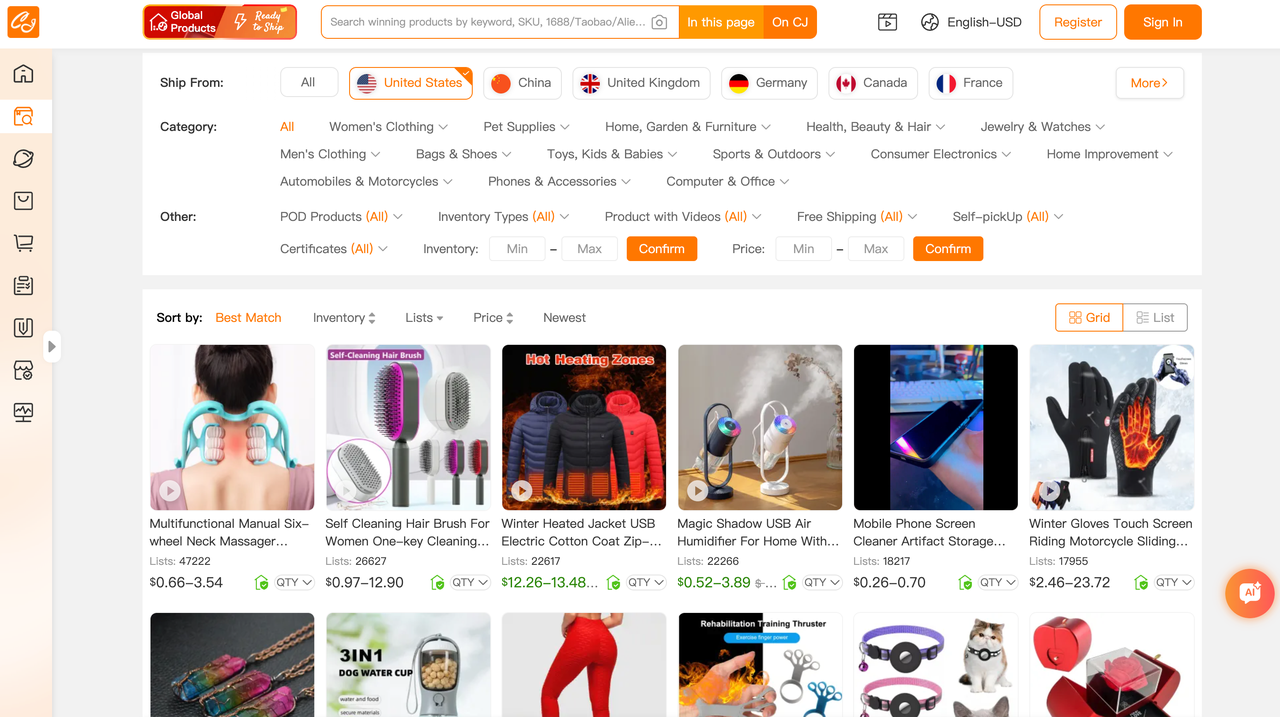
For sourcing, Alibaba's wholesale section and AliExpress's dropshipping center are good starting points for standard products at close-to-factory pricing. If you're focused on the US market, CJdropshipping offers US warehouse fulfillment with faster delivery times. DropCommerce specializes in North American suppliers with higher product quality and stronger brand presentation.
For sellers targeting Europe, the UK, and the US, EPROLO is worth considering. Shipping to the UK or US via EPROLO Express takes roughly 5 to 8 days, and 5 to 12 days to other parts of Europe. EPROLO also supports branded packaging — custom outer packaging, branded stickers, and personalized inserts — which helps your shipments feel like a real brand rather than a generic parcel. Branded packaging starts at $19.90 per year, and the platform itself is free with no monthly fee.
Whichever supplier you go with, place 1 to 2 test orders before you commit to scaling. Verify the packaging quality, actual shipping times, and that no supplier branding ends up inside the package.
Step 3: Create your Amazon listing
Product titles have a 200-character limit and can't include special characters like !, $, or %. Your main product image must have a white background with no watermarks or extra text. Your five bullet points are the first thing buyers read on your product page. Use them to highlight core use cases and functional benefits — not just a list of specs.
When pricing, account for every cost: supplier price, international shipping, Amazon's referral fee (roughly 8% to 15% depending on category), advertising spend, and a buffer for returns and refunds. A lot of beginners price based on the supplier cost alone, then get surprised when actual margins are much thinner than expected.
Step 4: Drive traffic to your listing
A new listing with no reviews won't rank well organically. You need to actively push traffic, especially early on.
- Sponsored Products (PPC): Keyword-based, pay-per-click ads. Start with automatic campaigns to gather data, then switch to manual campaigns to control bids more precisely.
- Coupons and promotions: Adding a coupon to your listing improves visual click-through in search results and can lift conversion rate.
- Amazon Vine: Invite verified reviewers to try your product in exchange for honest reviews. Useful for building initial social proof on new listings.
- External traffic: Publish content on TikTok, Instagram, or YouTube and direct that audience to your Amazon listing. Use Amazon Attribution to track how external traffic converts.
Step 5: Process orders and manage fulfillment
When a customer places an order on Amazon, you place the corresponding order with your supplier using the customer's shipping address. Confirm the supplier ships under your store name with no third-party branding in the package.
Once the supplier ships, update the tracking number in Seller Central before the promised ship date. Late shipment rate is one of the key metrics Amazon monitors. Missing the ship date window, even by a little, pushes that number up and affects your account health score.
Step 6: Monitor your account health metrics
Amazon tracks three core performance metrics in the Seller Central account health dashboard: Order Defect Rate, Late Shipment Rate, and Pre-Fulfillment Cancel Rate. Check these weekly and keep them within Amazon's required thresholds. With dropshipping, all three metrics depend heavily on your supplier's reliability. That makes them more volatile than self-fulfilled models, so they need closer attention.
Risks and limitations to know upfront
Dropshipping looks low-risk from the outside. In practice, a few things trip up new sellers consistently.
On the operational side:
- Account health risk. If your supplier ships late, your Late Shipment Rate goes up. Enough of that and Amazon can suspend your selling privileges.
- Supplier stockouts. Work with 2 to 3 backup suppliers so you're not left unable to fulfill orders if one runs dry.
- Quality control. You can't inspect products before they ship. Always test new suppliers with small orders before scaling.
On the platform side:
- Buy Box disadvantage. Without FBA's Prime badge, you're at a structural disadvantage when competing for the Buy Box.
- No access to customer data. Amazon doesn't share buyer contact information or purchase behavior with sellers. You can't proactively reach past customers to drive repeat purchases.
- High fees. Referral fees of 8% to 15%, combined with advertising costs and supplier margins, leave less room than most beginners expect.
- Hard to build a brand. Buyers on Amazon trust the platform, not your store name. Long-term brand equity is difficult to build here.
These aren't problems you can optimize your way out of. They're built into the platform model.
Build a second sales channel with your own store
Amazon is a great starting point, but as your business grows, its structural limitations become harder to work around. No customer data, no repeat purchase channel, no brand equity — these aren't fixable with a better ad strategy. The root issue is that you're building on someone else's platform, by their rules.
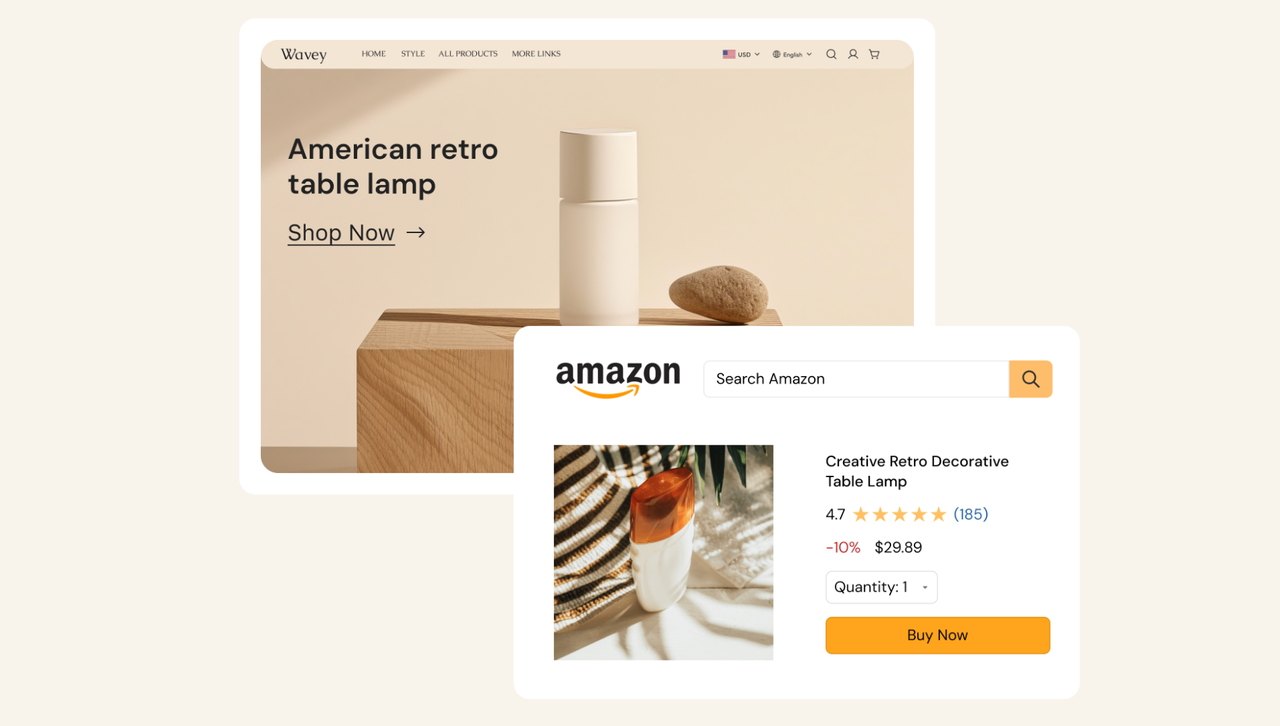
That's why many sellers, once they're stable on Amazon, build a DTC website in parallel. Your own store lets you own the customer relationship, collect first-party data, and build a brand that compounds over time. Amazon handles traffic acquisition and new customer conversion. Your own store handles long-term customer relationships and brand building. Shoplazza makes it straightforward to set this up.
Generate an online store with AI
You don't need to design anything from scratch. Shoplazza's AI Store Builder works through a guided conversation. You describe your store — something like "home goods, targeting North America, clean modern style" — or upload product images and URL your refer to, and the AI generates three store style designs for you to choose from. Once you pick a style, it builds a complete store: homepage, product pages, About, Contact, policies, and checkout. The whole process takes about 3 to 5 minutes, and the result is a fully functional store ready for products and payments.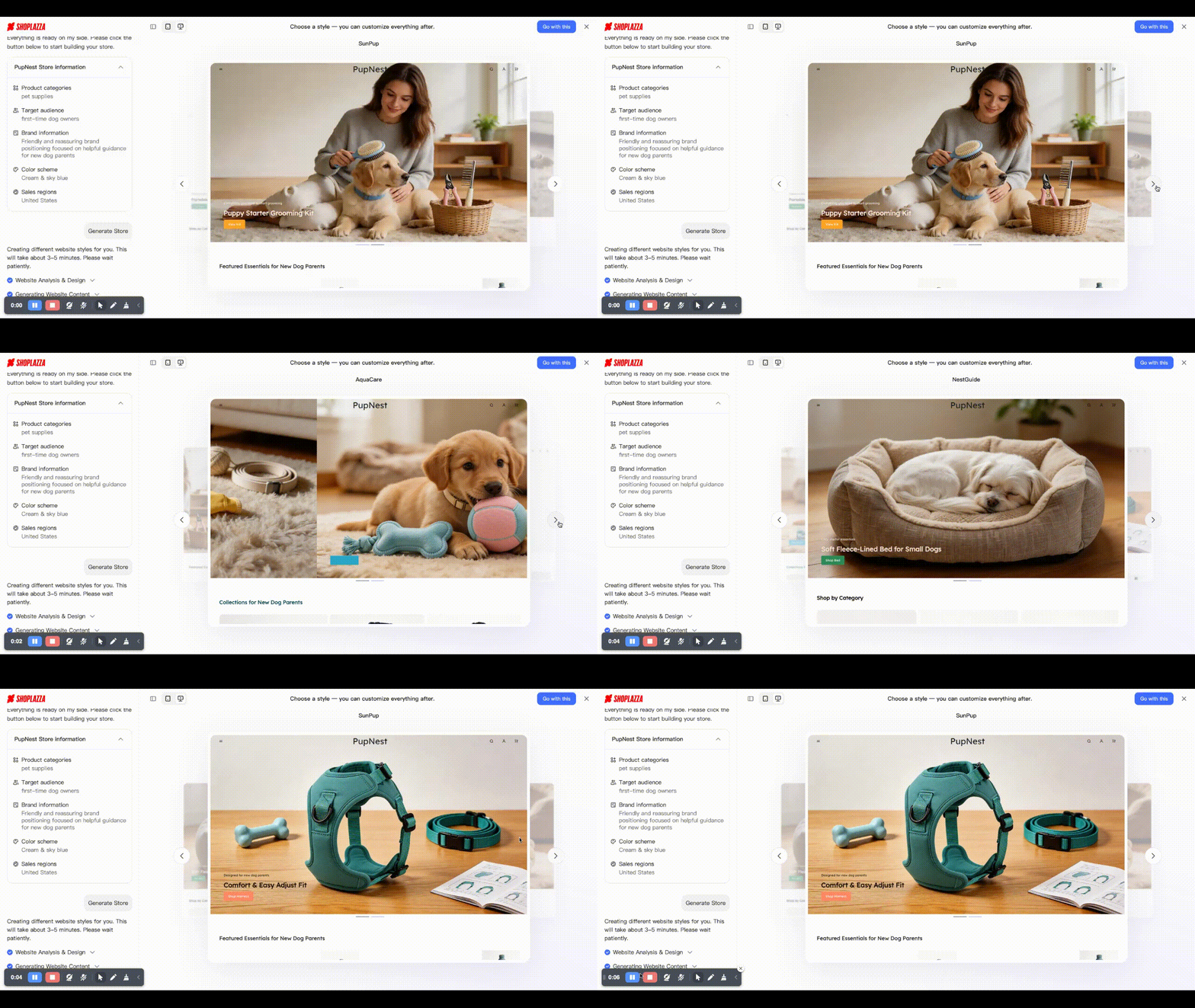
Sync your Amazon products
You don't need to re-list products manually. Shoplazza supports Amazon MCF (Multi-Channel Fulfillment) integration. Orders from your DTC website sync automatically to Amazon's backend and are fulfilled through Amazon's global logistics network. No separate fulfillment system needed — inventory and fulfillment across both channels are managed in one place.
Set up payments and shipping
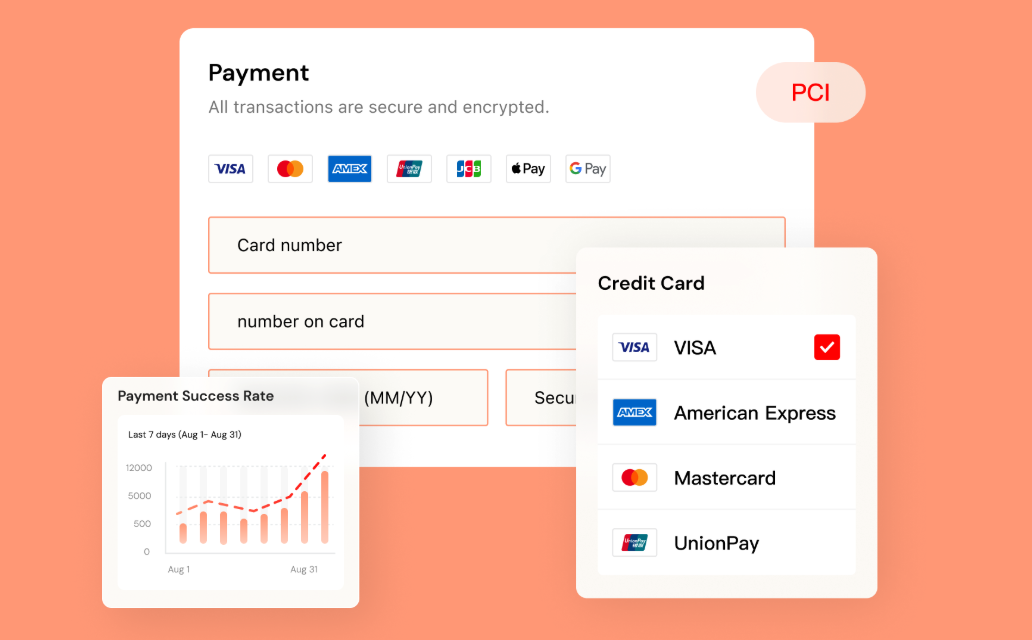
For payments, start with what your target market actually uses. Buyers in the US and Europe typically pay with Visa, Mastercard, Amex, or PayPal. German and Dutch shoppers lean toward Klarna and iDEAL. Southeast Asian markets are dominated by e-wallets, with significant variation by country.
If you're selling across multiple markets and want to manage everything in one backend, Shoplazza Payments supports 180+ payment methods globally — credit cards, e-wallets, buy-now-pay-later, and local payment options. It includes a built-in AI risk management system to help flag fraudulent orders, and onboarding is free with payouts in as fast as 2 business days.
For shipping, Shoplazza lets you configure shipping rate rules by market: free shipping, flat rate, or rates based on order value or weight, grouped by country or region. If you connect the same dropshipping suppliers to your own store, the fulfillment logic works the same way — the supplier ships directly to the customer, no separate logistics setup required.
Drive traffic between both channels
You can add a "Buy on Amazon" button to your DTC product pages, so visitors who prefer Amazon's checkout can complete the purchase there. Amazon's platform trust helps convert first-time buyers who aren't ready to check out on an unfamiliar site.
In the other direction, your DTC website can acquire customers through Google search, Meta ads, TikTok content, and influencer partnerships — channels you control. Shoplazza has integrations with Meta, TikTok, and Google, so you can manage ad campaigns and track performance from a single backend without switching between platforms.
For day-to-day store management, Athena — Shoplazza's built-in AI operations agent — lets you run backend tasks through plain language. You can ask Athena to upload products, process orders, set up discounts, or pull performance data, and it previews each action before executing. For sellers managing both Amazon and a DTC store at the same time, Athena cuts down on repetitive backend work and keeps more of your time free for sourcing and growth.
Ready to run both channels
Amazon dropshipping is a legitimate, workable model — if you understand the rules, choose suppliers carefully, and stay on top of your account metrics. For sellers who want to test a market with low upfront risk, it's a solid starting point.
But as volume grows, the platform's structural limits become more visible. A DTC website isn't a replacement for Amazon dropshipping — it's an extension of it. It gives you a place to own your customer relationships, build brand equity, and reduce your dependence on a single platform. Running both channels in parallel is the direction most serious cross-border sellers are heading. Shoplazza gives you the tools to build and operate that second channel without starting from scratch.
Frequently asked questions about Amazon dropshipping business
Q: Is dropshipping allowed on Amazon?
Yes. Amazon explicitly permits dropshipping in its seller policies, provided you follow the rules: you must be the seller of record, remove all third-party branding from shipments, and handle returns and customer service yourself.
Q: How much profit can you make dropshipping on Amazon?
It varies significantly by category and pricing strategy. After accounting for supplier cost, shipping, Amazon's referral fee (8% to 15%), and advertising, net margins typically land between 10% and 25%. Margins are tighter in the early stages when ad spend is higher, and tend to improve as you accumulate reviews and organic traffic.
Q: Is it allowed to source from AliExpress or Alibaba for Amazon dropshipping?
Using these platforms as a source is compliant — the execution is what matters. Your supplier must ship with no AliExpress or Alibaba branding in the package. The invoice and packing slip must show your store information only. If the customer receives a package identifying another platform, that's a policy violation.
Q: Do you need a registered business to dropship on Amazon?
A Professional seller account typically requires a business license or company registration. From a compliance and payment standpoint, registering a business entity is the better route — third-party payment accounts like Payoneer and WorldFirst also have higher approval rates and better account limits for business accounts.
Q: Should a beginner start with Amazon dropshipping or a DTC website?
They serve different purposes, and they're not mutually exclusive. Amazon comes with built-in traffic, which makes it easier to validate products quickly. A DTC website requires you to drive your own traffic, but you own the customer data and build brand equity over time. The practical approach is to start on Amazon, validate your product selection, then build your own store in parallel and connect both channels.