The global cross-border e-commerce market was valued at $1.14 trillion in 2024 and is estimated to reach $1.21 trillion in 2025, growing at a steady annual rate of 8.71% through 2030, according to research compiled by Capital One Shopping from sources including Statista and ECDB. By the early 2030s, it is projected to approach $2 trillion. That is not hype. That is a decade-long structural shift in how the world shops.
So why do so many beginners fail? In most cases, it is not the technology, the platform, or the payment processing. These are the fundamentals:
- Picking a product that has no real demand abroad
- Building a store that does not convert international visitors
- Trying to drive traffic without a focused strategy
Get those three things right, and the rest follows. Get them wrong, and no platform can save you. This guide covers exactly those three pillars — product selection, store building, and traffic generation — in a focused, data-grounded way. It is for beginners who want a realistic path to their first sale, not a wish list of things to figure out eventually.
Product selection: pick one niche, win one market
There is a tempting instinct for new sellers to chase the biggest categories because they seem to have the most buyers. Apparel and accessories, for example, account for 35.3% of all cross-border e-commerce by market share in 2025, according to Coherent Market Insights. But that share also represents the most intensely competitive space in the entire market. A beginner entering it goes head-to-head with established brands, massive ad budgets, and years of customer reviews.
The better path is to go narrow. A niche product in a specific category, sold to a specific audience in a specific country, has far less competition and far more room for a new seller to build authority and trust. Think ergonomic pet accessories for apartment-dwelling dog owners in Germany, or specialty hobby craft supplies for adult crafters in Australia. The more precisely you can define who you are selling to, the more effectively you can reach them.
The demand-competition test
Before committing to any niche, run one straightforward validation test. Search for your product idea on the dominant marketplace in your target market, such as Amazon in the US, Rakuten in Japan, or Amazon or Bol.com in Europe. Look at the top 10 results and check the review counts on each listing.
A useful working rule: if the average number of reviews on the top listings exceeds 500, the niche is probably too saturated for a beginner to enter without a significant differentiation advantage. If the top listings have review counts in the range of 50 to 200, there is genuine demand, but not so much entrenched competition that you cannot carve out space. Besides, you may pair this with Google Trends to confirm that search interest in the category is stable or growing in your target country, not declining.
Product categories that are proven in 2025 and 2026
Not all categories travel equally well across borders. The following categories have demonstrated consistent cross-border demand, supported by market data:
- Pet accessories. The global pet accessories market was estimated at $21.9 billion in 2024 and is projected to reach $43.1 billion by 2034, growing at a CAGR of 7.3%, according to Global Market Insights. Cross-border demand is especially strong in Japan, where international pet care brands ranked among the top five bestsellers on Rakuten in 2025, according to TMO Group's Japan eCommerce sales analysis. Premium products priced above $400, such as cat litter enclosures and pet strollers, saw particularly strong demand there, reflecting Japanese consumers' willingness to spend on high-quality international goods for their pets.
- Health and beauty. This category is driven by consumer trust in foreign certifications and a perception that international brands offer superior quality. It consistently appears in the top categories for cross-border purchases globally, alongside apparel and electronics, according to Business Research Insights.
- Home and living. In Japan's Rakuten marketplace, Household and Living, Electronics and Gadgets, and Food and Beverages together account for more than 60% of online market share, according to TMO Group. Home and garden categories also show strong organic growth in Europe and North America.
- Hobby and DIY. This category benefits from passionate, engaged audiences who search actively for niche products and are willing to buy internationally when they cannot find what they want locally. Engagement is high, which also makes it an effective category for social commerce and influencer marketing.
Check the margin before you order a single unit
This is the step most beginners skip, and it is the one that determines whether a product is actually viable. Work through the numbers before you commit to a supplier or a niche. A simple framework:
- Take your expected selling price and subtract the cost of goods, estimated shipping to the customer, payment processing fees (typically 2.5 to 3.5% for international transactions), and your estimated cost per order from advertising or other paid traffic. What remains is your gross margin per order.
For a cross-border e-commerce business to be sustainable, that gross margin should be at least 30%. Below that, you have very little room to absorb returns, currency fluctuation, customs complications, or any underperformance in your ad spend. If the numbers do not work at 30%, either the product cost needs to come down, the selling price needs to go up, or you need a different product.
Physical products account for 97% of all cross-border e-commerce, according to Capital One Shopping (Source). That means you are almost certainly dealing with weight, dimensions, and international shipping costs. Factor those in honestly. A product that looks profitable on a spreadsheet can become unprofitable quickly when a 500-gram weight difference pushes it into a higher shipping tier for buyers in Europe or Australia.
Store building: launch fast, launch right
A common debate among new sellers is whether to start on a marketplace like Amazon, eBay, or Etsy, or to go directly to an independent branded store. The honest answer is that both have a role, and they serve different purposes:
- Marketplaces are excellent for validation. They give you access to existing traffic, a built-in trust framework, and quick feedback on whether your product actually sells. If you are genuinely unsure whether there is demand for your product in a new market, listing on a marketplace first is a low-risk way to find out.
- Branded stores are where you build a brand and protect your margins. When you sell through a marketplace, you pay platform fees that typically range from 8 to 15% of revenue, you have limited control over the customer experience, and you cannot build a direct relationship with buyers for repeat sales. An self-hosted store solves all three of those problems.
The practical path for most beginners: validate with a marketplace listing, then launch an independent store once you have confirmed demand and have a few initial reviews or sales to build social proof from.
What does a no-code store builder need to handle for e-commerce?
Building an international e-commerce store is fundamentally different from building a domestic one. The technical requirements are specific, and the wrong platform will create friction that kills your conversion rate before you have a chance to drive meaningful traffic. Here is what your store needs to handle out of the box:
- Multi-currency display and checkout. Shoppers convert at much lower rates when they have to mentally calculate prices from a foreign currency. Your store needs to show prices in the shopper's local currency and language, and process payments in it.
- Localized online payment methods. Payment preferences vary significantly by region. Digital wallets account for 51.4% of the cross-border e-commerce payment market in 2025, according to Coherent Market Insights. In North America and Europe, credit and debit cards remain widely used alongside wallets. In parts of Asia, platform-specific payment systems are dominant. Offering the wrong payment methods at checkout is a direct and measurable cause of cart abandonment.
- Tax and VAT compliance by market. The European Union requires sellers to collect and remit VAT on cross-border sales above certain thresholds. The UK has its own regime post-Brexit. Australia has GST requirements. These are not optional considerations — getting them wrong creates legal exposure and a poor customer experience.
- Fast page load for international visitors. Page speed affects both conversion rate and search engine rankings. Hosting content on servers far from your customers adds latency. A platform with a global content delivery network is essential.
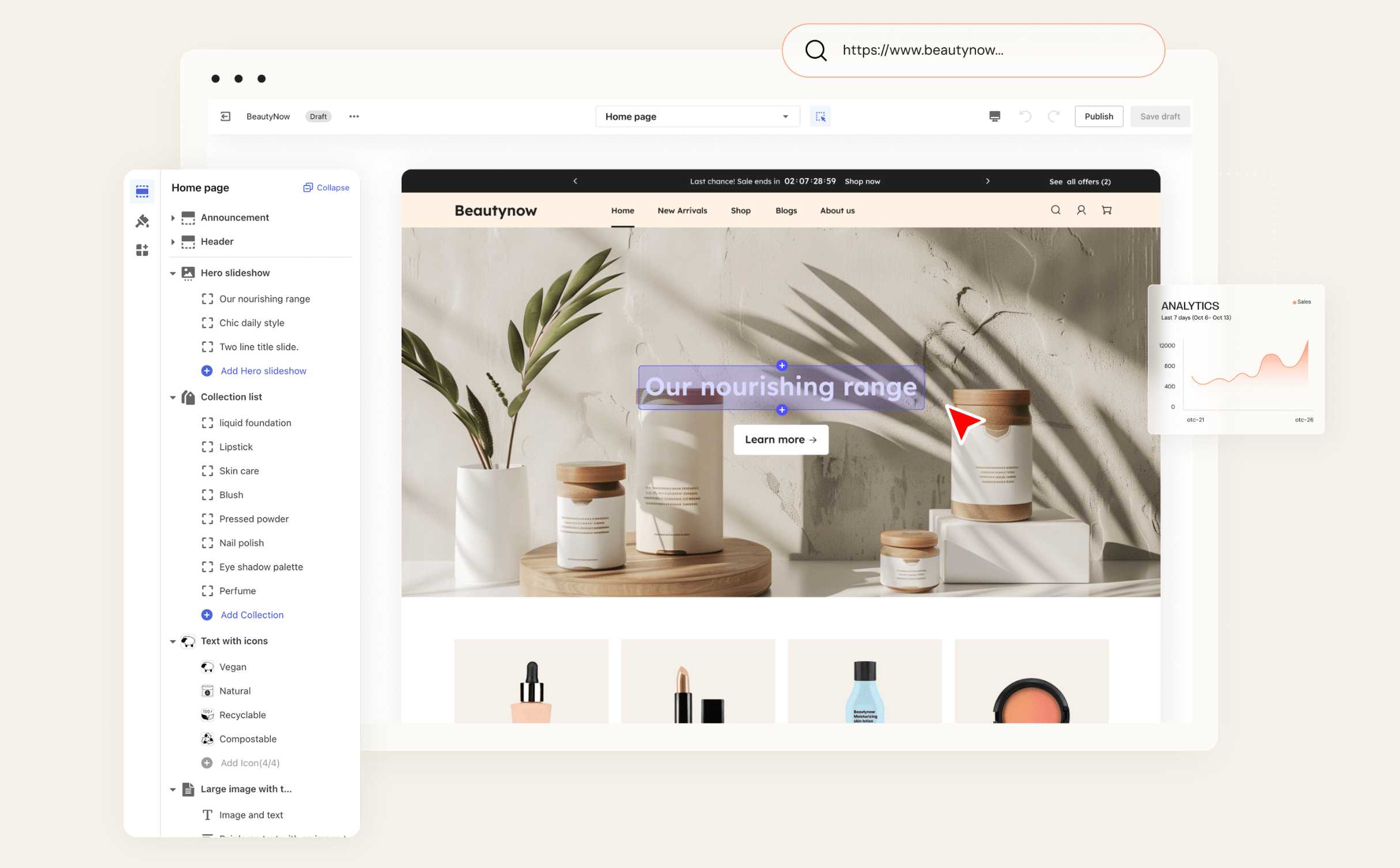
Shoplazza is a no-code store builder built specifically for cross-border e-commerce merchants. It supports multi-currency transactions, integrates with global payment gateways, and is designed with compliance in mind across multiple markets. With over 650,000 sellers on the platform, it is a proven option for merchants building independent international stores without requiring technical expertise.
The five store elements that most affect conversion
The global average e-commerce conversion rate as of mid-2024 is approximately 1.65%, according to data aggregated from IRP Commerce and other sources. For cross-border stores, where visitor trust is lower and shipping timelines are longer than domestic alternatives, new stores often start well below that benchmark. Getting these five elements right is the fastest way to close the gap.
- Trust signals above the fold. International shoppers have a higher baseline skepticism toward unfamiliar brands. Display trust indicators with Urgency Builder — security badges, privacy protection, and clear contact information — prominently on your product pages and at checkout. These are not decorative; they directly influence whether a shopper completes a purchase or leaves.
- Shipping ETA on the product page. Uncertainty about delivery time is one of the most common reasons shoppers abandon cross-border purchases. Do not make customers search for shipping information. State the estimated delivery window clearly on every product page, before the buyer reaches checkout. According to Capital One Shopping, 38% of cross-border online purchases are delivered within five days, and 55% within seven days. If your logistics can meet those benchmarks, say so explicitly.
- Returns policy, visible and simple. A clear, accessible returns policy reduces cart abandonment and increases purchase confidence. It signals to the buyer that you stand behind your product, even across an international border. Stating your policy on the product page itself — not buried in a footer link — makes a measurable difference.
- Social proof tailored to the market. Reviews and ratings are powerful for any e-commerce store, but their impact compounds when the reviews come from buyers in the same country as the shopper. If you have early buyers in Germany, display their reviews prominently for German visitors. User-generated content from real customers in the target market builds the kind of localized trust that generic brand copy cannot replicate.
- Mobile-first layout. Mobile commerce accounts for a dominant share of global e-commerce traffic. Your store must load correctly, display cleanly, and check out smoothly on a mobile device. Any friction in the mobile checkout flow is a direct loss.
Traffic generation: two channels, done well
The instinct when launching a new store is to be everywhere — TikTok, Instagram, Pinterest, Google, email, YouTube. In practice, spreading a limited budget and limited time across six channels produces mediocre results on all of them. The more effective approach is to choose two channels, execute them well, and add others once you have revenue to fund the expansion.
For most beginners, the two best starting channels are social commerce (primarily through short-form video and influencer content) and SEO. They complement each other well: social commerce generates faster early traction, while SEO builds compounding organic traffic over the medium term.
Social commerce: where your first customers actually come from
Social platforms have become genuine commercial channels, not just awareness tools. About 78% of TikTok users report having purchased a product after seeing it in a creator's video, according to data from Stack Influence (Source). That is an extraordinarily high purchase conversion rate for any awareness channel.
For beginners with limited budgets, the most efficient entry point into social commerce is micro-influencer partnerships. According to Later's 2025 Influencer Marketing Report, which surveyed over 1,000 creators and 200 U.S. marketers, 73% of brands prefer to work with micro and mid-tier creators because they offer the strongest engagement-to-cost ratio (Source). Micro-influencers — typically defined as creators with between 10,000 and 100,000 followers — charge a median cost-per-mille (CPM) of $119, compared to $300 or more for macro-influencers. Their engagement rates run between 6.15% and 6.76%, which significantly outperforms the 1 to 2% engagement typical of larger accounts.
Influencer Marketing Hub's 2025 data places the average ROI for influencer marketing at $5.20 for every $1 spent, with e-commerce brands achieving 6 to 10 times returns when attribution is tracked properly.
Platform selection matters, and it should be driven by your target market:
- TikTok leads younger audiences in the US, UK, and Southeast Asia.
- Pinterest delivers outsized results for home, garden, DIY, and lifestyle categories — Later's research found Pinterest achieving 11% engagement for home and lifestyle content, giving posts a longer shelf life than most other platforms.
- Instagram remains strong across most markets for visually oriented products.
When running micro-influencer campaigns, use unique discount codes or tracked UTM links for every creator partnership. This allows you to measure actual purchase conversions from each collaboration rather than relying on engagement metrics alone, which do not always translate to sales.
SEO: the slow burn that compounds
SEO takes three to six months to show meaningful organic traffic growth in a new market, according to Charle Agency's international ecommerce SEO guide (Source). That timeline makes it a poor fit for anyone who needs results this week. But it is an extremely good fit for anyone who wants to build a sustainable business, because once organic rankings are established, the traffic is essentially free.
For cross-border stores, international SEO has specific technical requirements beyond standard on-page optimization:
- Hreflang implementation. Hreflang tags tell Google which language and regional version of a page to serve to users based on their location and language settings. Without them, Google may serve the wrong version of your store to international visitors, or fail to index your regional pages at all.
- Localized keyword research, not just translation. This is where many cross-border sellers make a costly mistake. Translating your existing keywords word-for-word into another language does not produce the terms that shoppers in that market actually use. A UK shopper searches "mobile phone accessories" while a US shopper searches "cell phone accessories." In markets where English is not the primary language, the divergence is even greater. Research actual search terms in each target market using tools like Google Keyword Planner with the target country selected. Build product pages around those terms, not machine-translated versions of your home-market keywords.
- Localization beyond translation. Localization means adapting your content to fit the cultural context of each market — adjusting pricing display, trust signals, references, and tone — not simply running pages through a translation tool and publishing them.
Conclusion: a 30-60-90 day action plan
The cross-border opportunity in 2026 is genuinely significant. The market rewards sellers who move with focus and preparation, not those who move fastest with the least planning. Here is a concrete 30-60-90 day framework to move from zero to first sale:
- By day 30: Complete your niche validation using the demand-competition test. Run the margin reality check on your top three product candidates. Select one product and one target market. Build and launch your independent store using a no-code builder like Shoplazza and register your store with Google Search Console and submit your sitemap.
- By day 60: Identify five to eight micro-influencers in your target market whose audience matches your product niche. Launch your first two or three gifted collaborations. Begin keyword research for your target market and optimize your top three product pages for three to five long-tail search terms each. Implement hreflang tags if you are targeting more than one language or country. Review your Search Console data for early impressions.
- By day 90: Analyze which influencer content drove the most traffic and orders. Reinvest in the creators who performed and let the others go. Check your organic keyword rankings and look for any pages that have moved to page two of the search results. They are your priority for link-building or content improvement. Use your first real sales data to refine your product page copy, improve your checkout flow, and assess whether your margins are holding up against actual shipping and return costs.