Many sellers wonder the same thing when considering an AI website builder: Will Google actually index my site? Can it rank? Is SEO even worth doing?
The short answer is yes. AI-generated websites are SEO-friendly at the foundational level and can be indexed by Google. But building a site and doing SEO well are two different things. AI can get you a structurally sound, fully functional website fast. The harder work, like keyword strategy, content quality, and link building, still needs a human hand. This guide covers both sides and shows you how to combine AI and manual effort to get real SEO results.
AI website builders vs. traditional options: where do they start with SEO?
There are three main ways to build an ecommerce website, and each one starts from a very different SEO baseline:
- SaaS website builders (like Shoplazza AI and Wix AI): The underlying templates are already mobile-responsive and code-optimized. Out of the box, your site meets Google's basic crawling requirements. Built-in tools handle TDK configuration and structured data, so you don't need to deal with technical details manually. The trade-off is limited code customization, which means less SEO flexibility. That said, it's a solid starting point for small to mid-sized sellers.
- Open-source platforms (like WordPress): You get full code control and access to professional SEO plugins like Yoast and Rank Math, which means a higher SEO ceiling. The downside is that the setup takes more work. Many beginners run into issues like missing sitemaps, misconfigured robots.txt files, or slow page speeds. If these problems go unnoticed, they directly affect how well Google can crawl and index your site.
- Custom development: A dev team builds everything from scratch based on your business needs. SEO control is at its highest here. This option works best for established brands that need a fully tailored user experience. It takes longer and costs more, so it's usually not the first choice for smaller sellers.
Among the three, SaaS website builders offer the fastest and most stable SEO starting point. Open-source platforms have a higher ceiling, but only if you have the skills or resources to set everything up properly. Custom development makes more sense once your business has reached a certain scale.
Where AI website builders are actually good for SEO?
Here are the areas where AI-built sites have a clear advantage over traditional approaches.
Page structure that Google can actually read
Google's crawler, Googlebot, reads your page's HTML structure to understand what your content is about. It looks at heading tags like H1 and H2 to identify the main topic, uses URL paths to understand page hierarchy, follows internal links to discover more pages, and checks how the site performs on mobile.
When the structure is messy, for example, H1 tags are missing, URLs are full of random parameters, or the mobile layout is broken, the crawler struggles to make sense of the page. That affects both indexing and rankings.
Most AI-generated pages handle this well by default:
- Clear heading hierarchy: H1 is used for the main page title, with H2 and H3 organized by content level. Googlebot can read the structure directly.
- Clean URL structure: Product and category pages follow readable paths like /products/product-name, without parameter strings like ?id=123&ref=456.
- Complete internal linking: The homepage links to category pages, which link to product pages. Googlebot can follow these links to discover every page on your site.
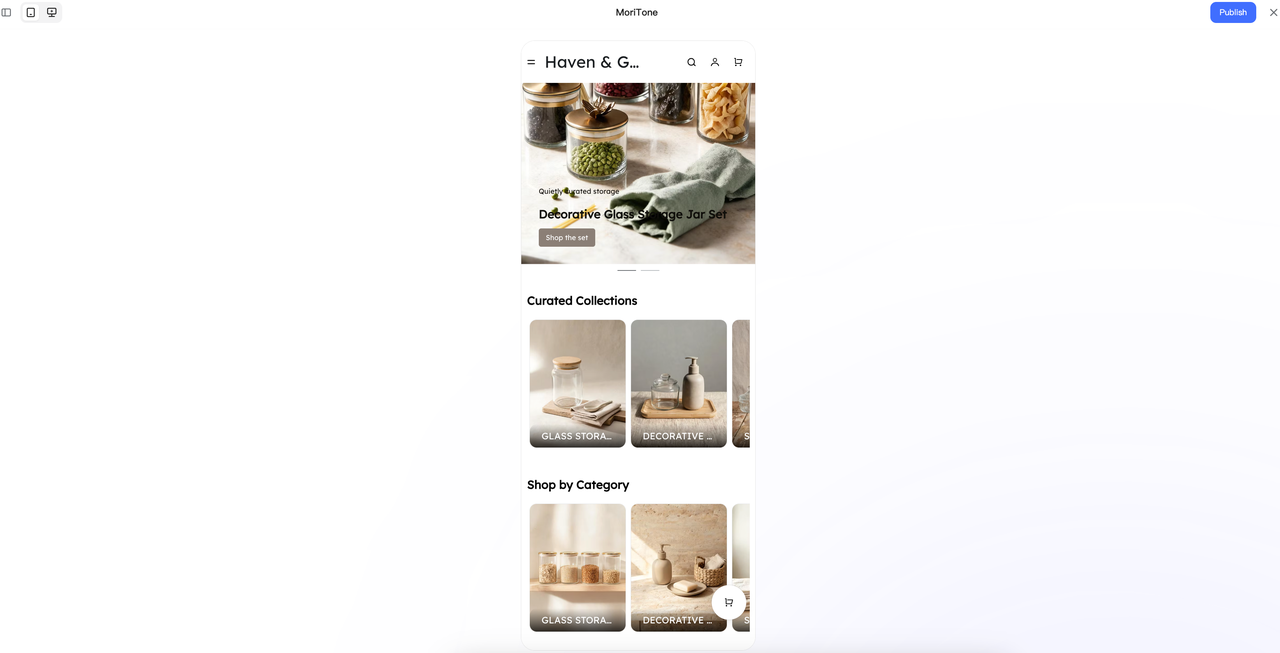
- Responsive design: Pages display properly on both mobile and desktop. Google uses Mobile-First Indexing, meaning it crawls and evaluates the mobile version of your site. If the mobile display breaks, rankings can drop. Shoplazza AI online store builder is automatically mobile-optimized with no extra adjustments needed.
TDK gets filled in from the start
Meta title and meta description are what users see in Google search results. They directly affect whether someone clicks on your link. Many new sellers either leave these fields blank or use the same description across every page. Both situations hurt SEO performance.
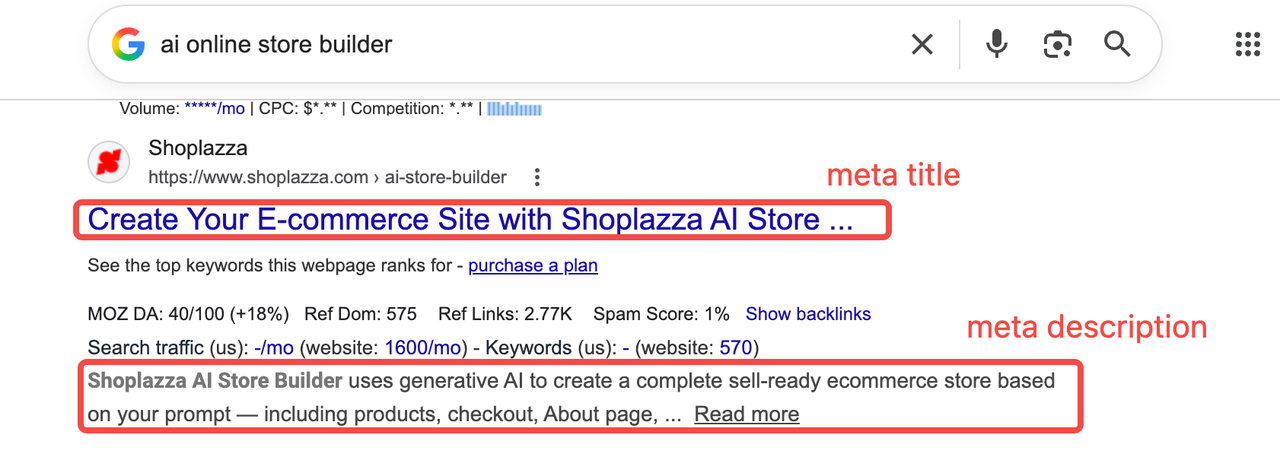
AI website builders fill in these fields during the site generation process, so you're not starting from zero. Shoplazza AI store builder, for example, automatically generates TDK for each page when it builds your store.
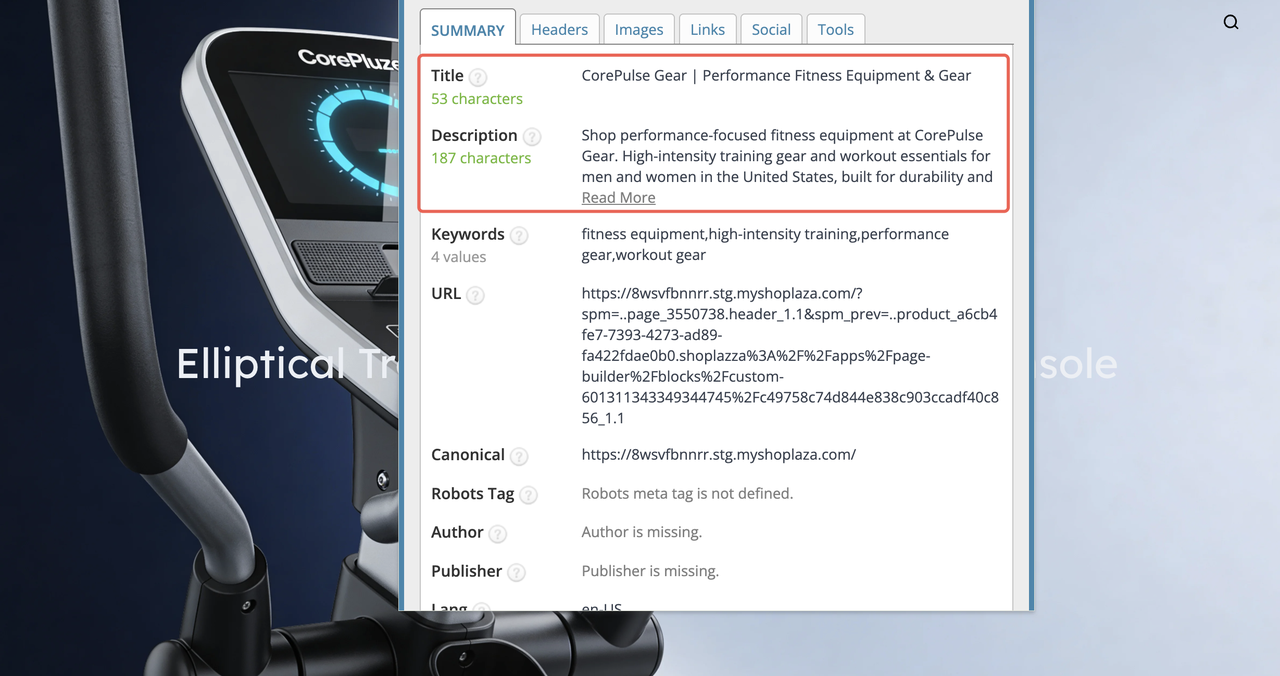
That said, treat AI-generated TDK as a first draft, not a final version. You still need to check that the keywords are accurate, the meta title stays within 60 characters, and the meta description lands around 156 characters and clearly describes what the page is about.
Technical SEO basics are covered
Technical SEO involves a lot of moving parts: generating and submitting a sitemap.xml, optimizing images, adding JSON-LD structured data so search results can display richer product information, setting canonical tags to prevent duplicate content issues. For beginners, each of these is easy to miss.
SEO Optimizer can handle most of this automatically. Features like sitemap auto-generation, bulk image Alt text setting, JSON-LD markup, and landing page SEO analysis are often built into these tools and run without manual input once installed.
If you're comfortable with code, you can go further. Setting canonical tags manually prevents duplicate indexing when multiple URLs point to the same content. Compressing images and trimming unnecessary scripts helps with Core Web Vitals (aim for LCP under 2.5 seconds and CLS under 0.1). Adding Product Schema to product pages lets search results show price, stock status, and ratings directly.
Speed to market matters for SEO timing
Some SEO opportunities are time-sensitive. New product launches, peak season campaigns, holiday promotions: these windows don't wait. Traditional outsourced development takes weeks. AI website builders can have a site ready in hours.
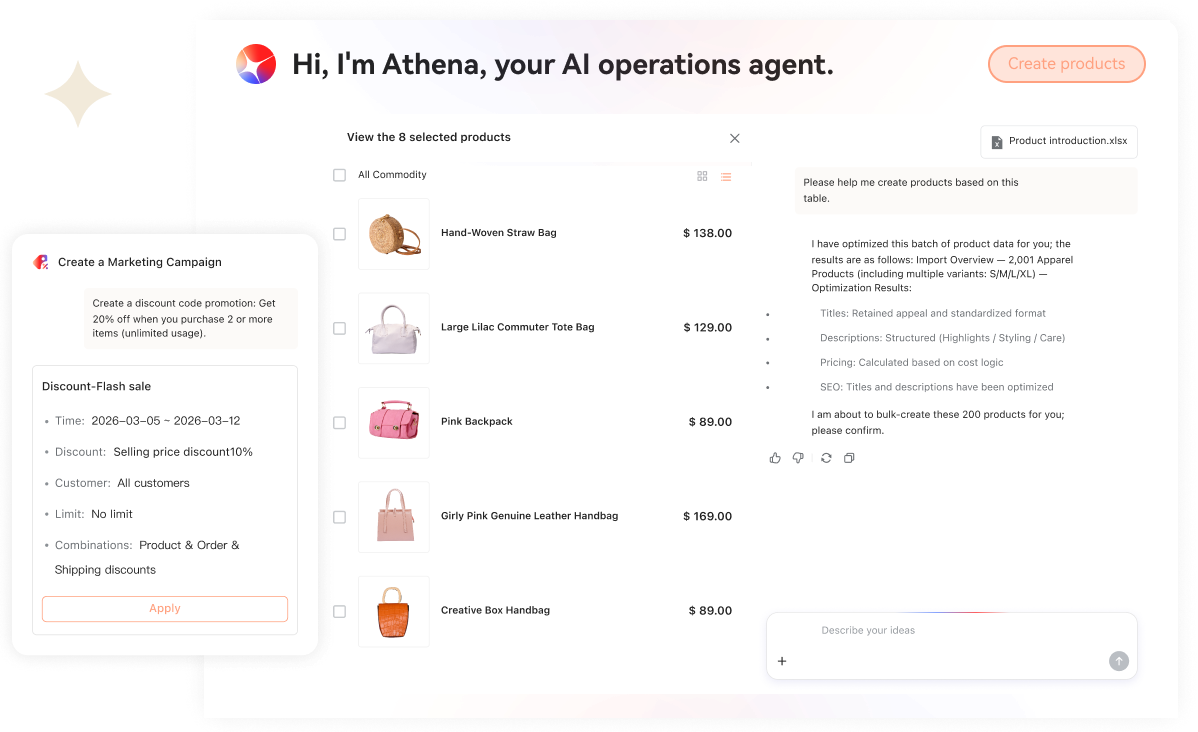
With Shoplazza AI, entering a simple prompt generates a fully functional online store in 5 to 10 minutes, complete with a homepage, product pages, checkout flow, and payment integration. After that, the Athena AI agent for ecommerce can handle product uploads, store data analysis, and product description optimization, cutting down the time from site launch to active operations.
Does Google penalize AI content? How much of it actually ranks?
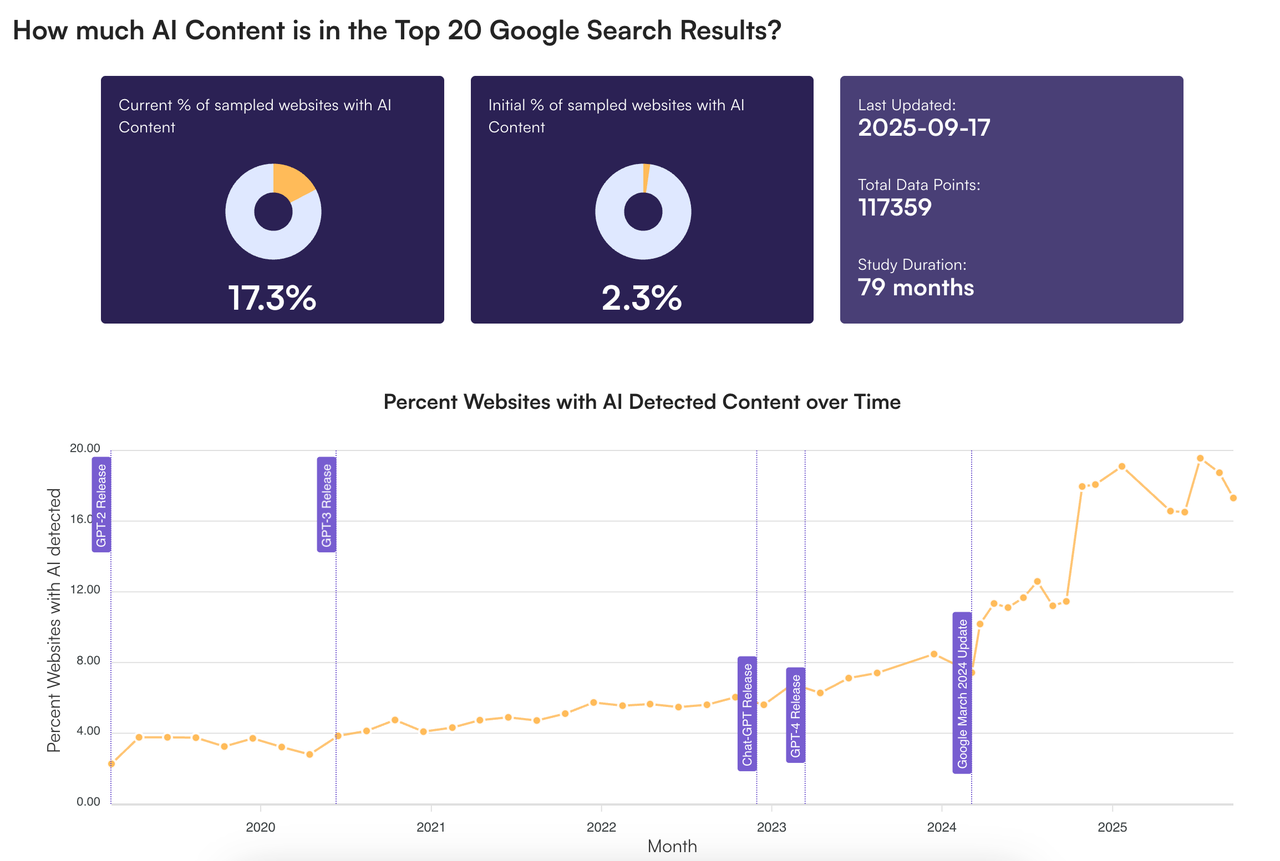
Many sellers assume Google punishes AI-generated content. The data tells a more nuanced story. According to ongoing research by Originality.ai:
| Time period | AI content share in Google top 20 results |
| February 2019 | 2.27% |
| December 2023 | 8.48% (peak at the time) |
| After March 2024 core update | 7.43% (noticeable drop) |
| July 2025 | 19.56% (all-time high) |
| September 2025 | 17.31% (slight decline) |
The overall trend is upward, but it's not a straight line. The March 2024 core update brought AI content share down from 8.48% to 7.43%, which shows Google does apply quality filters to AI content.
Source: originality.ai
In 2026, Google's position became even clearer. In March, Google rolled out both a spam update and a core update. The spam update targeted bulk AI content that lacked genuine editorial review. The core update tightened E-E-A-T standards, requiring content to have a credible author background rather than just a name attached to it. Then on May 21, 2026, Google launched its second core update of the year, designed to better surface relevant and satisfying content across all types of websites.
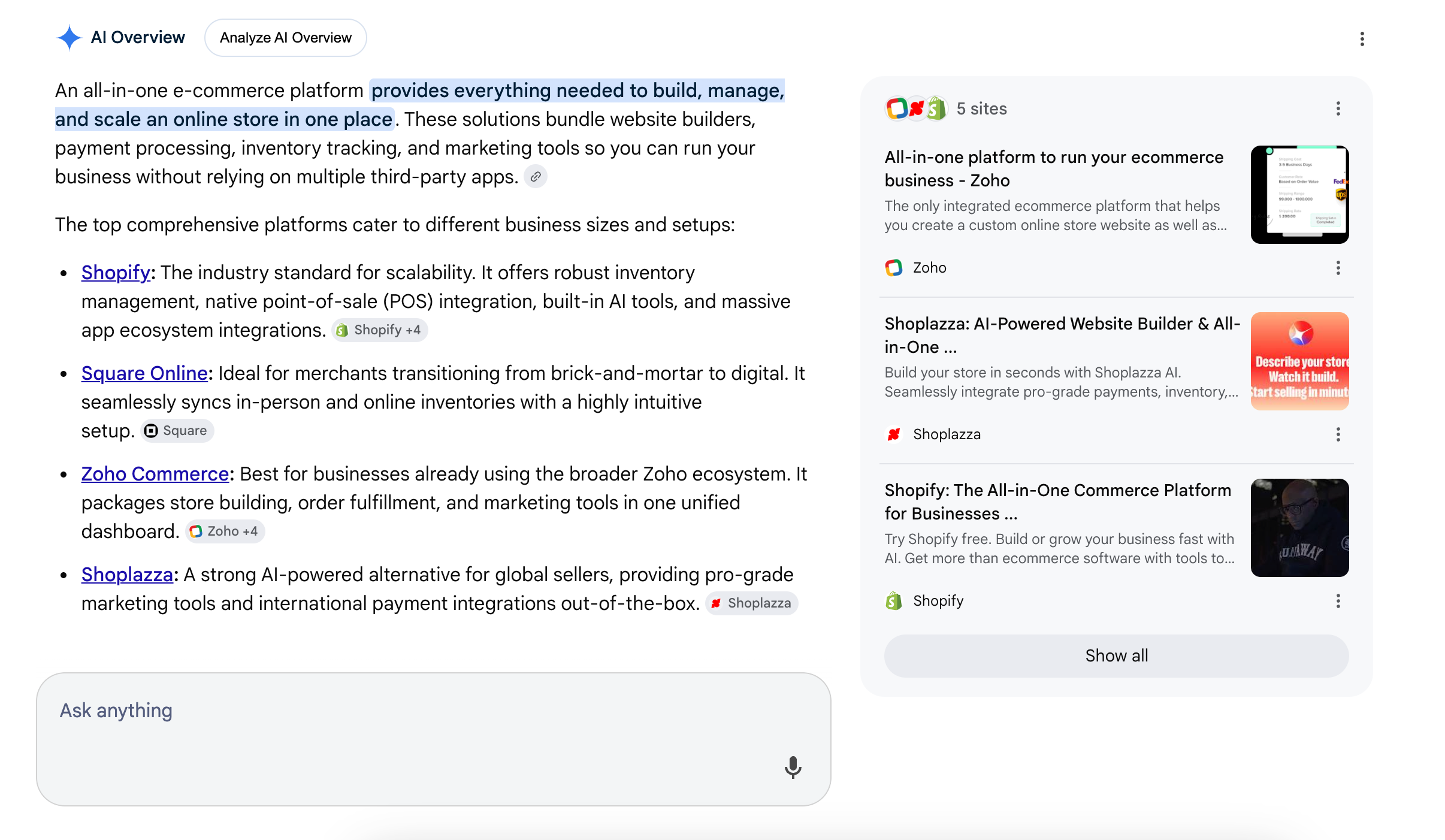
But the overall upward trend in AI content share tells the other side of the story. Google is not against AI content. It's against content with no value. Google itself uses AI Overview extensively to answer user queries. What gets filtered out is content that's mass-produced, lacks original information, and offers nothing useful to the reader, regardless of whether a human or an AI wrote it. In practice, sellers who add real product experience, specific use cases, and practical solutions to their AI-generated drafts tend to do fine. That kind of content gives readers something they can actually use.
AI Overview
Where AI website builders fall short on SEO?
AI handles the technical foundation well. But the parts of SEO that actually drive rankings are a different story.
Content that looks the same as everyone else's
Many sellers use similar prompts to generate product descriptions and end up with nearly identical content across different stores. Only the product name changes.
Google's Helpful Content system asks a straightforward question: does this page give users something they can't find anywhere else? If your product pages look the same as a dozen competitors', rankings will reflect that.
You might not notice this at first. But over time, pages with no original angle tend to get pushed down. The fix is straightforward: add what only you know. Why did you choose this product? What do buyers ask most often? How do you handle returns? These details are things AI cannot generate, and they're exactly what Google considers valuable.
Keyword strategy needs to happen before you build
AI website builders generate the site structure. They don't tell you which keywords to target or which pages need their own SEO focus. Many sellers finish building and then realize their page titles and URLs contain none of the terms their buyers actually search for.
It helps to do keyword research before you start building. Tools like Google Keyword Planner or Ahrefs can help you identify 3 to 5 core keywords. Build your page titles, URLs, and content structure around those terms from the beginning. Fixing this after the fact takes much more effort.
Backlinks require active outreach
Backlinks are links from other websites pointing to yours. They signal to Google that your content is credible, and in competitive product categories, they carry significant weight. No AI website builder can earn these for you.
Common approaches include publishing genuinely useful blog content, collaborating with niche creators or product reviewers, and seeking coverage from industry publications. Quality matters more than quantity here. A few links from relevant, authoritative sites outperform dozens of low-quality ones. Purchased backlinks often do more harm than good and can trigger Google penalties.
How to divide the work between AI and human effort?
Many sellers assume that using an AI website builder means SEO is handled. It's not quite that simple. AI gets you indexed. Ranking well requires human strategy. Here's a practical breakdown:
| Area | What AI can do | What still needs a human |
| Page structure | Auto-generates responsive layout | Check that H1/H2 hierarchy makes sense |
| Product descriptions | Generates a first draft | Add real details, unique selling points, customer feedback |
| Meta TDK | Generates reference copy | Check keywords, control character count |
| Blog content | Generates structure and draft | Add data sources, personal experience, brand perspective |
| Keyword strategy | Cannot replace human judgment | Fully manual — AI doesn't know your competitive landscape |
| Link building | Cannot replace human outreach | Fully manual — requires active relationship-building |
| Technical SEO basics | Handles most automatically | Review the checklist to confirm everything is in place |
Which sellers are a good fit for AI website builders?
AI website builders aren't the right answer for every stage of business. But for certain types of sellers, they're a genuinely efficient option.
- New sellers just getting started: Limited budget, no tech team, no coding background. This describes most people starting out in cross-border ecommerce. An AI website builder lets you launch a fully functional store for the cost of a domain and a monthly subscription, without waiting on an agency or learning to code. At this stage, the goal is to get through the full sales cycle once. SEO is about laying the groundwork, not chasing rankings from day one.
- Sellers testing a new product or market: You already have a main store, but you want to quickly launch a landing page for a new product category or test how a new market responds. AI website builders keep the cost of experimentation low, and they don't interfere with the SEO authority you've built on your main site.
- Sellers in focused niche categories: If your product focus is very specific, like outdoor pet gear or a particular type of home accessory, your audience's search intent is clear and your content structure is straightforward. That's a strong setup for pairing an AI-built site with targeted keyword planning to establish category authority efficiently.
- Sellers managing multiple stores: Some sellers run multiple product lines or target multiple markets simultaneously, which means building several sites at once. AI website builders significantly reduce the time and cost per site, making a multi-store strategy more practical.
10 SEO tasks to complete after launching your AI-built site
Launching the site is step one. Many sellers go live and then discover weeks later that Google hasn't indexed them yet. Usually it's because basic configuration was skipped. Work through this list in order:
- Submit your site to Google Search Console and verify ownership
- Generate and submit your sitemap.xml so Google can discover all your pages
- Check your robots.txt file to confirm it isn't accidentally blocking product or category pages
- Write a unique Meta Title and Meta Description for each core page — don't use the same copy across the whole site
- Make sure each page has only one H1 tag, and include the page's target keyword in it
- Add Alt text to every product image — describe the image naturally and include a relevant keyword
- Run your pages through Google PageSpeed Insights and aim for a score above 70
- Set up 404 pages and 301 redirects to prevent broken links from interfering with crawling
- Confirm that HTTPS is active and your SSL certificate is valid — most AI website builders enable this by default
- Test your mobile display using Google's Mobile-Friendly Test to make sure everything renders correctly on smaller screens
Conclusion
AI website builders lower the barrier to getting online. They handle the technical foundation so you don't have to spend weeks coordinating with an agency or debugging code. That's genuinely useful. But SEO hasn't changed at its core. Google wants to show users content that actually helps them, not content that just looks like it might. AI builds the structure. What you put inside it is still your responsibility. Launch fast with AI, then invest in content quality, keyword planning, and link building over time. That combination is what leads to sustainable organic traffic for ecommerce sellers.
Frequently asked questions about AI-generated websites and SEO
Q: Can Google index an AI-generated website?
Yes. Google indexes AI-generated sites the same way it indexes any other site. What affects indexing quality and ranking performance is the content itself. Original product descriptions, pages with a distinct point of view, and information that genuinely helps users are what Google wants to crawl and recommend. If your site relies heavily on unedited AI output with no original angle, indexing results tend to be weaker. That's not about the tool you used to build the site. It's about content quality. Submitting a sitemap and verifying ownership in Google Search Console helps Google find your pages faster, but long-term indexing and ranking depend on originality and usefulness.
Q: Will AI-generated content get penalized by Google?
Publishing raw AI output without editing carries real risk, especially after the 2025 and 2026 algorithm updates, which have become better at identifying content that lacks originality. Google's standard isn't about who wrote the content. It's about whether the content is useful. Adding accurate information, real examples, and your own perspective to an AI draft is the most effective way to reduce that risk.
Q: What's the difference between SEO tools in an AI website builder and professional SEO tools?
SEO features in AI website builder handle the basics: can the site be indexed, does it have TDK, has the sitemap been submitted. Professional tools like Ahrefs and Semrush address strategy: which keywords to target, how competitors are ranking, which pages need improvement. The two are complementary. Start with what's built into the platform, then bring in dedicated tools once your store is stable and you're ready for deeper analysis.
Q: I'm already using an AI builder to generate a website. Where do I start with SEO improvement?
Start with the 10-item checklist above and go through it one by one. The changes that tend to show results fastest are: writing unique Meta TDK for each core page, fixing missing Alt text on product images, improving the unique selling points in product descriptions, and submitting your site to Google Search Console. Once those are done, Google has a much clearer picture of what your site is about.
Q: Is AI website building a good foundation for long-term SEO?
It can be. If you launch a site and then leave the content unchanged, the SEO gains will be limited. But if you build on top of that foundation by publishing useful blog content regularly, planning a keyword strategy, and earning backlinks over time, you can build meaningful organic traffic. The platform gives you the starting point. What you do with it determines how far it goes.