Building a store that could actually sell things used to mean hiring a developer or wrestling with templates for weeks. Now, AI store builders let you describe what you want in a sentence and get a working store, complete with product pages and checkout, in minutes. But the tools behind that promise differ a lot in how they bill for AI, how deep their features go, and who they're really built for, and picking the wrong one can cost more in switching fees than you saved on the subscription. This AI store builder comparison puts two platforms that both promise a fully generated store, Shoplazza and Genstore, side by side. We'll walk through what each one actually offers, then help you match that against your budget, order volume, and goals.
Who are Shoplazza and Genstore built for?
- Genstore fits sellers with a tighter budget who want a low-effort way to get started and are comfortable letting AI handle most of the execution.
- Shoplazza tends to work better for sellers who want to run cross-border ecommerce seriously, need full payment and operations support, and plan to expand into multiple markets or build a brand.
- The biggest difference between the two comes down to AI billing. Shoplazza bundles unlimited AI usage for Athena AI Operations Assistant into its subscription, while Genstore runs on a credit system that requires top-ups once you use up your monthly allowance.
- On the building side, Shoplazza lets you preview a finished store without creating an account and gives you both a template and an AI path, while Genstore usually asks you to sign up before you can try its AI builder.
This comparison matters because it's easy to treat AI store builders as more or less interchangeable, judging them mainly on generation speed or template looks. What actually shapes your long-term costs and day-to-day efficiency tends to be less visible: how AI usage gets billed, how smoothly payments work, how many markets you can open, and whether your order volume will eventually bump up against a plan's limits. Here's how the two compare in detail.
Shoplazza vs Genstore at a glance
| Dimension | Shoplazza | Genstore |
| Store building | Templates or AI builder (chat, image upload, paste a store URL), with an agent team assisting on operations | AI conversational builder, with an agent team assisting on operations |
| Entry barrier | No sign-up needed to try the AI builder; full preview available | Sign-up required before you can try it |
| AI billing | AI agent usage included in the subscription, unlimited | Credit system, monthly allowance, top-up when exceeded |
| Built-in marketing and operations | Broad coverage, mostly free and built in | Delivered through apps and agents |
| Native payments | Integrated payments plus its Shoplazza Payments, with smart retry for failed payments | Integrated payments plus its Genstore Payments, supporting credit card and PayPal |
| Multi-market | Supports 50 international markets, 100+ language translation | Supports 1 to 5 markets depending on plan |
| Dropshipping sourcing | CJdropshipping, EPROLO, and others | DSers |
| Maturity | Founded 2017, 650,000+ sellers | Newer, site copyright dated 2025 |
| Entry price (monthly) | 7-day free trial; Basic $39/mo ($29.25/mo billed annually) | Free plan available; Lite $25/mo |
| Fee structure | Subscription + transaction fee | Subscription + credits + transaction fee |
What is Shoplazza?
Shoplazza is a cross-border ecommerce platform founded in 2017, built for merchants selling to a global B2C audience. By 2026, the platform had moved well past being just a store builder, building out a full AI-native operating system for ecommerce under the idea of taking a seller from a single prompt all the way to a sale.
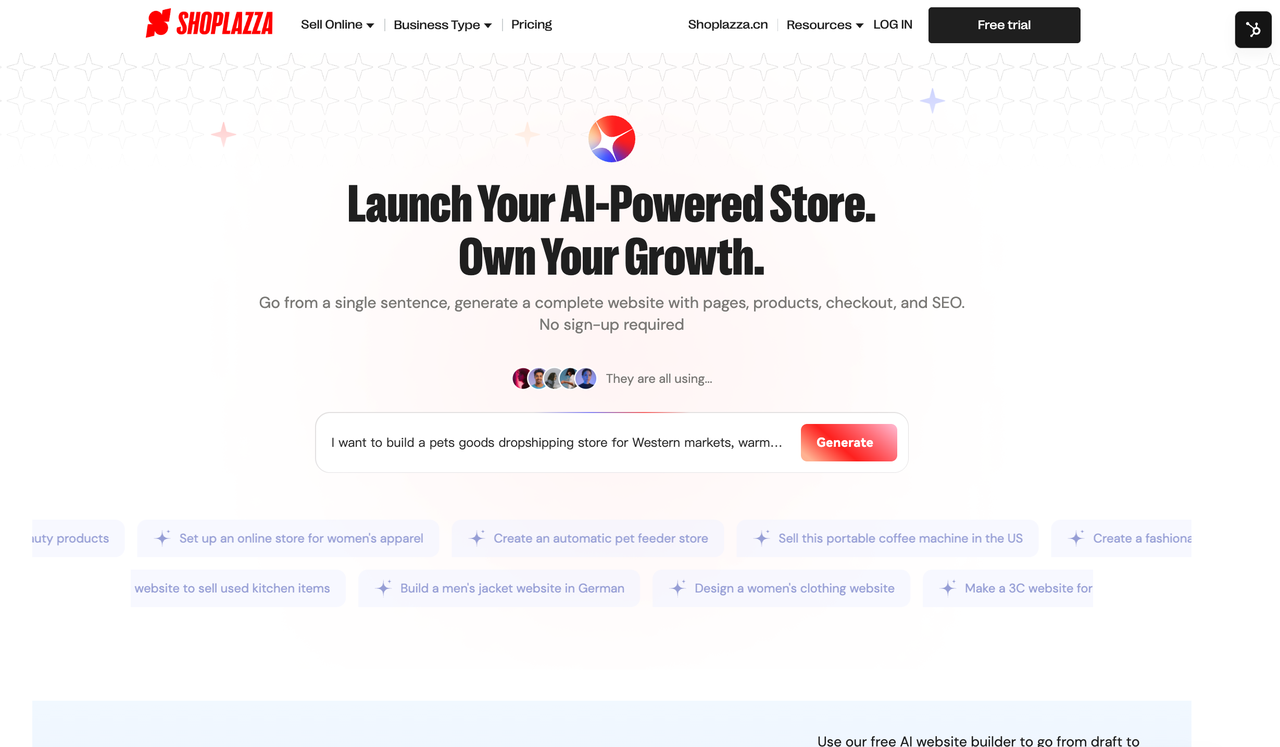
That shows up as a handful of AI agents and automation tools that cover the full path from opening a store to running it day to day:
- Shoplazza AI Store Builder generates a full store from a conversation, an image, or a URL. It first shows you a few style directions to pick from, then builds out the homepage, product pages, policy pages, and checkout in one pass.
- Athena, an AI assistant for ecommerce operations, pulls together and analyzes store data and can act on the backend directly, handling things like product updates, discounts, shipping setup, and bulk order fulfillment.
- LazzaStudio, an AI product image tool built on GPT Images 2.0, turns a plain product photo into commercial-grade images across different backgrounds and scenes, supports 2K and 4K resolution, and can batch-process multiple SKUs at once.
The platform has served more than 650,000 cross-border sellers to date.
Who is Shoplazza a good fit for?
Shoplazza tends to suit sellers who are serious about the business itself and care about platform stability and how complete the ecommerce feature set is. That breaks down into a few groups:
- First-time sellers who want to get a store live quickly can lean on the AI agents to launch and start operating faster.
- Sellers without their own inventory who plan to run dropshipping or print-on-demand can move faster thanks to built-in supply chain connections.
- Sellers who already have some traction but need stronger promotion tools can fill that gap with Shoplazza's marketing and ad toolset.
- Growing brands running multiple international markets at once can manage them from one place using the platform's multi-market and localization tools.
- Merchants with B2B wholesale needs can also find a matching plan and feature set.
If your goal is to sell globally and build something that lasts, Shoplazza's feature depth, stability, and value tend to work in your favor.
Shoplazza's strengths and trade-offs
Its strengths mostly show up in features and support:
- It offers a wide range of payment options and holds PCI DSS v4 security certification. You can also use its own payment processor, Shoplazza Payments, which includes smart retry and automatic failover for failed payments to help recover sales that might otherwise be lost.
- It connects directly with Meta, Google, and TikTok, letting you link accounts from the backend and pull conversion data back in.
- It supports automatic translation across 100-plus languages and automatic currency switching, and lets you open up to 50 international markets.
- Marketing tools like discounts, coupons, product reviews, abandoned cart recovery, and product recommendations come built in at no extra cost.
- It provides live human support, which is genuinely useful when you run into a setup issue or a real operational problem.
There are trade-offs worth knowing too:
- There's no free plan that lets you sell indefinitely at no cost. Selling for real requires a paid plan.
- Its AI store builder is mainly geared toward product-based stores, so it's a weaker fit if you're building a blog, portfolio, or local service site.
What is Genstore?
Genstore is a newer AI store builder that launched out of Southern California in 2025. It's built around the idea that no founder should have to build alone, with the goal of getting a store live in minutes rather than weeks.
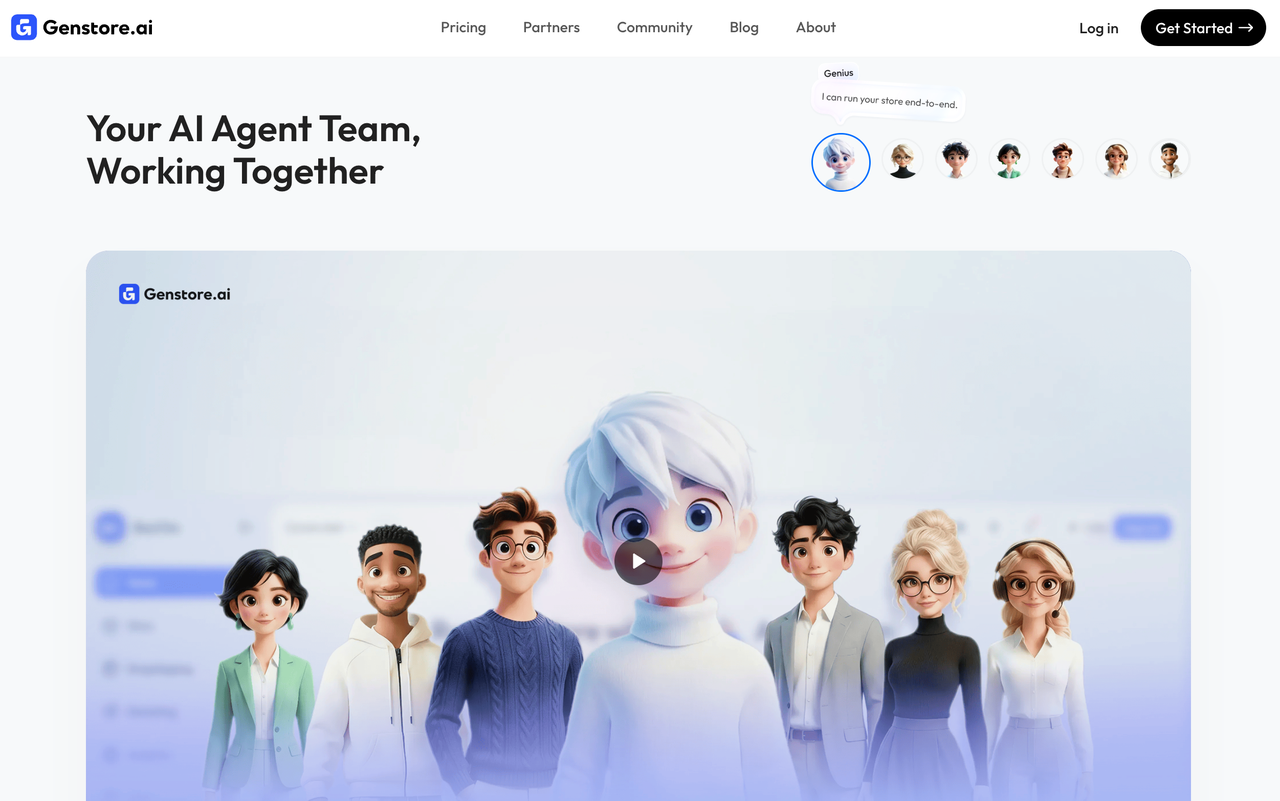
Like Shoplazza, Genstore runs its whole flow, from building to ongoing operations, through AI agents. The difference is in the structure: Genstore splits the work across a team of seven agents, each handling a specific job as you describe what you need:
- Genius oversees the whole operation and can run your store end to end.
- Malik handles setup, getting the essentials in place before launch.
- Dean handles design, shaping your store's pages and visual identity.
- Sara manages products, curating your catalog and flagging items with breakout potential.
- Olivia runs marketing, launching and tuning growth campaigns.
- Harvey works with data, turning it into concrete next steps.
- Ella helps you pull the store together.
The platform leans hard into a low-cost, low-effort pitch. You give it a one-line description, and it generates a store ready to sell.
Who is Genstore a good fit for?
Genstore tends to suit sellers on a tighter budget who want to test the waters and are comfortable handing execution over to AI. That breaks down into a few groups:
- Sellers looking to sell digital products.
- Part-time sellers working around a day job, who can add trending TikTok products and sell at their own pace.
- Content creators trying to turn TikTok or Instagram traffic into orders, since store and content can be connected directly for social selling.
- Early-stage sellers who like to test products quickly, since new items can be added in a few steps without holding inventory upfront.
If you'd rather not get into the weeds and are fine letting AI run the execution, Genstore's guided experience has a genuinely low barrier to entry.
Genstore's strengths and trade-offs
Its strengths also show up in features and support:
- It's fully conversational. You describe what you want, in plain language, for both the initial build and any later changes, with almost no manual interface work required.
- The build process lets AI recommend dropshipping products and add them straight to your store, so sourcing and listing happen in one smooth flow.
- It supports sales channels like TikTok and Amazon, which lines up well with a creator-led selling approach.
- Conversion features like smart search filters, wishlists, and free-shipping banners come built in, along with automatic membership rewards.
There are trade-offs too:
- It's a newer product with a smaller app ecosystem, and there's less public data on long-term stability.
- AI usage runs on a credit system, so costs get harder to predict the more you rely on it.
- Genstore is upfront that it's not built for sellers who want to fine-tune every pixel, trading precise control for speed.
Feature comparison: Shoplazza vs Genstore
With both platforms introduced, here's how they actually compare across the features that shape day-to-day store building and running: setup flexibility, AI billing, dropshipping, marketing, multi-market support, and payments.
Store building and design flexibility
- Shoplazza gives you two paths into building a store: templates and AI generation, both previewable without an account.
- Genstore leans entirely on AI conversation, and you typically need to sign up before you can try it.
Shoplazza's ecommerce template path lets you start from an industry theme, whether that's apparel, home goods, or electronics, all free to use, then edit text, images, and layout in an interface that feels close to editing a slide deck. Its AI path works through conversation: you describe what you're selling and where, and the AI follows up with questions about store style, brand name, and niche, usually offering three suggested answers at a time so you're rarely typing from scratch.
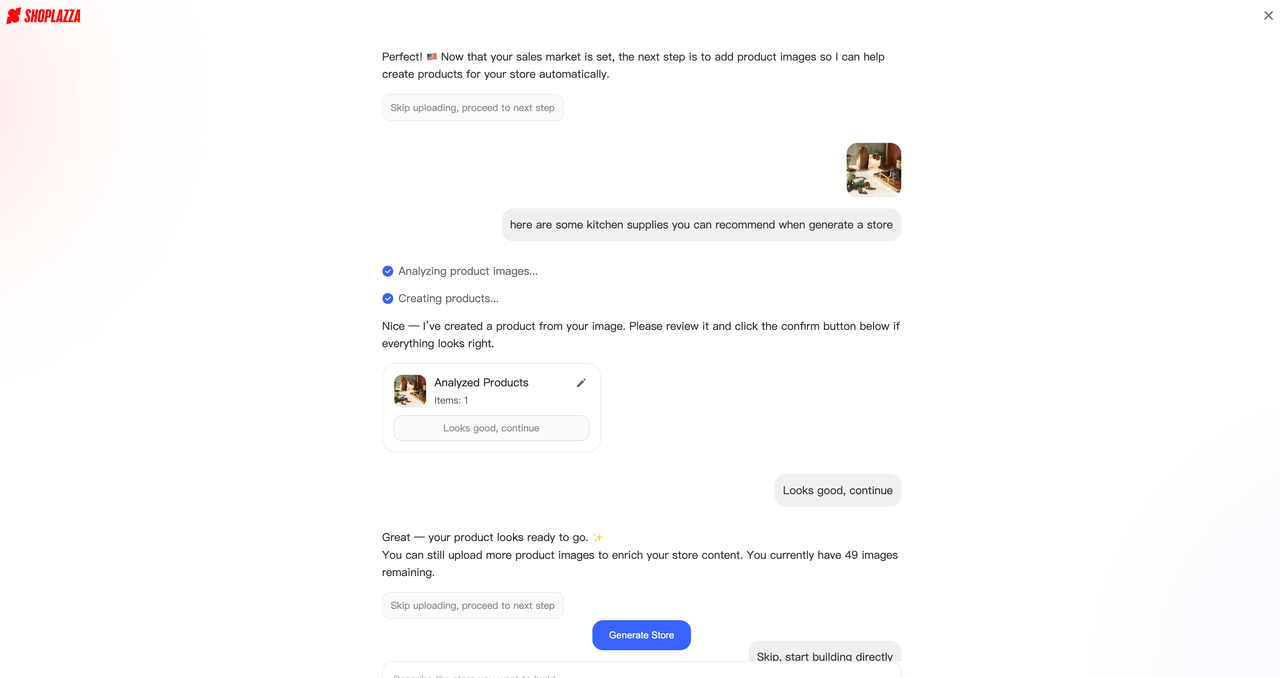
If you already know your product, you can upload it or hand over a reference URL, and the AI pulls in product details and style cues before generating a complete store, homepage, product pages, policy pages, and checkout, in one pass.
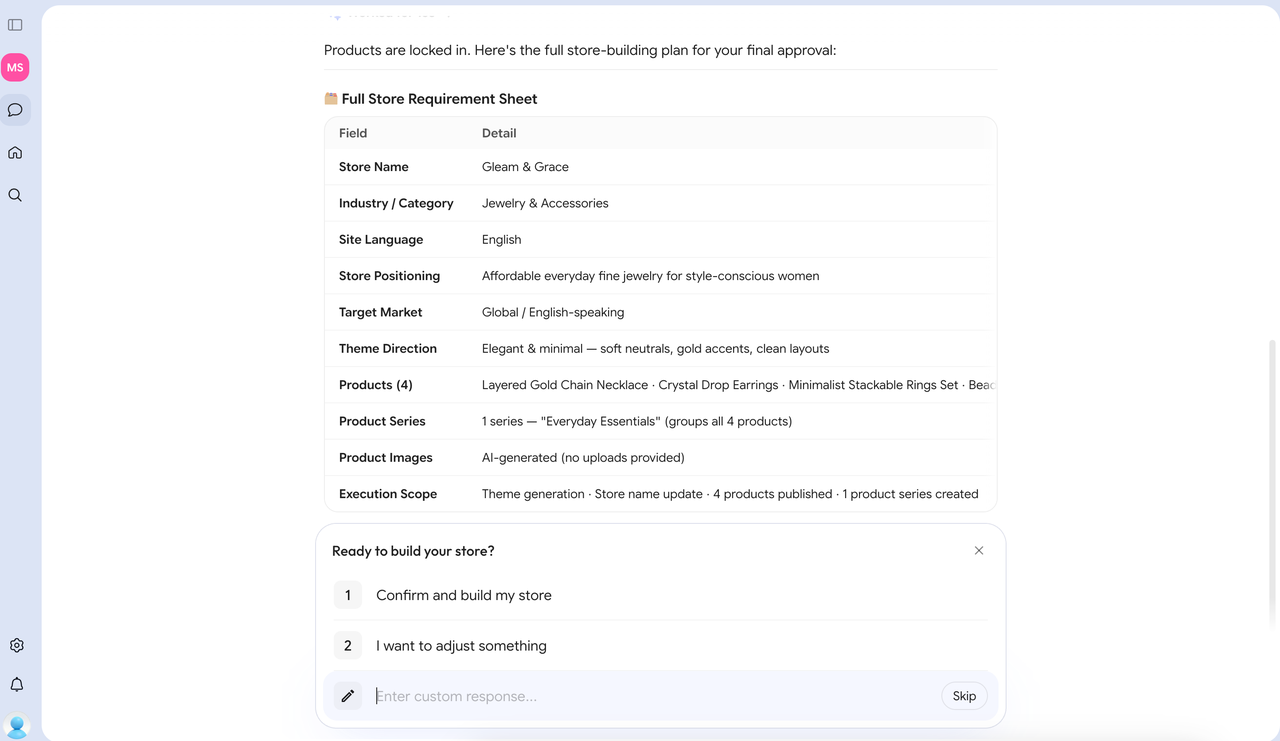
Genstore's flow starts by asking who you are, an Amazon seller, a creator, an influencer, or a general ecommerce seller, then which category you want to sell in. Based on that, it suggests initial products for you to confirm or adjust. Once confirmed, it builds out a full store brief covering store name, category, site language, positioning, target markets, theme, and the scope of products and tasks to handle.
If you're planning to dropship, Genstore can recommend real dropshipping products by category, complete with pricing and supplier links, though the free plan caps you at 10 products. Once the store details and products are confirmed, generating the store takes about as long as it does on Shoplazza, and neither requires any code.
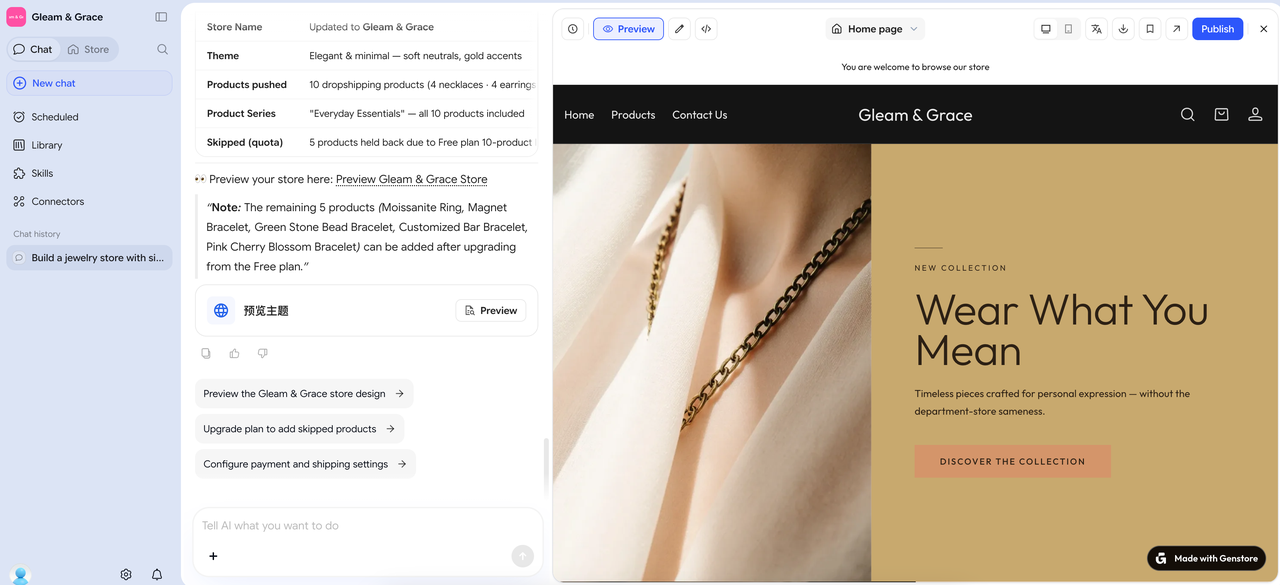
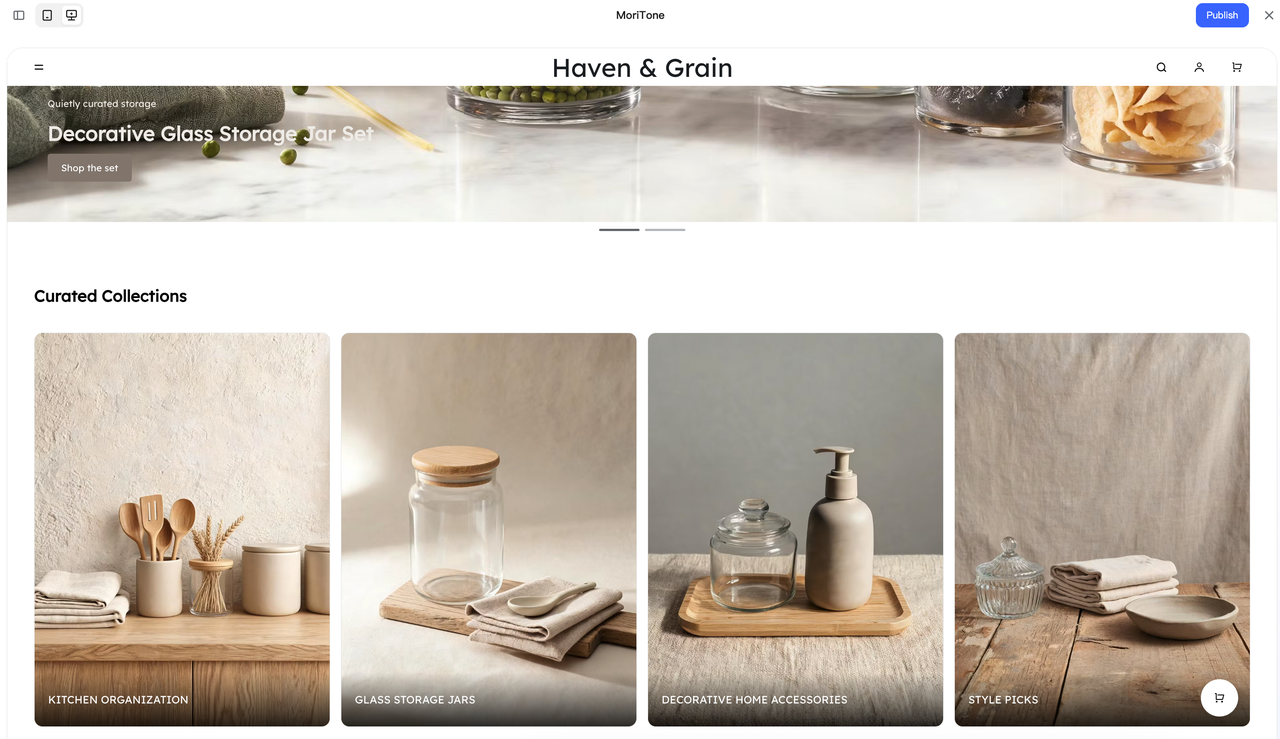
After generation, both platforms support visual drag-and-drop editing, letting you click into sliders, product collections, and grids to adjust them directly rather than treating the generated layout as fixed. The one difference is that continuing to make changes through AI prompts on Genstore after the initial build requires upgrading to a paid plan.
AI capabilities and pricing
- Shoplazza's Athena assistant is included in the subscription and doesn't charge per use, while LazzaStudio runs on credits, with 100 free credits for new accounts.
- Genstore's AI runs entirely on a monthly credit system.
Shoplazza's AI isn't billed per action, and Athena goes beyond conversation into actually executing tasks on the backend. Tell it to set an 80 percent discount on all dresses ahead of Black Friday, and it schedules the promotion. Ask it to set up shipping templates for the US, EU, and Japan at once, and it maps the right delivery zones. Need same-day orders batch-shipped and customers notified? It handles that too. Work that would otherwise take a human tens of minutes gets done in a few, with Athena running it.
Genstore ties its AI capabilities to a credit system, with monthly and daily allowances that vary by plan, and every AI action draws down your balance.
| Plan | Monthly credits | Daily credits |
| Free | 5 credits (sign-up bonus) | 5 |
| Lite | 50 credits | 5 |
| Growth | 200 credits | 5 |
| Scale | 700 credits | 5 |
Once credits run out, Growth and Scale tier users can buy additional credit packs to keep going.
The upshot: if your AI usage is fairly light, a credit system can end up cheaper. But if you're leaning on AI agents daily to handle real operational work, a plan with usage built in tends to be easier to budget for.
Ecommerce and dropshipping capabilities
- Shoplazza connects to multiple dropshipping suppliers and doesn't cap product listings on any plan.
- Genstore works through DSers and limits both product counts and dropshipping listings on its lower tiers.
Both platforms support dropshipping and print-on-demand businesses with no inventory required.
Shoplazza connects to dropshipping suppliers and POD tools including CJdropshipping, EPROLO, and CustoMeow. Once a customer orders, the system automatically passes that order to the supplier for fulfillment, and you can track it end to end, with no product limit on any plan. The backend also includes a built-in sourcing section powered by 1688, one of China's largest wholesale marketplaces.
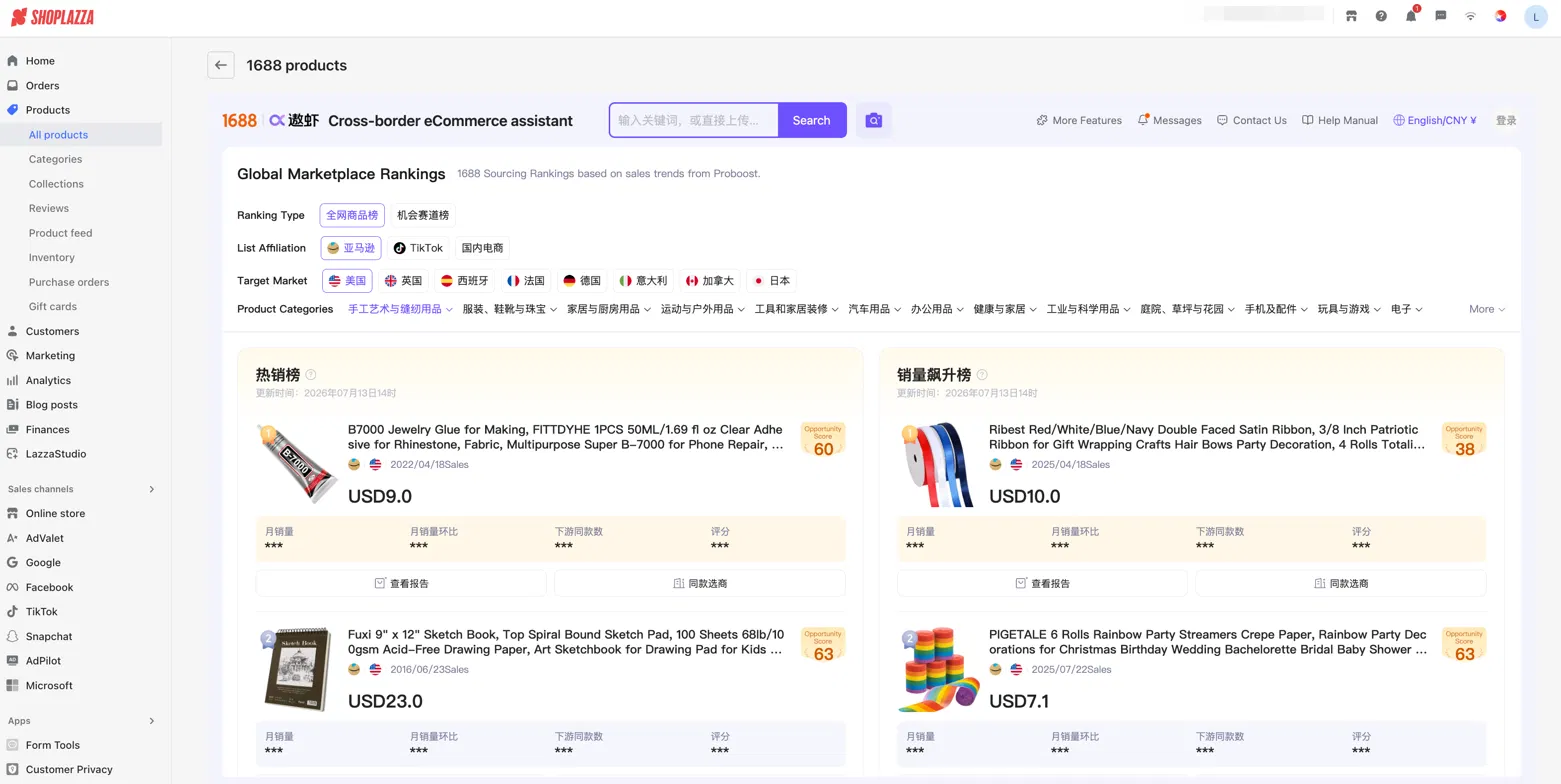
Inside it, a "Best Seller" ranking tracks trending products using sales data pulled from platforms like Amazon and TikTok, which is handy if you're trying to spot what's already selling well elsewhere. 1688 wasn't really built with international sellers in mind, so the interface and listings lean toward a domestic Chinese audience, but if you're after a wide range of low-cost, decent-quality goods, it's still worth sourcing from directly. The marketplace has also started building out overseas warehouses in a handful of countries to speed up delivery for international buyers, though that network is still fairly early. If 1688 isn't your thing, Shoplazza also connects to more familiar sourcing options, including CJdropshipping and AliExpress.
To help your listings look less like everyone else pulling from the same supplier photos, LazzaStudio can turn a supplier's plain product shot into commercial-grade images across different scenes, and AI can optimize the product description and translate it into multiple languages, so the same sourced product ends up with its own visual and content identity in your store.
Genstore's backend has its own dropshipping marketplace, searchable by keyword and filterable by category and price range, with curated sections for TikTok trending picks, new arrivals, and seasonal bestsellers. Adding a product to your store is a single click.
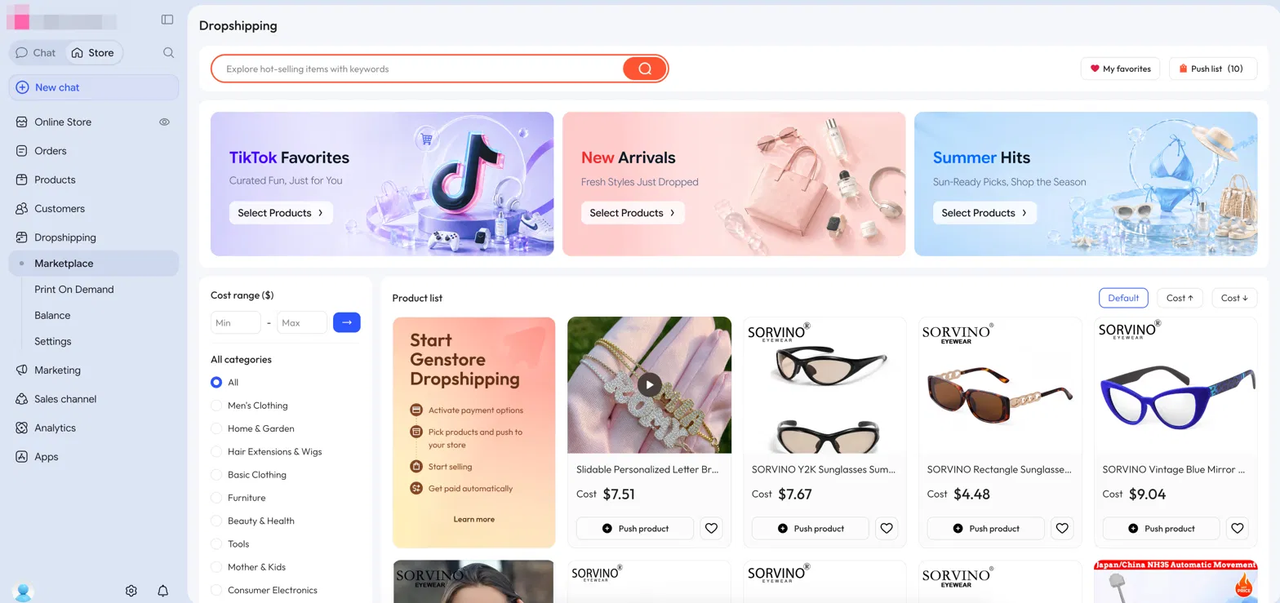
On sourcing, Genstore's app store shows it connects mainly through DSers, which pulls in products from AliExpress. You can browse and add products both before and after building your store, keeping the sourcing flow smooth. That said, its product counts are capped by plan tier, with clear limits on lower tiers, and Genstore separates the cap on total listed products from the cap on dropshipping-specific listings.
| Plan | Total product listings | Dropshipping product cap | Dropshipping service fee |
| Free | 20 | 10 | - |
| Lite | Unlimited | 10 | 9% |
| Growth | Unlimited | 100 | 6% |
| Scale | Unlimited | 1,000 | 3% |
So if you're planning to list a large number of SKUs from the start, Genstore's lower-tier limits are worth checking before you commit, since you may need to upgrade sooner than expected. Shoplazza doesn't cap product counts on any plan, which gives you more room to expand later without hitting a wall.
Marketing and loyalty
- Shoplazza's Loyalty & Push connects to store data and uses AI to suggest membership tiers and discount levels that protect margin.
- Genstore includes a standard, manually configured loyalty program on every plan.
On sales channels and basic email marketing, the two platforms are fairly close. Both connect to Facebook, Google, and TikTok for ads and social, and both work with Klaviyo, Mailchimp, and Omnisend for email. Where they diverge more is loyalty and membership marketing.
Genstore treats loyalty as a standard feature included on every subscription tier. It offers a points system where customers earn rewards through purchases or social engagement, customizable VIP tiers with referral bonuses, and customer management that lets you filter and group shoppers by spend, points, or VIP status, either manually or through CSV import. It's a genuinely complete toolkit, but the rules are yours to build from scratch.
Shoplazza's Loyalty & Push adds an AI layer on top of similar functionality. It connects to store data and factors in average order value along with a registered customer's purchase history and preferences to suggest membership tiers automatically. It can also estimate how much extra spend a given discount level might drive and how much margin you'd still keep, giving you a more data-backed starting point for your discount strategy. In effect, it links loyalty management, marketing emails, and AI product recommendations together, leaning more on data and AI to help you decide rather than leaving every rule up to you.
It has its own free tier too, covering 250 loyalty orders and 500 emails a month, five membership tiers, customer segmentation, and AI-personalized content, which is usually enough for a new store without paying anything. As the business grows, Starter, Growth, and Pro tiers unlock higher limits along with AI analysis and strategy recommendations.
Multi-market and localization
- Shoplazza supports up to 50 international markets with per-market pricing and listing control from a single product catalog.
- Genstore caps market count by plan tier.
Shoplazza's multi-market setup is fairly granular. You can add multiple target markets while working from a single product catalog, so you're not rebuilding a store for every country. More usefully, you can decide market by market whether a given product is listed there at all, so something might sell in North America but stay hidden in Southeast Asia. Pricing works the same way: you can set different prices by country or region, which is genuinely useful given current tariff conditions. A product heading to a higher-tariff market can carry a price that covers part of that cost, while the same product can stay competitively priced elsewhere. That kind of per-market pricing helps you protect margin in some regions without flattening prices everywhere, and changes in one market's pricing don't touch another's.
Genstore limits the number of localized markets you can open based on your plan tier, with higher tiers unlocking more.
| Genstore plan | Localized markets |
| Free | 1 |
| Lite | 2 |
| Growth | 3 |
| Scale | 5 |
So if you're running the US today but plan to expand into Europe and Japan later, it's worth checking Genstore's tier limits before committing, since unlocking all five supported markets requires its $199 a month plan. Shoplazza's markets support is broader across its plans, leaving more room to grow into without hitting a ceiling.
Payments and checkout
- Shoplazza supports a wide range of payment methods plus its own processor, Shoplazza Payments, with AI-based routing and automatic retry.
- Genstore offers two payment paths built specifically around dropshipping.
How you get paid affects what actually lands in your account. Shoplazza gives you more choice here. Beyond connecting to various payment methods, like PayPal, Stripe, Apple Pay, and Google Pay, it offers its own processor, Shoplazza Payments, covering many countries and payment methods with built-in AI routing. Pro-tier merchants using Shoplazza Payments can also get zero transaction fees. It also includes smart retry and automatic failover for failed card payments, which can recover orders that would otherwise just fail outright.
Genstore offers two payment paths built around dropshipping, with Drop Pay enabled by default on new stores. Drop Pay skips activation and underwriting entirely, so it's ready as soon as you connect a PayPal email and submit a signed tax form (W-8 or W-9), with funds settling to your PayPal account after sourcing costs and service fees are deducted. Genstore Payments is the more advanced option, aimed at growing brands, supporting expedited checkout and multi-currency processing with funds settling to a bank account, but it requires identity and business verification and currently only supports US or Hong Kong entities.
In short, Genstore's Drop Pay gets new sellers accepting payments in minutes with no review process, though the dropshipping service fee is worth factoring into your margins. Genstore Payments offers lower fees and faster checkout but is limited to US or Hong Kong entities, while Shoplazza Payments covers a broader range of entities, including Hong Kong, the US, Canada, the UK, and EU countries.
Support and platform maturity
- Shoplazza launched in 2017 and has served more than 650,000 sellers with responsive live support.
- Genstore is a 2025 launch that leans on help center documentation and community support.
Shoplazza has been around longer, founded in 2017 and backed by a $150 million Series C round led by SoftBank Vision Fund in 2022. It's an official partner of Meta and Google, has served more than 650,000 sellers to date, and holds PCI DSS v4 security certification. When you run into a real setup issue, plugin question, or operational problem, helpcenter and human support is there to help.
Genstore, by contrast, launched publicly in 2025 after being founded in late 2024, and reportedly topped Product Hunt's daily rankings on launch before raising a $10 million seed round led by Weimob. Its public track record is still thin, with about $2.3 million in beta-period GMV disclosed so far, so its long-term reputation is still being written. Support currently runs through help center documentation and a Discord community.
Pricing comparison
Let's see Shoplazza pricing first:
| Plan | Monthly | Annual (per month) | Platform transaction fee | Staff accounts |
| Basic | $39 | $29.25 | 2% | 3 |
| Advanced | $105 | $78.75 | 1% | 5 |
| Pro | $399 | $299.25 | 0.50% | 15 |
Every tier allows unlimited product listings and comes with a free 7-day trial, no credit card required. Pro also includes B2B wholesale support and Avalara automatic tax, and gets zero transaction fees when paired with Shoplazza Payments.
Here's Genstore pricing:
| Plan | Monthly | Annual (per month) | Credit card rate (starting) | Additional third-party payment fee | Staff accounts |
| Free | $0 | $0 | Payments not supported | None | No extra seats |
| Lite | $25 | $20 | 2.8% + $0.30 per transaction | 2% | +1 seat |
| Growth | $75 | $60 | 2.6% + $0.30 per transaction | 1% | +10 seats |
| Scale | $199 | $159 | 2.5% + $0.30 per transaction | 0.60% | +20 seats |
The Free plan doesn't support payments at all, so it can't actually process real sales; real selling starts at Lite, where dropshipping orders also carry a 9 percent service fee on top (see the dropshipping table above).
Which platform fits your situation?
With the details out of the way, the more useful question is which one actually fits where you are right now. Here's how that tends to break down by situation:
- Budget-conscious beginners testing the waters. Both can work, but run the real numbers. Genstore's Free tier is free but can't process checkout, so real selling starts at the $25-a-month Lite tier, plus a service fee on dropshipping orders. Shoplazza's Basic plan costs more, but includes payment processing and doesn't add extra fees on dropshipping orders, and you can preview a store without even creating an account.
- Sellers with heavy AI usage, generating and regenerating content or images constantly, tend to do better on Shoplazza. Its included AI usage makes costs more predictable at scale, without the need to track a credit balance. Genstore is more likely to trigger extra charges under that kind of usage pattern.
- Sellers planning to list a lot of SKUs through dropshipping should factor in their sourcing habits. If you're used to AliExpress, Genstore's DSers integration is a smoother path, but keep its lower-tier product caps in mind. If you want more room to grow and prefer suppliers like CJdropshipping or EPROLO, Shoplazza's uncapped listings give you more runway.
- Sellers who want AI to handle as much as possible, while they focus on sourcing and promotion, may prefer Genstore's agent-team structure, where design, SEO, support, and data each go to a dedicated agent that keeps working after launch. Shoplazza's Athena can also operate the backend directly, but the overall experience leans more toward you steering with AI support, rather than AI running the show.
- Sellers planning to run multiple country markets at once tend to fit better with Shoplazza, which supports up to 50 international markets with per-market listing and pricing control, useful given current tariff conditions. Genstore caps markets by tier, topping out at 5 markets on its $199-a-month plan. If you're running the US now and eyeing Europe and Japan later, factoring in that ceiling early can save you a costly upgrade or migration down the line.
- Sellers with B2B wholesale needs and automatic tax requirements are better served by Shoplazza's Pro plan, which includes B2B wholesale support and Avalara automatic tax calculation. Genstore doesn't currently offer an equivalent.
- Creators selling through TikTok or Instagram can work with either, depending on AI usage and budget. Genstore's creator-first positioning and lower entry price suit smaller, early-stage audiences, while Shoplazza's more complete marketing and ad toolset and platform stability make more sense once you're ready to scale and run paid ads.
What to check before you choose Shoplazza or Genstore?
Choosing a platform is as much about where you'll be in a year as where you are today.
- If you expect order volume and SKU count to grow quickly, confirm the platform's market limits, staff seat count, and dropshipping product caps upfront, so you're not forced into an upgrade right after launch.
- Both platforms generate mobile-responsive stores, but it's worth walking through the full checkout flow yourself on a phone before going live.
- On migration, Shoplazza offers a free one-click migration tool that can pull in an existing store, with most merchants live within a day or two. Genstore also offers its own migration tool.
- Switching platforms later isn't especially hard, but customers, order history, and SEO links usually take some hit in the process, so it's worth getting the choice right from the start.
Final take
Both platforms are AI-native at their core: both let AI execute backend actions directly, pull store data, and offer real analysis and recommendations, and both work reasonably well for budget-conscious beginners. Where they actually differ is orientation and cost structure.
- Genstore has a lower barrier to entry, with a free tier to test the waters and real selling starting at $25 a month on Lite, backed by a clear agent-team pitch that handles most of the work for you. It's a solid fit if you want the lowest possible starting cost, as long as you factor in the dropshipping service fee and the fact that the Free tier can't actually process payments.
- Shoplazza offers similar AI depth, but with unlimited usage on Athena that keeps costs more predictable, a more established platform with live human support, and support for running several markets at once, plus marketing tools that are mostly free to use. It tends to suit sellers planning to grow steadily and stick around for the long haul.
Neither platform wins across the board. The right call depends on where you are right now and what matters most to you, weighed against the specifics above.