A single number range doesn't tell you much once you actually start selling, because the real cost of running an ecommerce store in Australia depends on three things. What kind of store you're running, which specific apps and suppliers you connect, and a handful of Australia-specific rules around domains and payments that catch a lot of first-time sellers off guard. This guide walks through actual, sourced numbers for three common store types, dropshipping, print on demand, and direct to consumer, then flags every line item an Australian seller tends to forget until the first invoice shows up.
A quick answer about the total ecommerce website cost in Australia
The exact number depends on your business model, but here's what the three most common setups actually cost once the platform, apps, and fees are added up.
- Dropshipping: around US$39 (AU$55.77) a month, plus the product and shipping cost per order;
- Print on demand: from US$88 (AU$125.84) to US$213 (AU$304.59) a month, depending on your app and order volume;
- Direct to consumer: US$39 to US$399 (AU$55.77 to AU$570.57) a month, plus your own inventory and storage costs.
On top of whichever model you pick, every Australian store also carries the same shared costs regardless of business type, and most of them add up to close to nothing beyond a one-time domain purchase.
Hosting, the AI Store Builder, and most marketing tools are all free, so the only fixed cost here is your domain, roughly US$4.35 to US$34 (AU$6.22 to AU$48.62) per year. Transaction fees and BNPL card rates don't fit into that flat figure, since they scale with your sales rather than sitting at a set dollar amount, but they're worth budgeting as a percentage on top, roughly 0.5% to 2% on every sale for the platform fee, and 4% to 6% plus US$0.30 (AU$0.43) per order if you turn on Afterpay.
What type of store are you building? Cost breaks down by model
"How much does an ecommerce website cost" doesn't have one answer, because a dropshipping store, a print on demand store, and a direct to consumer brand pull from completely different cost structures. Here's what each one actually costs to run.
Dropshipping store cost
Dropshipping tends to have the lowest fixed cost of the three models, since you're not paying for personalization software or holding any stock yourself. Using Shoplazza as an example, here's what the core setup looks like.
| Item | Cost |
| Shoplazza Basic plan | US$39.00/month (AU$55.77/month), or US$29.25/month (AU$41.84/month) billed annually |
| Product catalog limit | Unlimited on every plan |
| CJdropshipping, a dropshipping sourcing platform | Free, no setup fee, no monthly fee, no storage fee |
| EPROLO, a dropshipping and branding platform | Free to use; a one-time US$19.90 (AU$28.46) lite membership unlocks custom labels, hangtags, and packaging if you want branded packaging |
| Estimated monthly total (platform only, unbranded) | ~US$39.00 (~AU$55.77) |
| Estimated first-month total (with EPROLO branding, one-time) | ~US$58.90 (~AU$84.23) |
Shoplazza doesn't just connect to a couple of pre-approved suppliers. You can upload products from any dropshipping supplier you already work with, and if a specific supplier isn't listed on the App Store, Shoplazza's own Skuowner plugin lets you pull products in from AliExpress, Amazon, or Shopify-powered stores with one click, sync pricing and inventory automatically, and push them straight into your product catalog for listing. There's no separate account or import fee for this step, since Skuowner is built and maintained by Shoplazza itself.
The bigger cost difference shows up once you actually sell something. Shoplazza only charges its standard platform transaction fee (2% on Basic, dropping to 0.5% on Pro), and doesn't add a separate cut on top of dropshipping orders specifically. That's a real structural difference from platforms like Genstore, where dropshipping carries its own per-order fee layered on top of the subscription.
| Genstore plan | Monthly | Dropshipping product cap | Dropshipping service fee |
| Lite | US$25 (AU$35.75) | 10 | 9% |
| Growth | US$75 (AU$107.25) | 100 | 6% |
| Scale | US$199 (AU$284.57) | 1,000 | 3% |
On Genstore, that fee applies on every dropshipping order regardless of which tier you're on, and the lower tiers also cap how many dropshipping products you can list at once, 10 products on Lite. Shoplazza doesn't cap product listings on any plan and doesn't layer a dropshipping-specific fee on top of the standard transaction rate, so a seller running a high volume of dropshipping orders isn't losing an extra percentage on each one.
That shipping line is still where Australian sellers get caught out, regardless of platform. CJdropshipping and EPROLO are both built around Chinese and US warehouse networks, and neither publishes a flat "cost to ship to Australia" figure, since it depends entirely on the product, weight, and shipping method you choose inside their own dashboards. The honest takeaway is that your fixed monthly cost stays low and predictable at US$39, while the variable part, the actual product and shipping cost, needs to be checked against the specific items you plan to sell before you lock in your retail prices.
Print-on-demand (POD) store cost
POD stores carry a real extra cost on customization tools that dropshipping doesn't, because the personalization software itself charges a subscription plus a per-item fee on top of your Shoplazza plan. Here's what that looks like across the three apps commonly used with Shoplazza.
| App | Monthly fee | Per-item transaction fee | Free trial |
| Customily | US$49 (AU$70.07) | US$1.00 (AU$1.43) for the first 100 items/month, then US$0.50 (AU$0.72) up to 1,000 items | 9 days, no credit card required |
| CustoMeow (Basic) | US$9 (AU$12.87) | US$0.80 (AU$1.14) for the first 100 orders, dropping to US$0.40, US$0.20, then US$0.10 (AU$0.57 / AU$0.29 / AU$0.14) at higher volumes | 9 days |
| PrintDoors | No subscription fees | Charged per product ordered, similar to a supplier's wholesale pricing rather than a software fee | Not applicable |
Customily and CustoMeow both work as design and personalization software layered on top of a POD production partner, which is why they carry a monthly fee on top of your Shoplazza subscription. PrintDoors works differently. It behaves more like a supplier than a design tool, so there's no monthly charge, and your cost shows up per product ordered instead, the same pricing shape as CJdropshipping or EPROLO in the dropshipping model above.
Added to your Shoplazza subscription (US$39 / AU$55.77), here's what two different order volumes actually look like using only the official rate cards above.
| Setup | 50 personalized orders a month | 150 personalized orders a month |
| Shoplazza Basic + Customily | US$39 + US$49 + (50 × US$1.00) = US$138 (AU$197.34) | US$39 + US$49 + (100 × US$1.00 + 50 × US$0.50) = US$213 (AU$304.59) |
| Shoplazza Basic + CustoMeow Basic | US$39 + US$9 + (50 × US$0.80) = US$88 (AU$125.84) | US$39 + US$9 + (100 × US$0.80 + 50 × US$0.40) = US$148 (AU$211.64) |
These figures don't include the underlying blank product cost (the t-shirt, mug, or phone case itself), which varies by which POD fulfillment partner you connect for production.
Which app makes sense usually comes down to order volume rather than features alone. At low volume, Customily's higher monthly fee is harder to justify against CustoMeow's lower entry cost, but the gap narrows as volume climbs since Customily's per-item fee drops faster past 100 orders. If you're weighing this by order volume specifically, our POD apps comparison breaks down where each app tends to make more sense as your monthly order count grows.
Direct-to-consumer (DTC) branded store cost
A DTC store is simpler to price than dropshipping or POD, since it doesn't rely on a sourcing or personalization app at all. The core cost is just your Shoplazza subscription plus whatever you spend on inventory and storage.
| Plan | Monthly | Annual (per month) | Staff accounts |
| Basic | US$39 (AU$55.77) | US$29.25 (AU$41.84) | 3 |
| Advanced | US$105 (AU$150.15) | US$78.75 (AU$112.61) | 5 |
| Pro | US$399 (AU$570.57) | US$299.25 (AU$427.93) | 15 |
A solo founder running their own inventory can start on Basic. Advanced or Pro tends to make more sense once a small team needs backend access, or once B2B and tax tools become relevant. Beyond the subscription, warehousing and stock costs depend entirely on your product category, order volume, and how much you're holding at once, so there isn't one honest number to quote here.
Two optional tools are worth knowing about if you're shipping physical inventory to Australian customers. ShipSaving bundles discounted USPS, UPS, FedEx, and DHL rates for merchants shipping out of the US, with a free Starter plan covering up to 50 labels a month and a Pro plan starting at US$15 (AU$21.45) a month for up to 5,000 labels. AfterShip Tracking covers more than 1,200 carriers worldwide, and its own user reviews on Capterra confirm Australia Post is one of them, which matters if you want a branded tracking page your Australian customers actually recognize.
Here's AfterShip shipping pricing:
| Plan | Monthly | Shipments/year included | Extra shipment fee |
| Essentials | US$29 (AU$41.47), starting at | 6,000 | US$0.08 (AU$0.11) |
| Premium | US$59 (AU$84.37), starting at | 6,000 | US$0.12 (AU$0.17) |
| Enterprise | Custom | Custom | Custom |
Both of these sit outside your Shoplazza subscription and are entirely optional, so they only apply if you decide your DTC store needs dedicated shipping or tracking software on top of the platform itself.
The line items every Australian seller forgets to budget for
Beyond the store type itself, a handful of specific costs tend to show up as a surprise for Australian sellers. Here's what each one actually involves.
Transaction fees
Shoplazza's platform transaction fee is tied to your plan tier. This fee applies regardless of which payment processor you connect.
- Basic, 2% transaction fee
- Advanced, 1% transaction fee
- Pro, 0.5% transaction fee
Take Basic and Advanced as an example. At US$5,000 (AU$7,150) in monthly sales, Basic charges US$100 (AU$143) and Advanced charges US$50 (AU$71.50). At US$10,000 (AU$14,300) in monthly sales, Basic charges US$200 (AU$286) and Advanced charges US$100 (AU$143).
Domain
If you check Shoplazza's in-admin domain purchase tool, the extensions available to buy directly are .com, .shop, .store, .net, .org, .site, .co, .online, and .ai, with first-year prices ranging from about US$4.35 (AU$6.22) for extensions like .online and .site up to around US$34.00 (AU$48.62) for .co, and higher for less common extensions like .ai at US$101.00 (AU$144.43).
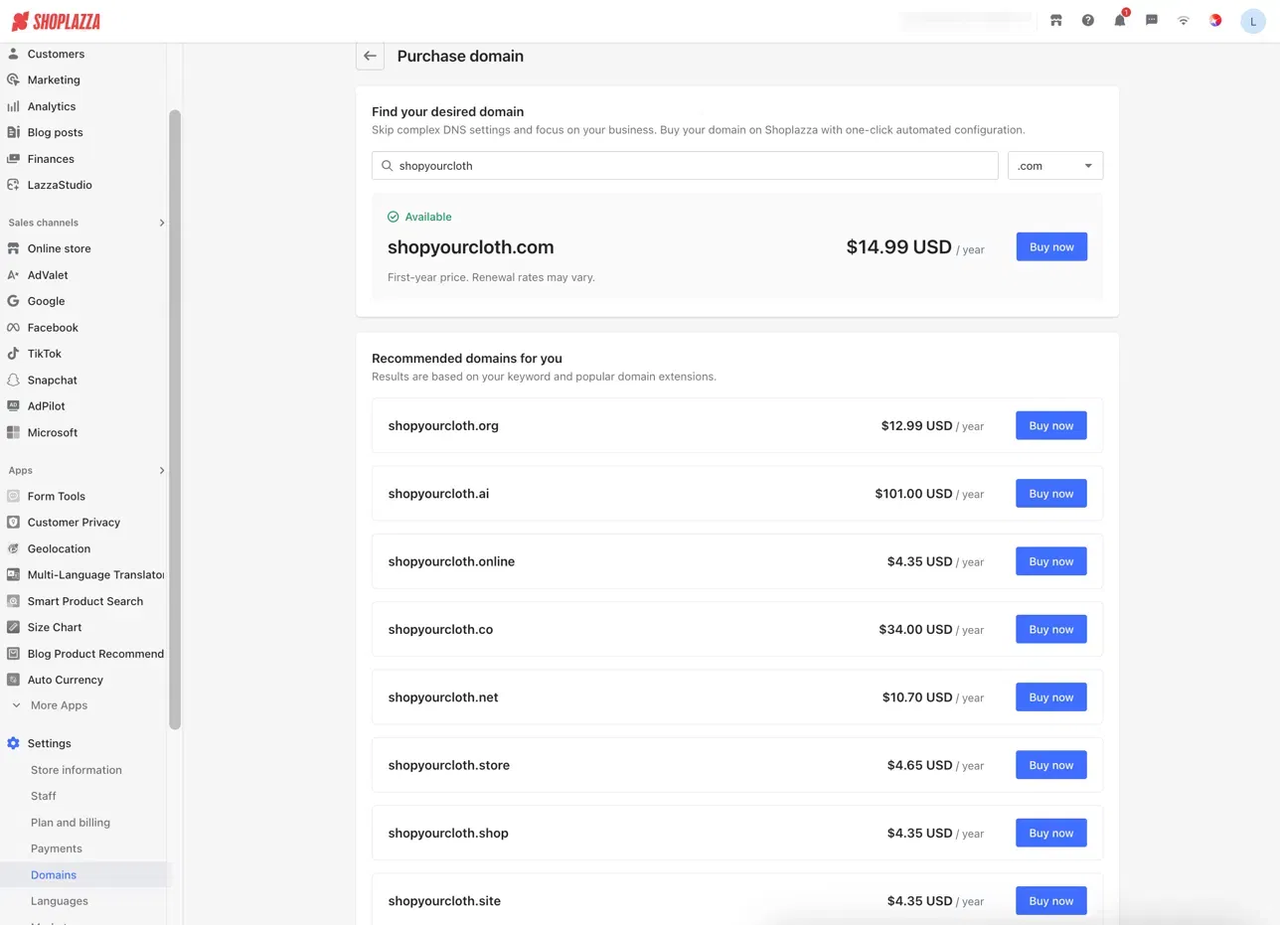
A .com.au or other .au extension isn't part of that list yet. If your business needs an .au domain specifically, you'd register it through an auDA-accredited registrar separately, then connect it to your Shoplazza store through the standard domain-connection flow in Settings once it's yours.
That .au registration comes with its own eligibility rule worth knowing before you go shopping for one. Per auDA's official Domain Administration Rules, registering a .com.au or .net.au domain requires proving an Australian presence, most commonly through an active ABN or ACN, though a registered trade mark, business name registration, or incorporated association number can also satisfy this requirement. The .id.au namespace is meant for individuals and carries a lighter requirement, without needing a business-level credential.
Hosting
With Shoplazza, hosting is bundled into the subscription rather than being something you buy separately. Per Shoplazza stores run on Amazon Web Services with servers based in the western United States, with Cloudflare acceleration and CDN edge caching layered on top. This setup gives merchants outside mainland China, which includes Australia, generally stable access speeds. If you build with WordPress or WooCommerce instead, hosting becomes a separate, ongoing purchase you're responsible for on top of the platform itself.
Card rates
Shoplazza supports Australia's most common local payment preferences. Through its integration with Oceanpayment, you can turn on Apple Pay, Google Pay, and Afterpay directly from Settings > Payments in your admin, without setting up each one separately. Apple Pay Express Checkout is fully live on both the product and checkout pages, while Google Pay Express Checkout currently covers the checkout page, with product-page support still rolling out.
On cost, Afterpay doesn't publish one flat merchant fee, since the rate is set per merchant agreement. As a general reference point, independent sources covering the Australian market consistently put Afterpay's typical merchant fee somewhere around 4% to 6% of the sale value, plus a fixed US$0.30 (AU$0.43) per transaction, noticeably higher than standard card processing rates. The accurate answer for your own store is whatever rate you see once you activate Afterpay in your Shoplazza settings.
Ecommerce website design
Both the AI Store Builder and the template-based builder on Shoplazza are free to try. You don't need to sign up to preview a finished store, and payment only kicks in once you're ready to publish, so you can see exactly what you're getting before committing to a plan.
Marketing tools
Discounts, coupons, abandoned cart recovery, and similar conversion tools come built into Shoplazza rather than requiring a stack of paid apps. Nearly 90% of its marketing apps are free, which covers most of what a standard Australian store needs without adding extra software costs on top of the subscription.
How to get an accurate quote instead of guessing?
Every number above comes from a public rate card, but your actual monthly cost still depends on your specific order volume, product type, and how many of these apps you end up using at once. Rather than trying to average someone else's estimate, the more reliable move is to preview your actual store for free with no sign-up, then run your expected order volume through the tables above using your own numbers. That gives you a real figure instead of a guess, and it takes about the same amount of time as reading another generic pricing article.
Build your ecommerce website in low cost
Now that you know exactly where your costs come from, dropshipping, POD, or DTC, the next step is seeing it for yourself. Every model here starts on the same low, predictable subscription, with hosting, the AI Store Builder, and most marketing tools already included by Shoplazza at no extra cost. Preview your store for free, with no sign-up and no credit card required, and see the real homepage, product pages, and checkout you'd actually be launching with. Find out what your true monthly cost looks like before you commit to a plan.
Frequently asked questions about ecommerce website cost
Q: Does a .com.au domain require an ABN?
Usually, yes. Per auDA's official rules, .com.au and .net.au registrations require proof of an Australian business presence, most often an active ABN or ACN, though a registered trade mark, business name, or incorporated association number can also qualify. The .id.au extension for individuals has a lighter requirement.
Q: Can I buy a .au domain directly through Shoplazza?
Not currently. Shoplazza's in-admin domain store covers extensions like .com, .shop, .store, .net, .org, .site, .co, .online, and .ai. For a .com.au or other .au domain, you'd register through an auDA-accredited provider separately, then connect it to your Shoplazza store.
Q: How do I enable Afterpay, Apple Pay, or Google Pay on my Australian Shoplazza store?
These connect through Shoplazza's Oceanpayment integration in Settings > Payments. Apple Pay is fully live on product and checkout pages, Google Pay currently covers checkout, and Afterpay is available through Shoplazza's global partnership that includes Australia.
Q: What's the real cost difference between dropshipping and POD apps on Shoplazza?
Dropshipping apps like CJdropshipping and EPROLO don't charge a monthly fee, so your cost is mainly the product and shipping price. POD apps like Customily ($49/month) and CustoMeow ($9/month) add both a subscription and a per-item transaction fee on top of your Shoplazza plan.
Q: Does Shoplazza include hosting, or do I need to buy it separately?
Hosting is included in every Shoplazza plan, running on AWS with Cloudflare and CDN acceleration. You'd only need to buy hosting separately if you built your store on an open-source platform like WordPress or WooCommerce instead.