The US market gets a lot of attention with its higher order values and greater brand potential. But for sellers who are just getting started, Southeast Asia is often the more practical entry point. Lower deposit requirements, a return rate under 10%, fast platform growth, and relatively forgiving rules make it easier to test, learn, and adjust without too much at stake. That said, Southeast Asia isn't a smaller version of the US market. Consumer habits, commission structures, fulfillment rules — they all work differently here. Copying a US playbook into Southeast Asia tends to create problems. This guide breaks down what actually matters when you're starting out in this region.
Why is Southeast Asia market worth considering first?
The numbers back it up. TikTok Shop's GMV in Southeast Asia market crossed $50 billion in 2025, more than doubling from 2024, with daily GMV up 90% year-on-year. In Thailand, TikTok Shop's market share jumped from 27% in 2024 to 33% in 2026, overtaking Lazada to become the second-largest ecommerce platform in the country. Indonesia tells a similar story. TikTok Shop is now second only to Shopee.
Beyond the growth numbers, Southeast Asia has a few practical advantages for new sellers:
- Combined return rate is under 10%, well below what you'd see in Western markets.
- Individual sellers can register in Singapore, Malaysia, Thailand, Vietnam, and the Philippines — no company required in many cases.
- TikTok launched a zero-fee trial period and multi-store-per-license policy in 2026, lowering the cost of testing. New sellers who complete onboarding tasks can get up to 90 days of commission-free selling (roughly $90 per market), useful for keeping early costs down.
Cross-border store vs local store: which one should you choose?
Before anything else, there's one decision worth getting clear on: are you opening a cross-border store or a local store?
Cross-border store: lower barrier, slower shipping
TikTok Shop took off quickly across Southeast Asia — Indonesia, Malaysia, Thailand, Vietnam — and the region's proximity to China makes cross-border fulfillment a practical starting point for many sellers. Some suppliers ship via ePacket or dedicated freight lines and can reach most Southeast Asian markets in 5–9 days, which is workable for this region.
That said, shipping speed still matters. Most Southeast Asian buyers expect reasonably fast delivery, and if your orders consistently take 2+ weeks, negative reviews start to pile up. Before committing to a supplier, ask them directly for average delivery times to your target market. It varies more than you'd expect.
If you're sourcing from China, CJdropshipping has warehouses in Yiwu, Shenzhen, and Jinhua that support cross-border fulfillment to Southeast Asia — a straightforward option if you're just getting started. Platform rules also require orders to reach a designated sorting hub within 72 hours of being placed, so suppliers located closer to major logistics hubs tend to be more reliable on that front.
Local store: faster shipping, higher barrier
A local store requires a business entity or personal ID in the target country, plus inventory pre-positioned in a local warehouse or a working relationship with a local supplier. The payoff is meaningful: delivery in 1–3 days, smoother COD handling, fewer logistics complaints, and more stable seller scores.
For new sellers, finding a reliable local supplier is usually the hardest part. CJdropshipping has local warehouses in Thailand and Indonesia, which lets you access near-local shipping speeds without managing your own stock. You get the fulfillment advantage of a local store without needing to pre-ship inventory yourself.
Worth mentioning for the longer term: if you eventually expand beyond TikTok Shop into your own DTC ecommerce website, CJdropshipping integrates directly with Shoplazza. Product listings sync across both channels in one step, so you're not re-uploading everything manually. For sellers running TikTok Shop and their own site in parallel, having one supplier connected to both saves a noticeable amount of time.
Where to start for beginners?
Start with a cross-border store. Use dropshipping to test products at low cost, and once you find something that sells consistently, consider moving inventory locally or switching to a local store setup. For your first market, Malaysia or Thailand tends to work well:
- Malaysia has strong cultural adaptability, high English proficiency, and relatively straightforward operations.
- Thailand's users watch an average of 98 short videos per day — the interest-commerce environment is strong, and viral products spread fast.
3 key differences between Southeast Asia and the US market
Many sellers who've had some success in the US assume Southeast Asia works the same way. In practice, a few things are quite different.
Consumer behavior: COD is common and order values are lower
Cash on delivery (COD) is still widely used in Indonesia, Vietnam, and Thailand. Many buyers simply prefer to pay when the product arrives rather than upfront. This means your fulfillment process needs to handle COD orders, and you should expect some buyers to refuse delivery. One thing to note: COD is only available for orders fulfilled through TikTok's official logistics; it doesn't apply to self-shipped orders.
On pricing, the typical order value in Southeast Asia sits between $5 and $15, compared to $10–$25 in the US. That doesn't mean the margins are worse, but it does change how you approach product selection. Volume matters more than unit price here. Lightweight, frequently purchased products with lower price points tend to move better than premium items.
Platform fees: varies by market and category
The US charges POP sellers a flat 6% commission across most categories. Southeast Asia is more fragmented. Each market charges different rates depending on the product category, and it shifts regularly:
- In Indonesia, beauty products are around 4.3%, mobile phones around 1.9%, electronics accessories around 4.3%, and pet supplies around 2.7%.
- Malaysia has the highest overall commission rates, with fast-moving consumer goods reaching above 11% for standard sellers and above 14% for mall sellers.
- Vietnam has gone through several rounds of adjustment, with health, beauty, mother and baby, and home categories generally seeing rates come down.
Given how frequently these change, you're better off checking the current rates directly in TikTok Shop Seller Center rather than relying on third-party summaries.
Fulfillment rules: timing requirements and key checkpoints
Unlike the US, Southeast Asia hasn't moved toward mandatory platform logistics. Cross-border self-shipping is still the norm, and the rules are relatively stable. Sellers have two options: TikTok's official logistics or self-shipping, each with different timelines and responsibility structures.
Fulfillment deadlines
For cross-border orders shipped from a domestic warehouse:
- Pickup or drop-off at a collection point: pack and update order status to "awaiting pickup" within 48 hours of order creation
- Warehouse drop-off: update status within 48 hours, and complete delivery to the TikTok warehouse within 96 hours
For local overseas warehouse fulfillment: arrange pickup with a carrier and input a valid tracking number within 2 business days.
Auto-cancellation and order limits
If a standard order hasn't been updated to "awaiting pickup" within 3 calendar days, or hasn't shipped within 7 calendar days, TikTok will automatically cancel it and refund the buyer. If your late fulfillment rate exceeds 4%, or your seller-caused cancellation rate goes above 2.5%, TikTok applies order limits for 7 days until both metrics recover. During that period, all your listings show as out of stock. This penalty structure applies in the US too, not just Southeast Asia.
Fake tracking is a hard line
Dropshipping operations with more distributed supply chains are more prone to this issue. Invalid tracking numbers, duplicate tracking numbers, or tracking that shows no movement 24 hours after being submitted are all flagged as fraudulent fulfillment. The consequence can be immediate store closure. When evaluating suppliers, verify that their tracking numbers update reliably in real time.
Product categories worth focusing on in Southeast Asia
Each Southeast Asian market has its own preferences, so blanket category advice only goes so far. That said, a few categories have shown consistent growth across the region:
- Beauty and personal care: The top GMV category across all Southeast Asian markets. In 2025, beauty accounted for roughly 20% of monthly GMV in Thailand and 17% in Indonesia. Within this category, ingredient-focused skincare (niacinamide, SPF sprays, oil-control products), Halal-certified beauty (a genuine requirement in Indonesia and Malaysia, not just a nice-to-have), and men's grooming are less saturated and still growing.
- Muslim fashion: In March 2025, Muslim fashion made up 16.28% of GMV in Indonesia and 24% in Malaysia — on par with beauty in both markets. Abayas, hijabs, and inner layers in breathable fabrics like Tencel and cotton-linen are the main movers.
- Mother and baby: TikTok Shop officially segments this into 10 sub-categories and 126 sub-sub-categories. Kids' clothing and infant feeding products are the core focus areas. Vietnam is particularly strong here — younger parents spend more and are more open to brand-premium products than buyers in other Southeast Asian markets.
- Home and daily essentials: Low price point, high repeat purchase rate, good for volume-driven dropshipping. A single product — a wall-mounted tissue dispenser pack — hit $10.76 million in monthly GMV on Vietnam's TikTok Shop, which shows just how far a simple everyday item can go in this market.
- Sports and outdoor: Total GMV in this category approached $10 billion across Southeast Asia over the past 12 months, with Thailand and Indonesia leading. Lightweight items like UV-protective sleeves, quick-dry tees, and outdoor organizers perform well and are easy to film for content.
One thing many sellers overlook: Southeast Asian buyers are sensitive to localization. Product titles and descriptions need to be in the local language — Bahasa Indonesia, Vietnamese, Thai — not English. Promotional-style images that work in other markets often don't land well here. This detail directly affects conversion rates.
For product images, LazzaStudio's AI product picture maker lets you generate localized visuals with AI models that match the look and style of your target market — whether that's a deeper skin tone with a hijab for the Indonesian market, or a Thai or Vietnamese aesthetic. You can set the model characteristics and generate market-specific imagery in one go, without needing separate photoshoots for each country.

Use AI to do dropshipping more efficiently
Southeast Asia spans five or six countries with different languages. Handling product listings manually for each market takes a lot of time. AI tools help cut that down significantly.
TikTok's AI tools
TikTok currently offers a couple of built-in AI features worth knowing about:
- Symphony Creative Studio is TikTok's official AI ad creative tool. It generates video content from existing product materials and supports multilingual output — useful if you're running the same product across Indonesia, Vietnam, and Thailand at the same time.
- Product quality optimization suggestions in TikTok Shop Seller Center uses the platform's algorithm to flag specific improvements for your titles, descriptions, and images. Following those recommendations tends to improve organic reach.
In the TikTok ecosystem, a few third-party AI tools are also widely used. EchoTik AI tracks trending products and creator data to help with content ideas. Tabcut focuses on TikTok Shop data analysis — store performance, video metrics, live data — and is useful for product research. AdsPolar handles paid ad management across TikTok, Meta, and Google from one dashboard, which is handy once you're ready to put budget behind what's working.
Other AI tools to consider
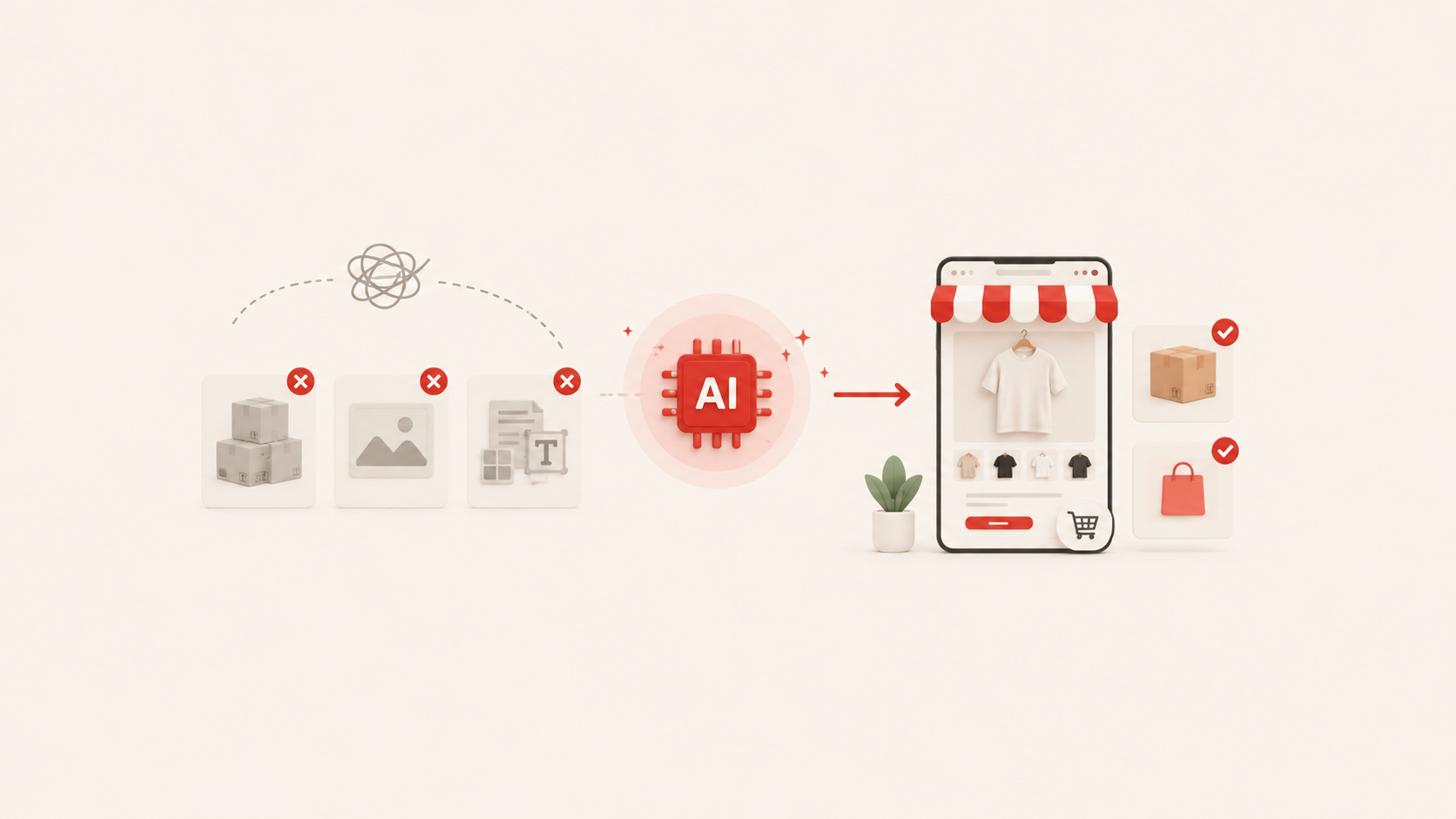
For product listings, Shoplazza's AI description generator can batch-produce multilingual titles and descriptions in Bahasa Indonesia, Vietnamese, Thai, and other Southeast Asian languages. Once you've sourced your products, you can translate and publish listings in one step rather than handling each one manually. If the initial output isn't quite right, you can run it through AI optimization to refine the copy before going live.
Many sellers doing dropshipping in Southeast Asia eventually run into the same realization: every order placed on TikTok Shop belongs to the platform's data ecosystem, not yours. Southeast Asian buyers do repeat-purchase, but without a channel you own, those customers stay on the platform.
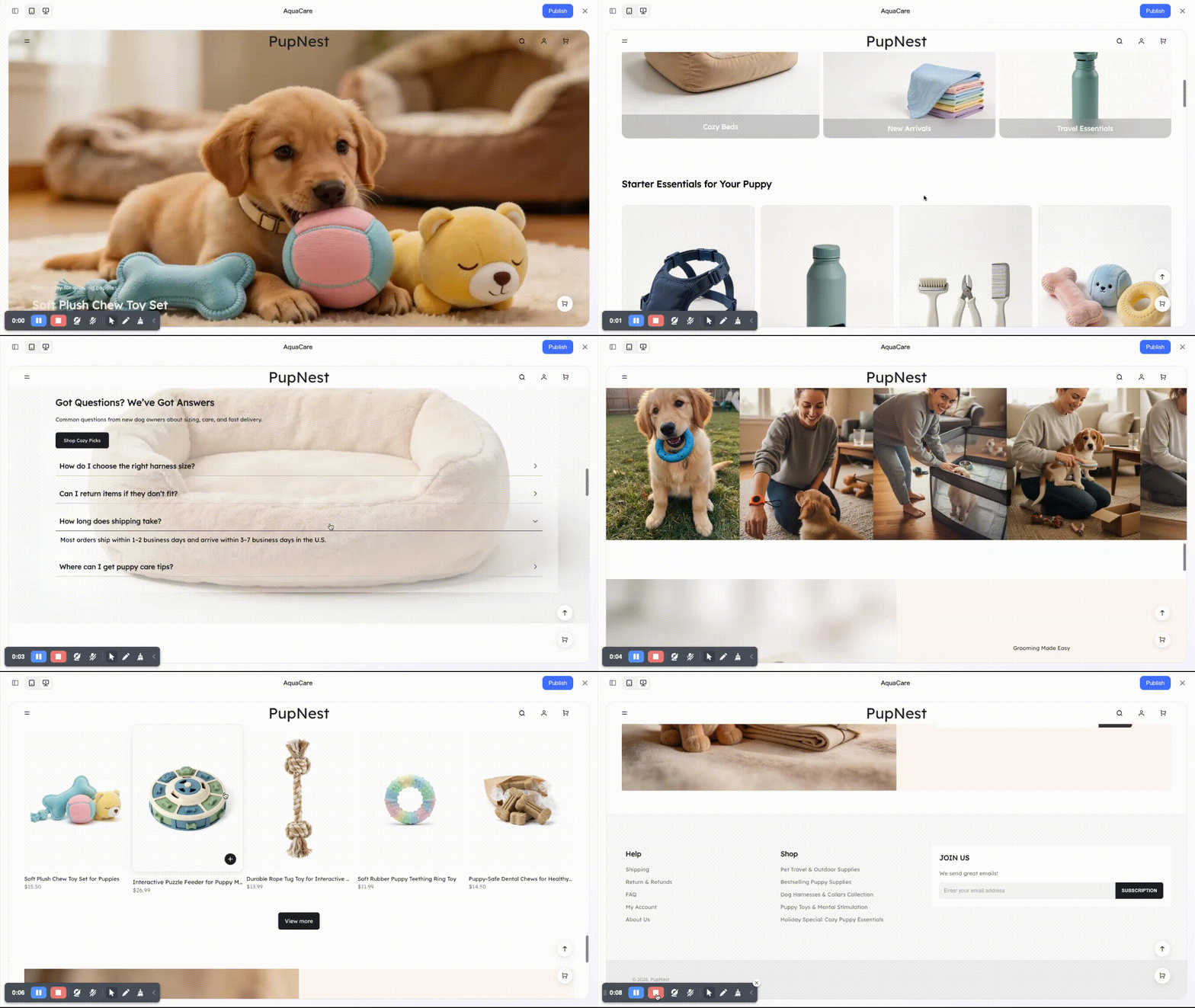
Building your own DTC ecommerce website fills that gap. With Shoplazza's AI dropshipping store builder, you can generate a complete store — homepage, product pages, cart, checkout — in 3–5 minutes. Tell the AI your category, target market, and customer type, and it handles the rest. TikTok drives the traffic. Your own site keeps the customers and builds the brand over time.
Wrapping up
Southeast Asia is one of the more accessible entry points into TikTok dropshipping right now. Low barrier, stable rules, strong growth. But accessible doesn't mean automatic — COD return risk, different commission rates per market, and fulfillment deadlines all need proper attention before you scale. You may start with one market and one category. Run the full cycle: product selection, listing, fulfillment, content. Get that working before expanding to other markets. Once you find a product that sells consistently, that's when to start thinking about building something more durable — your own site, your own customer base, and a brand that doesn't depend entirely on one platform's algorithm.