What are the most cost-effective ways to launch an online clothing line and reach customers fast in Australia? That question has a real answer, and it's not "spend less on everything." It's about choosing the right fulfillment model, the right selling platforms, and the right acquisition channels for the AU market specifically. This article breaks each one down so you can compare your options and move forward without wasting budget on the wrong approach.
Why "cost-effective" and "fast" pull in different directions in the Australian market?
Clothing sellers should know that the cheapest launch strategies are rarely the fastest ones. And the fastest ones are rarely the cheapest. You usually have to pick a balance.
Geography is a big reason for this. Australia sits far from major manufacturing hubs in China and South Asia. That means longer shipping times and higher freight costs compared to what founders in the US or UK deal with. On top of that, domestic shipping through Australia Post or Sendle adds real cost per order. If you haven't factored that into your pricing, it quietly eats your margin.
There is also the GST threshold to keep in mind. Once your annual turnover hits AUD $75,000, GST registration becomes mandatory. It is not a day-one concern, but it shapes how you price and structure your business as you grow.
So the goal is not to find one perfect strategy. It is to combine the right fulfillment model, a low-cost storefront, and an acquisition channel that fits your budget. The rest of this article helps you do exactly that.
The most cost-effective fulfillment strategies for an Australian clothing launch
Your fulfillment model determines how much cash you tie up before you make a single sale. Here are the three approaches that keep startup costs lowest in the Australian market.
Print-on-demand with local AU fulfillment hubs
Print-on-demand (POD) is a fulfillment model where your designs are printed onto blank garments only after a customer places an order. The POD provider handles printing, packing, and shipping directly to your buyer. You never touch the stock.
For Australian founders, local fulfillment nodes matter. Printful Australia prints and ships domestically, covering apparel, accessories, and wall art with no minimum order quantity. Gelato operates a local hub as well, routing orders to the nearest print facility automatically to reduce delivery time. For a customer in Melbourne or Brisbane, domestic fulfillment typically means 2 to 5 business days rather than a 2 to 3-week international wait. That difference shows up in your conversion rate, your review score, and your repeat purchase rate.
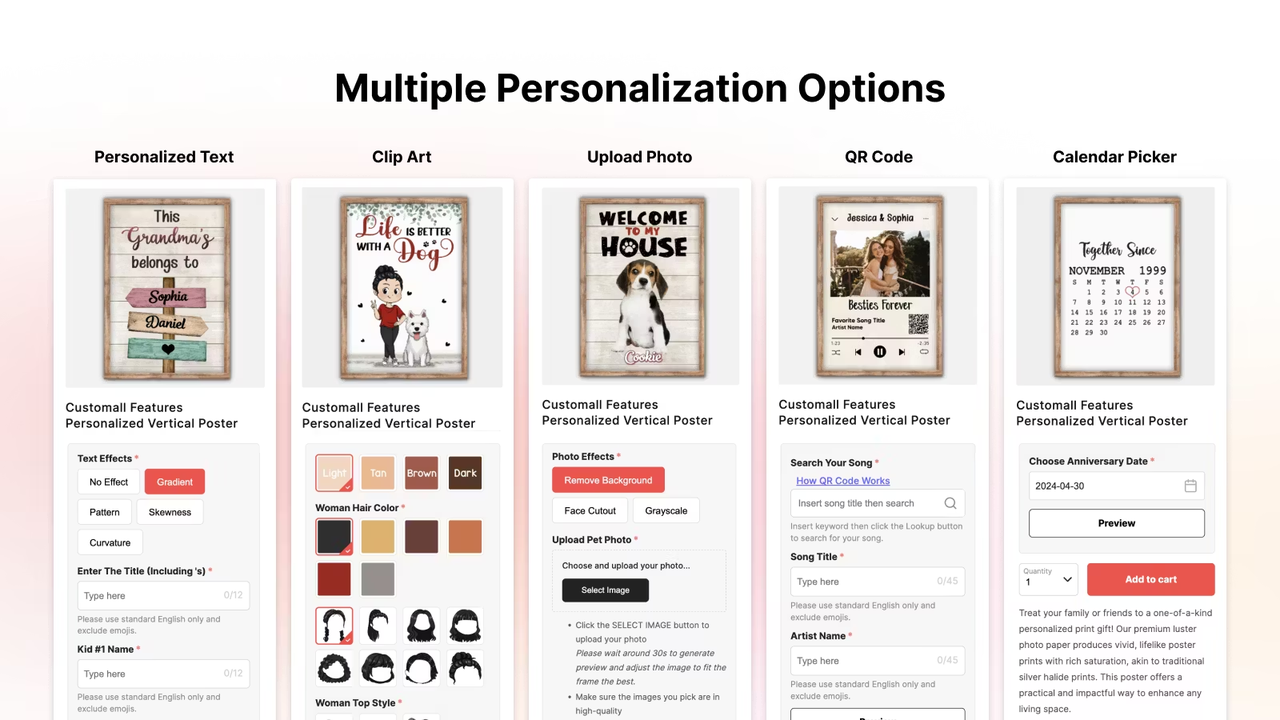
If you build an online store on Shoplazza, you can do POD buisness easily. You may integrate Customall POD Product Customizer directly. When a customer places an order, it is automatically sent to your chosen POD supplier for printing. No manual forwarding, no copy-pasting order details. Customall connects to Printful, Printify, Dreamship, Printway, and Gearment. Key features include:
- Real-time product preview: Customers see exactly what their customised item looks like before they buy.
- Custom text and photo upload: Buyers can personalise products with their own images and text directly on your product page.
- Background remover and face crop tools: Built-in editing features that reduce design friction for the customer.
- QR code integration: Supports QR codes linked to YouTube and Spotify, useful for music-related or gift-oriented apparel.
- Printable file export: Generates print-ready files automatically for supplier processing.
POD works best when your brand is built around original graphic designs, niche aesthetics, or personalised products. The trade-off is margin: you pay per unit at a premium price, so profit per item is lower than bulk manufacturing. But with zero inventory risk and no upfront manufacturing cost, it remains one of the most financially accessible ways to launch a clothing line in Australia.
Dropshipping with apparel suppliers
Dropshipping lets you list and sell clothing from a supplier's existing catalog without purchasing inventory in advance. When a customer buys, the supplier ships the order directly to them. You pay the supplier cost after you've already collected the customer's payment.
For AU clothing brands, the key variable is where your supplier warehouses stock. Suppliers with fulfillment centers in Australia give you delivery windows that meet AU shopper expectations. Suppliers shipping from mainland China typically add 7 to 15 business days in transit, which hurts repeat purchase rates and generates more customer service inquiries.
A few Australian dropshipping suppliers worth knowing:
- Iconic Brands Australia: AU-based wholesaler with domestic dispatch, covering fashion and lifestyle categories.
- Modalyst: Connects to independent AU and global fashion brands with automated order routing.
- Trendsi: Apparel-focused dropshipping platform with a growing AU-compatible supplier network.
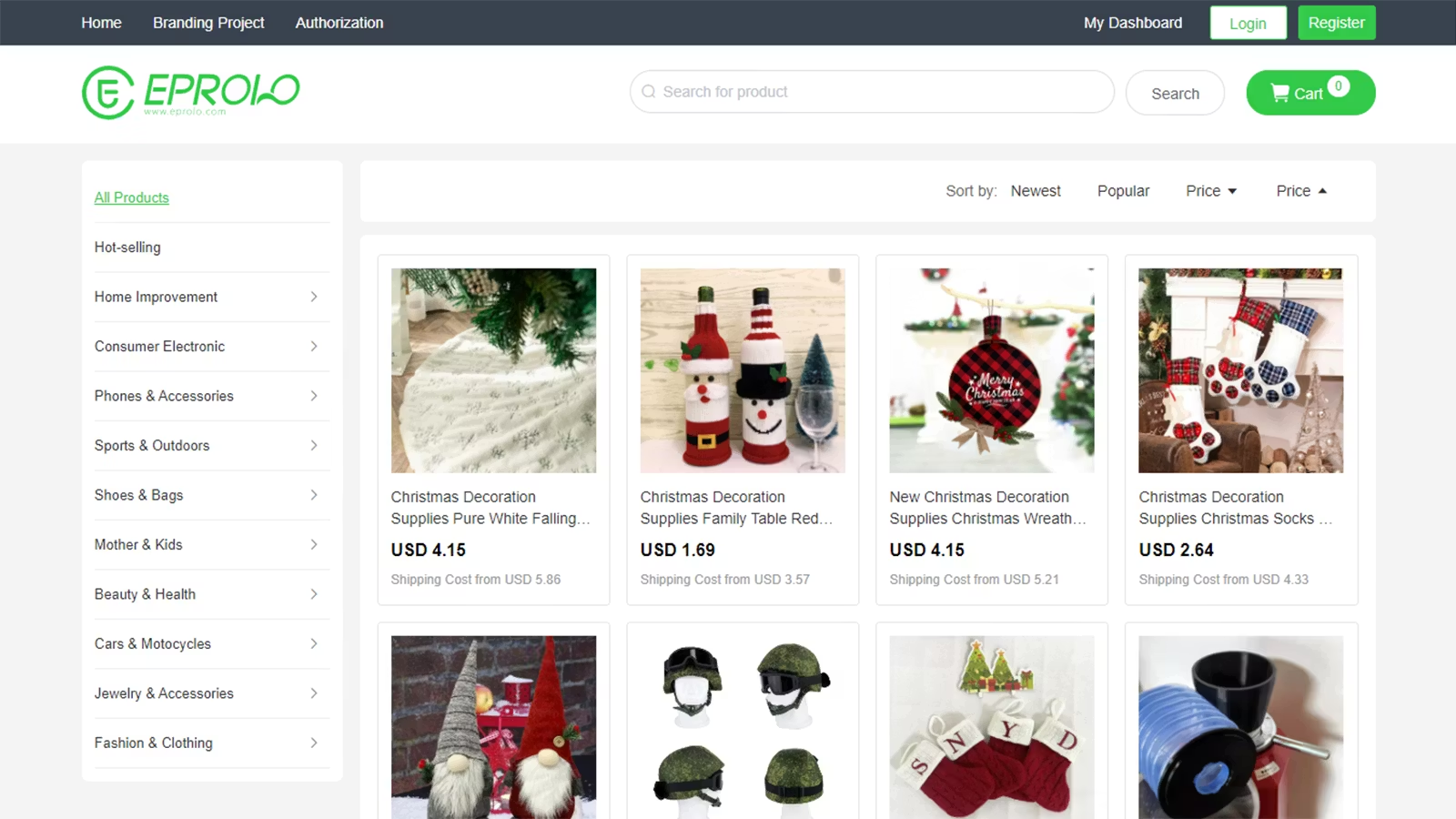
If you build your store on Shoplazza, you can connect EPROLO as your dropshipping supplier directly from the platform. EPROLO operates over 26 warehouses globally with dedicated facilities in Australia, and it is built specifically for clothing brands:
- Local delivery: Domestic warehousing with shipping speeds of 5 to 14 days across Australia.
- Custom branding: Custom labels, hangtags, packing bags, and tape on every order.
- Easy returns: 7-day no-questions-asked local returns for clothing.
- Product range: Over 3,000 new clothing arrivals added weekly.
- Cost: Free to use with no monthly subscription fees.
Dropshipping gives you a wider product range and more style variety than POD, but less control over packaging unless you use a supplier that supports branded fulfillment. It suits founders who want to move fast with ready-made styles rather than original custom designs.
Pre-order and VSP campaigns
Most clothing brands manufacture first, then hope customers buy. The VSP model does the opposite: Validate, Sell, Produce.
Here is how it works. You design one or two pieces, make a single sample of each, and launch a pre-order campaign. Customers pay upfront. You use that money to fund the production run. You only make what is already sold.
The trade-off is that you need an audience before you launch. Without traffic or followers, a pre-order page goes nowhere. This model works best for AU founders who have already built some social presence, an email list, or an engaged community around a specific niche.
The upside is significant. No unsold stock. No external financing. No guessing whether customers actually want what you made. For a micro-brand launching its first collection, that is a meaningful advantage.
Fastest ways to build your store without a developer
Once you've chosen a fulfillment model, you need somewhere to sell. Your platform choice affects both your setup cost and your long-term unit economics, so it's worth thinking through the three main paths before committing.
AI-powered store builders: the fastest path to a branded ecommerce store
Building a store used to mean hiring a developer or spending weeks on templates. An AI-powered store builder cuts that down to hours. Shoplazza's AI store builder for dropshipping business is built specifically for ecommerce, not general web publishing. You get two ways to start:
- Describe your business: Enter a brief description of your product, target customer, and business needs. The AI generates three store design options based on your input. Pick the one that fits your brand, and it builds out the full store including homepage, product pages, navigation, and checkout.
- Upload product images: If you already have product photos, upload them directly. The AI reads the visuals and generates store content and layout ideas from there.
No credit card required to preview. When you are ready to launch, plans start at $39/month (or $29.25/month on an annual plan). No developer fees. No designer fees.
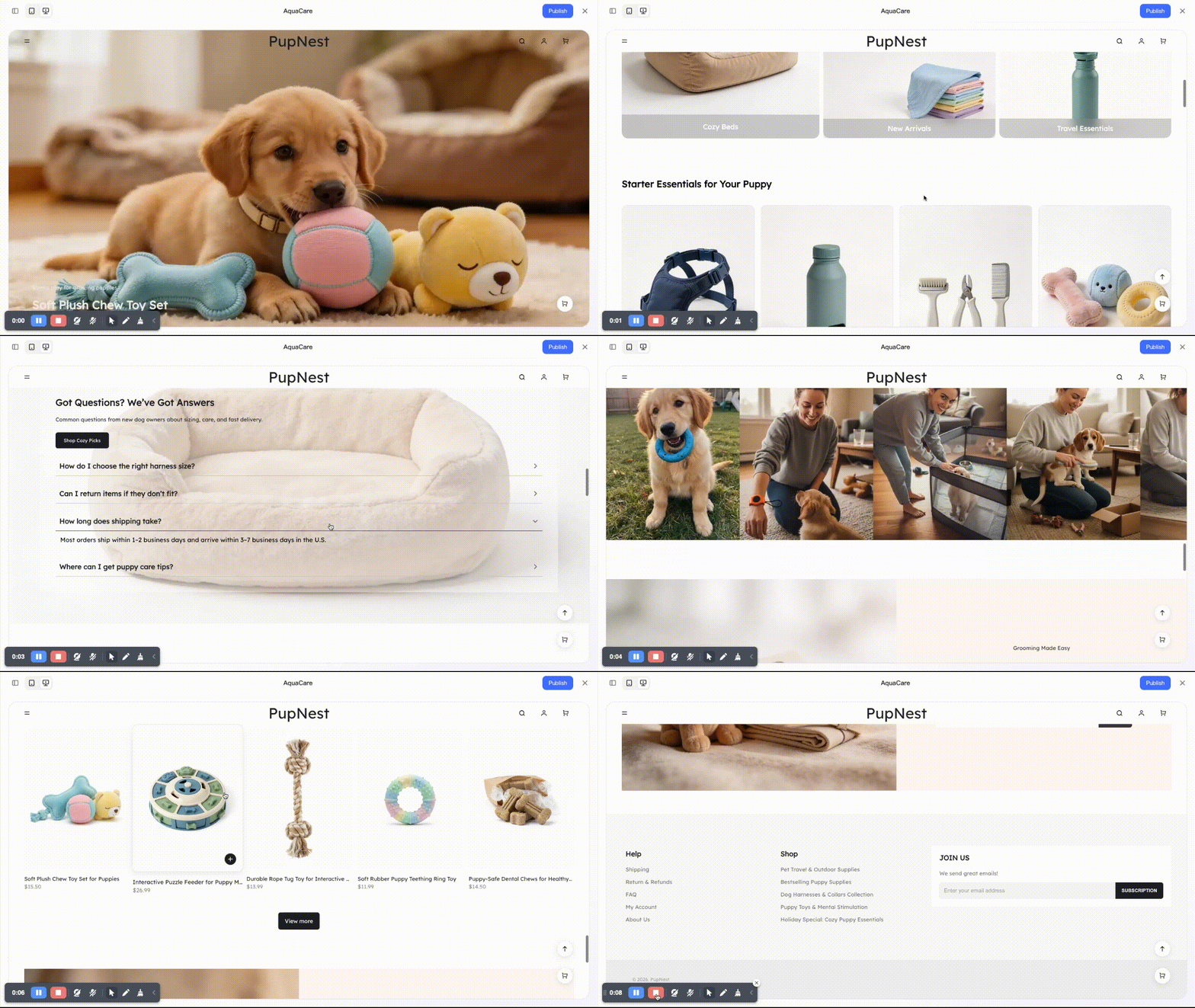
Once your store is live, global payments and multi-currency support are built in. Native integrations with CJdropshipping and EPROLO let you connect your fulfillment workflow on day one.
Shoplazza also includes Athena, an AI admin agent that handles back-office operations through natural language. Instead of navigating multiple dashboards, you describe what you need and Athena prepares the task, previews the result, and executes after your confirmation. For a clothing brand, that covers:
- Product management: Create and edit listings via text, images, product links, or CSV and Excel files, useful when adding new SKUs quickly or syncing supplier catalogs.
- Order and logistics tracking: Check order status and logistics updates without leaving the conversation interface.
- Discount configuration: Set up and adjust promotional campaigns through a single prompt.
- Data analysis: Ask business questions directly and receive charts, key metrics, and operational suggestions, no manual report building required.
For founders who want full brand ownership at the lowest possible setup cost, this is the most efficient starting point available in the Australian market right now.
Social commerce platforms: sell directly where Australian shoppers already scroll
TikTok Shop AU and Instagram Shopping let you sell directly inside the apps, turning your content feed into a purchase channel. No separate website to build or maintain.
The setup is fast. Connecting a TikTok Shop to an existing account takes hours, not days. Products are linked to your posts and videos, so viewers can buy without leaving the app. For a clothing brand that is already creating content, this adds a sales layer with almost no extra overhead.
The trade-off is ownership. You have no access to customer email addresses, no ability to retarget past buyers, and no control over the platform's algorithm or fee changes. If the platform shifts its policies or reduces your organic reach, your sales channel shifts with it.
Use social commerce platform as a complementary channel to drive early sales and test what products resonate. Build your primary store separately so you own the customer relationship long term.
Online marketplaces: tap into existing Australian buyer traffic immediately
Australian marketplaces give you access to existing, high-intent shopper traffic without building an audience from scratch. Each platform has a different shopper profile:
- Etsy attracts buyers actively searching for handmade, vintage, and niche design-led apparel. It has a substantial AU buyer base and works particularly well for clothing with a craft or custom angle.
- MyDeal, owned by Woolworths Group, is a mainstream AU marketplace suited to ready-made and value-positioned clothing lines.
- Catch.com.au has a broad AU audience and performs well for basics, accessories, and volume-priced items.
- eBay Australia has the highest overall traffic of any AU marketplace and accommodates everything from new clothing to secondhand and vintage.
The trade-off across all marketplace channels is the same: you pay listing fees or sales commissions, and you get no customer data for retargeting or email follow-up. Factor those costs into your margin model before committing significant catalog inventory to any marketplace.
The fastest ways to reach customers in Australia without a large ad budget
Driving traffic costs money, unless you use the channels that reward effort and creativity over budget. Here are the five most effective options for AU clothing brands at the early stage, ordered from fastest to slowest payoff.
Short-form video on TikTok and Instagram Reels
Short-form video is the highest-ROI zero-cost channel for a clothing brand right now. And the content that performs is not polished brand advertising. It is raw, real, and specific.
What works:
- Packing orders and showing the unboxing experience
- Behind-the-scenes of sourcing fabric or sampling new styles
- Styling the same piece multiple ways for different occasions
- Reacting to customer reviews or UGC content
For Australian audiences, localisation matters. A few things that push your content into AU-specific feeds:
- Tag your city, Sydney, Melbourne, Brisbane
- Use AU-trending audio, not just globally trending sounds
- Reference AU seasonal context — summer falls in December, not June
- Use hashtags that reflect AU fashion communities and local culture
You do not need a camera crew or editing software. You need consistency and a willingness to show the real process behind your brand. That is what builds trust, and trust is what converts.
Turn your photos on Pinterest for long-lived organic traffic
A TikTok video drives traffic for 48 to 72 hours. A well-optimised Pinterest pin can drive clicks for 12 to 18 months. That is the core difference.
Pinterest users are actively searching for style inspiration and products to buy. For clothing brands, that is exactly the right audience. What works well:
- Boards organised by outfit style, occasion, season, or colour palette
- Keyword-rich pin descriptions targeting AU search terms like "summer dresses Australia," "linen outfits for hot weather," or "streetwear outfits Melbourne"
- Pinning product photos consistently so your boards build search authority over time
The time investment per pin is low. The compounding return is one of the best passive traffic channels a clothing brand can build.
Micro-influencer gifting in Australian fashion niches
Macro-influencers charge thousands per post. Micro-influencers — creators with 1,000 to 10,000 AU followers in a specific niche — typically cost a free garment worth $30 to $80 AUD.
The return is often better because micro-influencer audiences trust their recommendations more. A coastal lifestyle creator in Byron Bay wearing your linen shorts drives more qualified traffic than a broad fashion account with a disengaged following.
When you pitch, be specific:
- Explain why their aesthetic matches your brand
- Tell them exactly what you would like them to create
- Be clear about what you are offering in exchange
A personalised DM outperforms a copy-paste template every time.
Community seeding on Reddit, Facebook Groups, and Discord
Before you promote, participate. Relevant AU communities include:
- r/ausfemalefashion: Active discussion on AU fashion, brands, and styling.
- City-specific Facebook fashion groups: Local buyers and sellers in Sydney, Melbourne, Brisbane
- Discord servers around streetwear, sustainable fashion, or specific aesthetics.
Spend two to four weeks genuinely contributing — answering questions, sharing opinions, being useful without pitching. When you do eventually share your brand, the community already knows you. That trust converts into word-of-mouth referrals that no ad budget can replicate.
SEO, not the fastest channel, but the one that pays you back indefinitely
SEO will not drive traffic in your first month. That is just the reality. But it is the only channel where ranking once means free traffic with no ongoing spend.
For an AU clothing brand, focus on long-tail queries like "affordable linen dresses Australia" or "print-on-demand clothing brands Australia." These attract buyers who are already researching before they purchase. A well-structured page can start ranking within three to six months.
The upside most founders miss: organic traffic can spike without warning. A page that earns a Google AI Overview citation or catches a trending search query can go from zero to thousands of monthly visits in days. Think of SEO as a low-cost insurance policy running in the background while your social channels handle short-term sales. The brands that run both rarely struggle for traffic.
When paid advertising becomes cost-effective for an Australian clothing brand?
Paid advertising isn't something to avoid — it's something to time correctly. Running Meta ads before you've validated your product with organic traffic is expensive and often inconclusive. Running them after you know what content and messaging resonates is a different exercise entirely.
The entry point for AU clothing brands testing paid is Meta ads at $5 to $10 AUD per day, targeting hyper-specific interest clusters — "Sustainable Fashion Australia," "Melbourne Streetwear," or "Australian Independent Brands." Video creative consistently outperforms static images for clothing because it shows fit, movement, and styling in ways a flat product photo cannot.
Use the first two to four weeks of paid spend purely for data collection: which audience segments click, which creative formats hold attention, and which product angles drive add-to-cart. Only scale budget once you have a clear signal from the data.
How to keep Australian shipping costs from eating your margins?
Shipping is the silent margin killer for AU clothing brands. Australian shoppers abandon carts over unexpected shipping costs at higher rates than shoppers in most comparable markets — so your shipping strategy is as much a conversion tool as it is a logistics decision.
Australia Post's MyPost Business account gives you discounted domestic rates that scale down as your volume grows. Sendle is a competitive alternative, particularly for smaller parcels, and integrates directly with most ecommerce platforms. Compare both against your average package dimensions and weight before committing to one.
On pricing structure, a flat-rate model — for example, $8 AUD standard, $15 AUD express — removes the uncertainty that causes abandonment. A free shipping threshold, typically set between $100 and $120 AUD, lifts average order value without requiring a margin cut on every order. Customers will often add an item to their cart specifically to qualify for free shipping, which benefits both conversion rate and revenue per transaction.
Compare cost-effective launch paths: which approach fits your situation?
There's no single right answer here. The most cost-effective path depends on where you're starting from.
- If you have original designs and a near-zero budget, POD with an AU local fulfillment hub gives you brand control without inventory risk.
- If you want to move fast with ready-made styles and minimal setup, dropshipping from a supplier with AU or SE Asian warehousing gets you to market quickest.
- If you have some capital and a strong brand vision, a pre-order or VSP campaign lets you fund production with customer money rather than your own.
- If your priority is reaching customers fast, TikTok organic content combined with micro-influencer gifting generates qualified traffic faster than any other zero-budget channel.
- If you're thinking 12 months ahead, SEO and Pinterest are the channels that compound quietly in the background while you focus on day-to-day sales.
The most resilient launch strategies use at least two of these in combination: one fulfillment model that minimises upfront cost, and one acquisition channel that drives traffic without requiring a paid media budget to sustain it.
Conclusion
Launching a cost-effective clothing line in Australia comes down to one principle: validate before you invest. Start with a zero-inventory fulfillment model, build your storefront on an AI-powered platform like Shoplazza that requires no developer, and drive your first traffic through channels that reward effort over budget. Once you have real demand, scale what is working. That sequence is the most reliable path to a sustainable AU clothing brand.
Frequently asked questions
Q: How much does it cost to launch an online clothing line in Australia?
With a POD or dropshipping model, startup costs can be as low as $30 to $200 AUD, covering a domain name, basic branding, and sample orders. Among these, Shoplazza plans start at $39/month (roughly $54 AUD/month), with no developer or designer fees on top. Your first meaningful cost is typically sample garments for content creation or influencer gifting, not inventory.
Q: Can I start a clothing brand in Australia with no upfront inventory costs?
Yes. Both print-on-demand and dropshipping are zero-inventory models. With POD, you pay the production cost only after a customer buys. With dropshipping, you pay the supplier cost from the revenue you've already collected. Neither requires you to purchase or store stock in advance.
Q: What is the fastest way to get my first clothing customers in Australia?
Short-form video on TikTok or Instagram Reels, posted consistently with AU-localised audio and location tags, is the fastest organic channel. For immediate credibility, pair it with micro-influencer gifting to creators with 1,000 to 10,000 Australian followers in your specific niche.
Q: Do I need to register for GST to sell clothes online in Australia?
GST registration is only mandatory once your annual turnover reaches AUD $75,000. Below that threshold, registration is optional. You can register voluntarily if you want to claim GST credits on business expenses, but it's not a requirement at the early stage of launching.
Q: Which ecommerce platform is best for a clothing startup in Australia?
An AI-powered ecommerce store builder gives you the best combination of low setup cost and long-term brand control. Shoplazza's AI store builder generates a complete store from a single prompt, includes built-in global payments, and supports dropshipping integrations with no developer required. Marketplaces like Etsy or eBay Australia are useful supplementary channels but shouldn't replace an owned storefront as your primary sales infrastructure.