Finding a winning product used to take days of manual research, scrolling through supplier pages, and making educated guesses. In 2026, that process looks very different. AI dropshipping tools can surface demand signals, margin estimates, and competitor data in minutes — giving sellers a real edge in a market that moves faster than ever. This guide walks through everything: what a winning product actually looks like, why AI has become a practical necessity, which tools are worth using, how to validate your findings before you spend a cent on ads, and how to go from verified product to live store quickly.
What makes a winning product?
These factors do not exist in isolation. A product that checks one or two boxes but fails the others rarely holds up past the first test. When you put it all together, a winning product looks like this:
- Net margin above 30% after all costs
- Solves a problem or fulfils a clear consumer desire
- Visually compelling for social media creative
- Consistent demand over three to six months rather than a single viral spike
- Multiple competitors active in the market, but not yet saturated
- A reliable supplier who can fulfill orders within an acceptable shipping window
These criteria are not new. What AI has changed is how quickly you can screen thousands of products against all of them simultaneously.
Why AI product research is a prerequisite for dropshipping?
The dropshipping market was valued at around $401 billion in 2026 and is projected to reach $828 billion by 2030, according to Research and Markets. More sellers, more products, faster trend cycles. A product that is genuinely differentiated in January can be commoditized by March, which is why manual research has become a structural disadvantage, not just an inconvenience.
Manual product research is slow by nature. A thorough session — browsing supplier catalogs, checking order counts, cross-referencing bestseller lists, scrolling TikTok for viral signals — can take six to eight hours. By the time you finish, the data you gathered at the start may already be stale.
AI tools do the same work across multiple data sources simultaneously, in minutes. According to Sell The Trend's State of AI Dropshipping 2026 report, the difference is measurable:
- Sellers using AI-assisted research achieve up to 85% reduction in research time.
- Those using structured AI validation tools experience up to 45% fewer failed product tests.
- AI-driven insights can help sellers identify emerging products three to four weeks before they reach mainstream demand.
That lead time matters in a market where trends peak and fade within weeks. Catching a product early means lower ad costs, less supplier competition, and more room to establish traction before the category gets crowded.
Beyond speed, AI is increasingly what makes running a lean dropshipping operation viable at all. Research, listing optimization, ad creative, order management, and customer service have each become difficult to handle manually at any meaningful scale. For single-operator or small-team stores, AI is the layer that bridges the gap.
How AI finds products for you?
Not every platform that calls itself "AI-powered" works the same way, so it is worth understanding what is actually happening under the hood before you choose one.
The core capability is pattern recognition at scale. A good AI research tool ingests data from multiple sources simultaneously and identifies products where positive signals align across all of them. What would take a human analyst hours of cross-referencing happens in seconds.
Here is what the better tools are actually tracking:
- Sales velocity on AliExpress and Amazon: how fast orders are moving, and whether that pace is accelerating. A product with rapidly increasing sales but relatively few sellers is a classic early-opportunity signal.
- Social media engagement: shares, saves, and comments from real consumers, not just paid impressions.
- Competitor ad activity: how much money experienced sellers are spending to promote a product, which is one of the most reliable demand validation signals available.
- Geographic arbitrage: products gaining traction in secondary markets like the UK, Australia, or Canada often reach the US two to four weeks later, giving you a window to launch before ad costs rise.
The output is a shortlist of product candidates with demand context, margin estimates, and supplier options. That shortlist is not a guarantee. It still requires your judgment and a small validation test. But it gives you a structured starting point rather than a blank page.
5 Popular AI tools for product research
Not every tool is right for every stage of research. The five below represent different approaches: some are broad discovery platforms, one is a general-purpose AI assistant, and one is purpose-built for AliExpress-based dropshipping. Understanding where each fits in the workflow will help you choose the right combination for how you operate.
Sell The Trend
Sell The Trend is built around product discovery as its core function, with automation and store management added on top. Its standout feature is the NEXUS engine, an AI-powered discovery layer that aggregates signals from AliExpress, Amazon, and CJdropshipping. Rather than simply showing trending products, NEXUS categorizes findings into "Hot Products," "New Stars," and "Hidden Gems", which helps sellers distinguish between products already at peak demand and those still in early-growth territory.
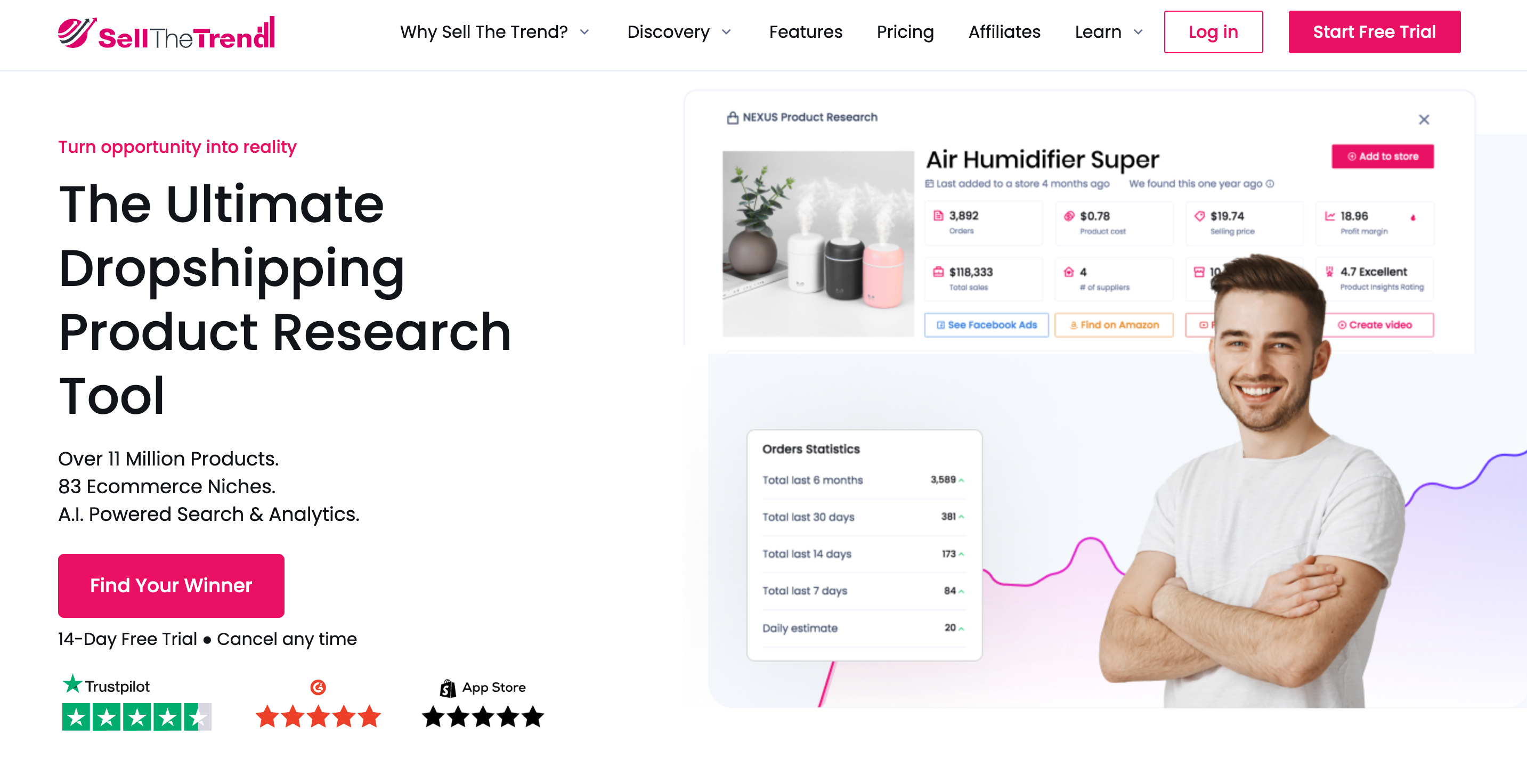
The platform's Store Intelligence tool is also worth noting. You can enter any competitor's store URL and see their estimated best-sellers, revenue data, and installed apps. This is useful for validating your own product candidates by checking whether established sellers are actively promoting the same items.
Key AI features:
- NEXUS AI product discovery engine: scans real-time data from multiple marketplaces and competitor stores, then ranks products by momentum rather than static popularity metrics
- Store Intelligence: analyzes any competitor store to surface estimated revenue, best-selling products, and performance trends you can use to validate your own shortlist
- AI Brand Builder: takes a niche input and generates a store name, logo direction, and brand positioning to get a new store off the ground quickly
- One-click product import: pulls pre-filled descriptions, images, and pricing into your connected store so you can go from research to listing without manual data entry
- Built-in video ad creator: generates ad creatives directly from product data, reducing the time between finding a product and running a paid test
- Chrome extension: lets you research products on AliExpress and CJdropshipping pages in real time, without switching between tabs or platforms
Doba Pilot
Doba is a US-based dropshipping platform that has served more than 3.2 million sellers worldwide. In March 2026, it launched Doba Pilot, described as the industry's first AI dropshipping agent, which represents a meaningful shift in how the platform works. Rather than requiring users to navigate between modules for sourcing, listing, pricing, and fulfillment, Doba Pilot accepts plain-language instructions and executes the corresponding workflow steps automatically.
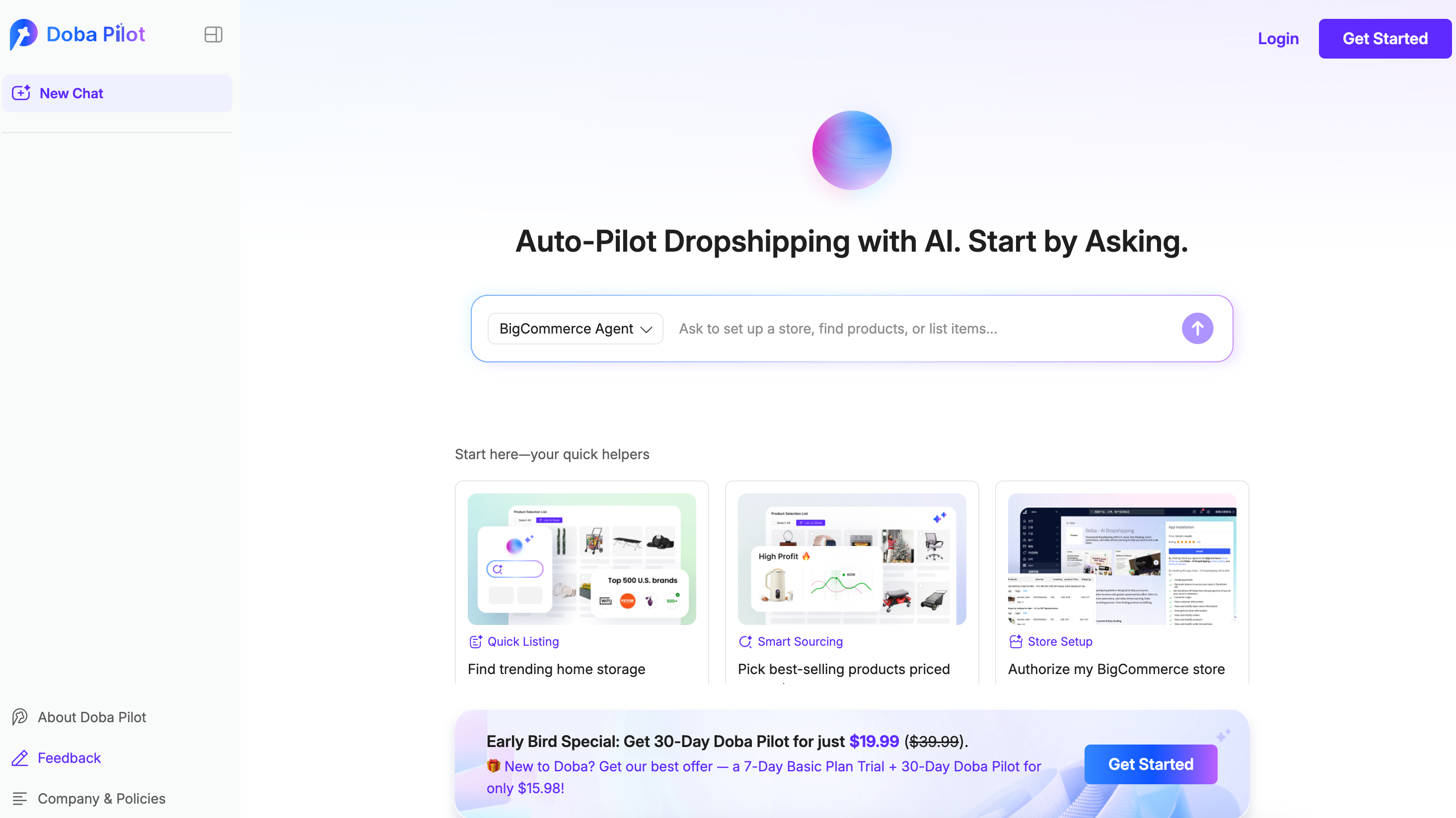
A seller can type a single instruction, for example, "Find trending outdoor products and list them at a 20% margin", and Doba Pilot initiates product discovery, generates complete listings with AI-written descriptions and recommended price points, and synchronizes inventory in real time. According to the launch announcement (source), the platform draws product recommendations from Doba's supplier catalog of over one million products, with over 90% of suppliers based in the United States.
Key AI features:
- Natural language command interface: instead of navigating separate modules, sellers type plain-language instructions and the platform executes the corresponding workflow automatically
- AI-powered product discovery: surfaces items matched to your category, pricing targets, and demand signals drawn from Doba's vetted supplier network of over one million products
- AI-generated product listings: produces complete descriptions, recommended price points, and item attributes already formatted for your chosen sales channel
- Real-time inventory synchronization: keeps stock levels and pricing updated automatically across all connected stores
- Deep Research Mode (in development): predictive niche analysis designed to identify categories before mainstream demand peaks, giving sellers an early-mover advantage
- Multi-platform integration: connects with Amazon, eBay, Walmart, WooCommerce, TikTok Shop, Wix, and more from a single setup
ChatGPT
ChatGPT is not a dedicated dropshipping research platform, and it is worth being clear about what it does and does not do. It does not have access to live sales data, real-time ad spend information, or marketplace velocity metrics. What it offers is a highly versatile AI assistant that accelerates the brainstorming, content production, and strategic analysis layers of the dropshipping workflow.
For product research specifically, ChatGPT is useful for identifying niche angles, generating trend hypotheses based on its training data, and structuring your research thinking before you take it into a data-driven tool. You might ask it to outline emerging product trends in the home fitness category and explain the consumer behavior driving them, or to generate a list of product ideas inspired by recent lifestyle shifts among a specific demographic. The output gives you a starting point for deeper validation, not a finished shortlist.
Where ChatGPT becomes genuinely valuable is in content production at scale. When you onboard a new supplier catalog with fifty or a hundred products, generating unique, SEO-ready descriptions for each one manually would take days. With well-structured prompts that include your brand voice, target audience, and primary product benefits, ChatGPT can produce first drafts in minutes — typically requiring only a light human review before publishing.
Key AI capabilities for dropshipping:
- Niche and trend brainstorming: generates product category ideas and explains the consumer demand drivers behind them
- Audience research: builds demographic profiles and buying motivation analyses for specific niches
- Product description generation at scale: takes structured prompts and produces ready-to-edit copy across an entire supplier catalog at once
- SEO title and metadata drafting: produces optimized titles and meta descriptions for product pages based on target keywords
- Ad copy and creative angle generation: covers multiple formats including hooks, headlines, and email subject lines from a single product brief
- Supplier outreach templates: drafts professional outreach emails and customer service response scripts tailored to common dropshipping scenarios
One important limitation: ChatGPT generates ideas based on its training data, not live market information. Always cross-reference its outputs with a real-time data tool before committing a product to your test budget.
Dropshipping Copilot
Dropshipping Copilot occupies a specific and useful position in the research stack. It is an official AliExpress partner app, which means it has direct platform access rather than relying on third-party scraping. For sellers who want to do dropshipping business with AliExpress, that official partnership matters. It generally means tighter data accuracy, more stable supplier information, and a more integrated workflow between research and sourcing.
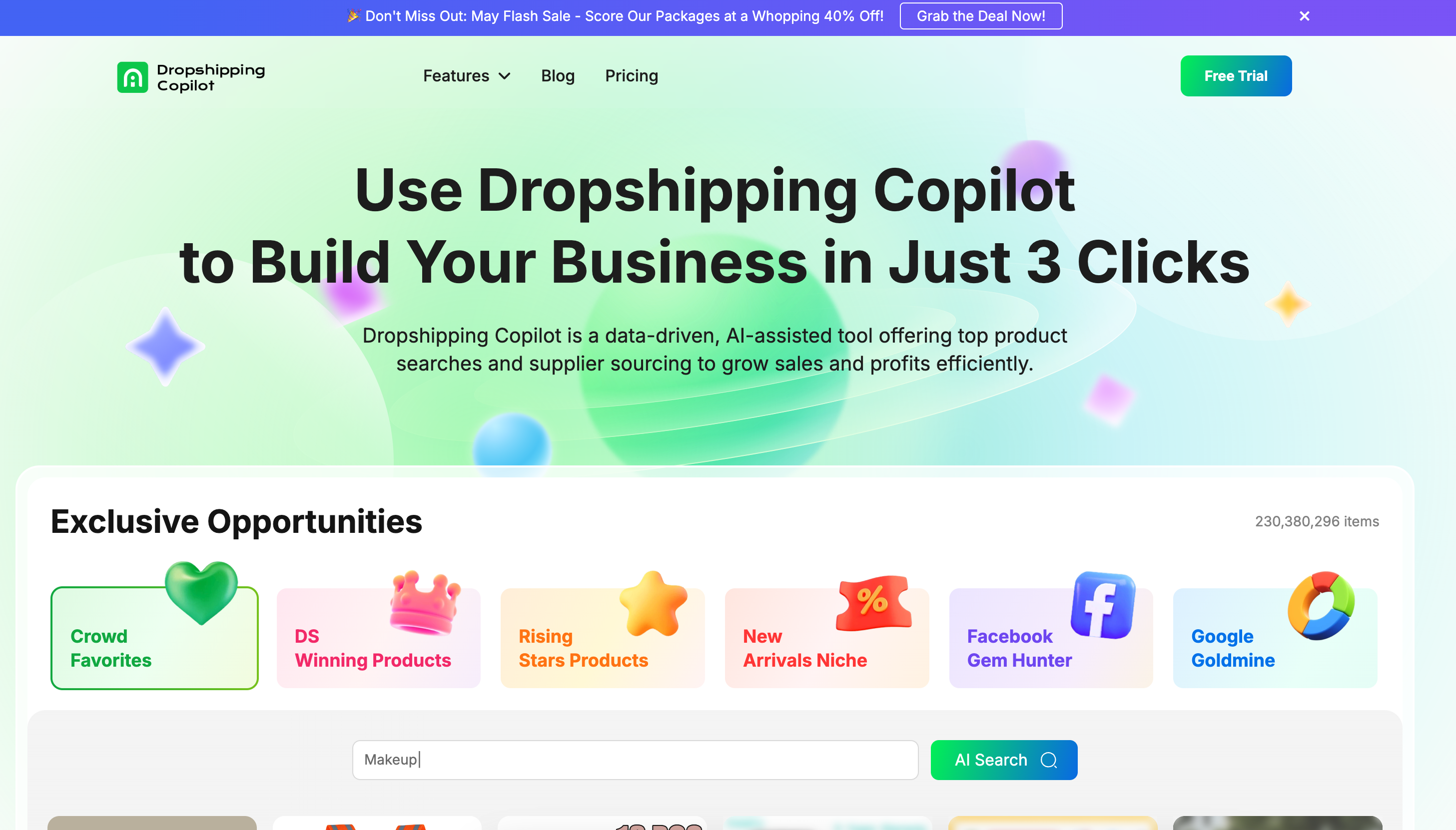
The platform's core research feature is called Opportunity Finder, an AI-assisted product search that allows sellers to filter by categories such as "DS Winning Products" and "Newest Arrivals." There is also a supplier search feature that lets you browse AliExpress suppliers by their best-selling products and fulfillment metrics, which adds a useful layer of supplier validation to the research process. When you find a product worth testing, a direct integration allows one-click importing, so the transition from research to listing is minimal.
For sellers at the beginning of their dropshipping journey who want to do dropshipping business with AliExpress specifically, Dropshipping Copilot is one of the more practical free starting points available.
Key AI features:
- Opportunity Finder: an AI-assisted product search tool that filters results by categories including "DS Winning Products" and "Newest Arrivals," helping you narrow down candidates without manually browsing thousands of listings
- Supplier search: lets you browse AliExpress suppliers ranked by their best-selling products and fulfillment performance metrics, adding a supplier reliability layer directly into the research process
- AI product content generation: pulls data from AliExpress product listings and automatically produces titles, descriptions, and listing copy ready to publish or lightly edit
- Reverse image and URL search: upload a product image or paste a URL and the tool matches it to verified AliExpress suppliers, useful for sourcing products you discover on social media or competitor stores
Dropship.io
Where most research tools focus on product-level data — sales counts, review volumes, trend scores — Dropship.io operates at the store level. Its primary strength is showing you what real competitor stores are selling, how their catalogs are changing over time, and what estimated revenue those stores are generating. This approach is particularly useful during the validation phase, because it moves you from algorithmic trend scoring to actual observed market behavior.
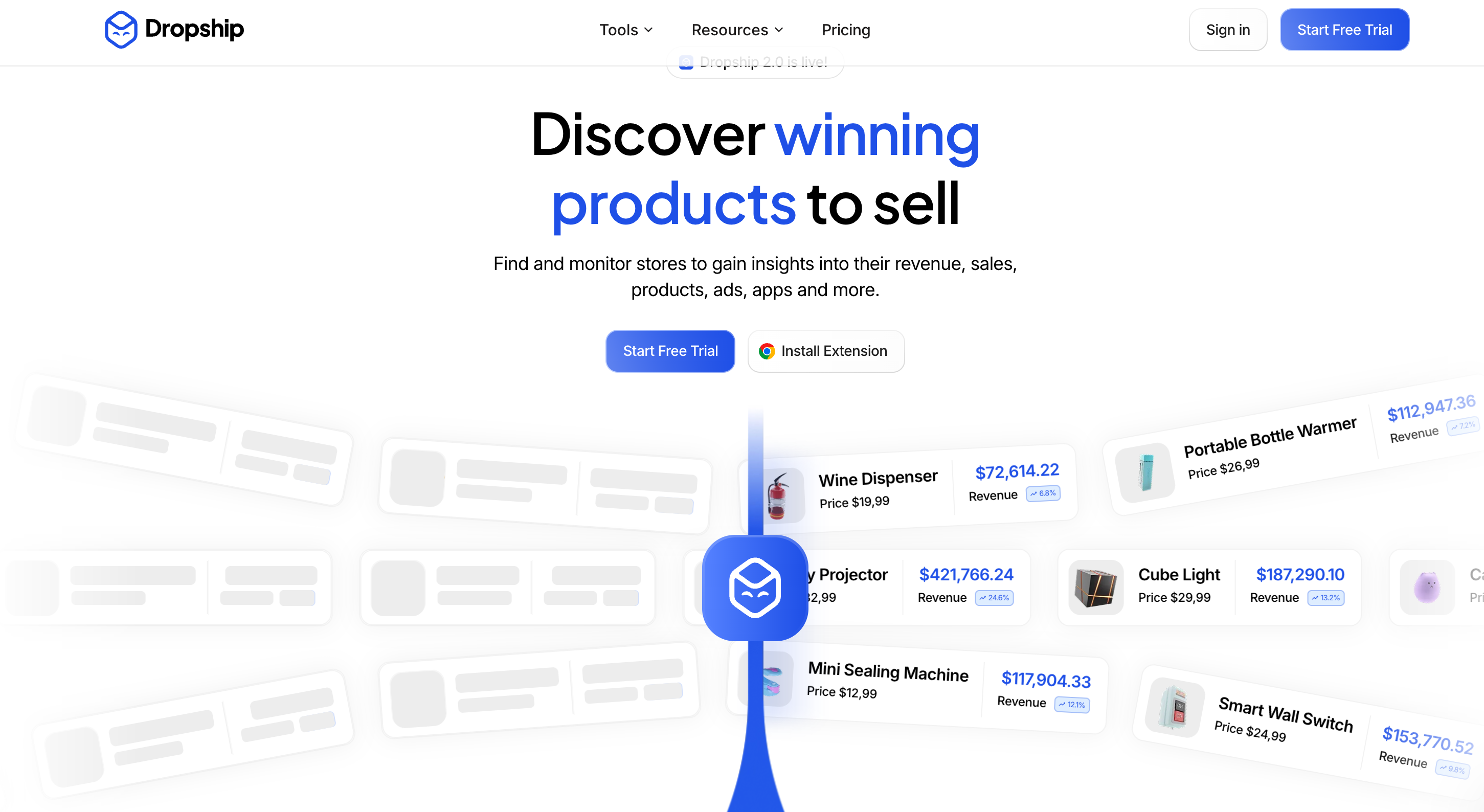
The Magic AI Search feature is one of the more practical capabilities in this category. You upload a product image, video, or URL, and the AI locates matching stores and active ads across its database. This means you can take a product idea you spotted on social media and immediately find out which sellers are already running it, at what scale, and with what creative approach. The Advertiser Library adds another layer by indexing brands running Facebook ads, filterable by spend and launch date — letting you see how long competitors have been investing in a product and at what level.
Key AI features:
- Magic AI Search: upload any image, video, or URL and the AI identifies matching products, stores, and active ad campaigns running across its database — useful for sourcing products you spot on social media or competitor sites
- Sales Tracker: monitors competitor store revenue with breakdowns by day, 7 days, and 30 days, giving you a clear picture of whether a product is gaining or losing momentum over time
- TikTok Shop Tracking: surfaces products gaining traction on TikTok before they reach mainstream saturation, helping you catch trends in the early window when ad costs are still low
- Advertiser Library: indexes Facebook ad campaigns by spend, reach, country, and launch date, so you can see how long competitors have been investing in a product and at what scale
- Competitor spying: monitors rival stores continuously and alerts you to new product launches and catalog changes as they happen
- Weekly curated portfolio: delivers a shortlist of algorithmically and manually screened winning products each week, useful as a starting point if you prefer curated discovery over open-ended research
How to validate a product before you list it?
AI tools produce a shortlist of candidates. Manual cross-checking confirms which ones are worth spending actual money on. Skipping this second step is one of the most common reasons test budgets get wasted.
Once you have a candidate product, run it through these three free checks before committing to a test campaign:
- Facebook Ad Library (facebook.com/ads/library) shows every active ad running globally, with no paywall. Search the product name and look for multiple competitors spending on ads over a sustained period. Five or more sellers actively promoting the same product, with some ads running for thirty days or more, is meaningful demand validation. Experienced advertisers do not maintain spend on products that do not convert. Zero ads can mean the product is genuinely early, or that it has already been tried and abandoned.
- TikTok Creative Center (ads.tiktok.com/business/creativecenter) lets you filter by category and engagement to see what is gaining organic and paid traction. If a product appears in multiple high-engagement videos and is also attracting paid creative spend, that is a strong signal. If it is already appearing in hundreds of videos with very high view counts, you may be entering after the peak.
- Google Trends (trends.google.com) shows the twelve-month search trajectory for any product keyword. A rising line confirms growing consumer interest. A line that spiked and dropped sharply suggests the trend has already passed.
If all three signals align positively, the product is worth a focused test with a controlled budget. If only one or two align, dig deeper before spending. If none align, the product may have good platform metrics but limited real-world demand.
How to launch fast once you've found a winner?
AI tools help you find the product. Shoplazza helps you sell it. Research and validation are the first half of the workflow. The second half is getting a verified product in front of buyers quickly, before the trend window closes. For most solo sellers or small teams, the biggest bottleneck is not the product itself but the operational steps required to get it live.
Build your store with AI in minutes
Shoplazza's AI Store Builder for dropshipping removes the most time-consuming step between finding a product and testing it. With AI, you can just input your niche direction and product you want to sell, and the AI generates three store styles for you to preview — each showing a distinct visual direction with banner and product collection layouts.
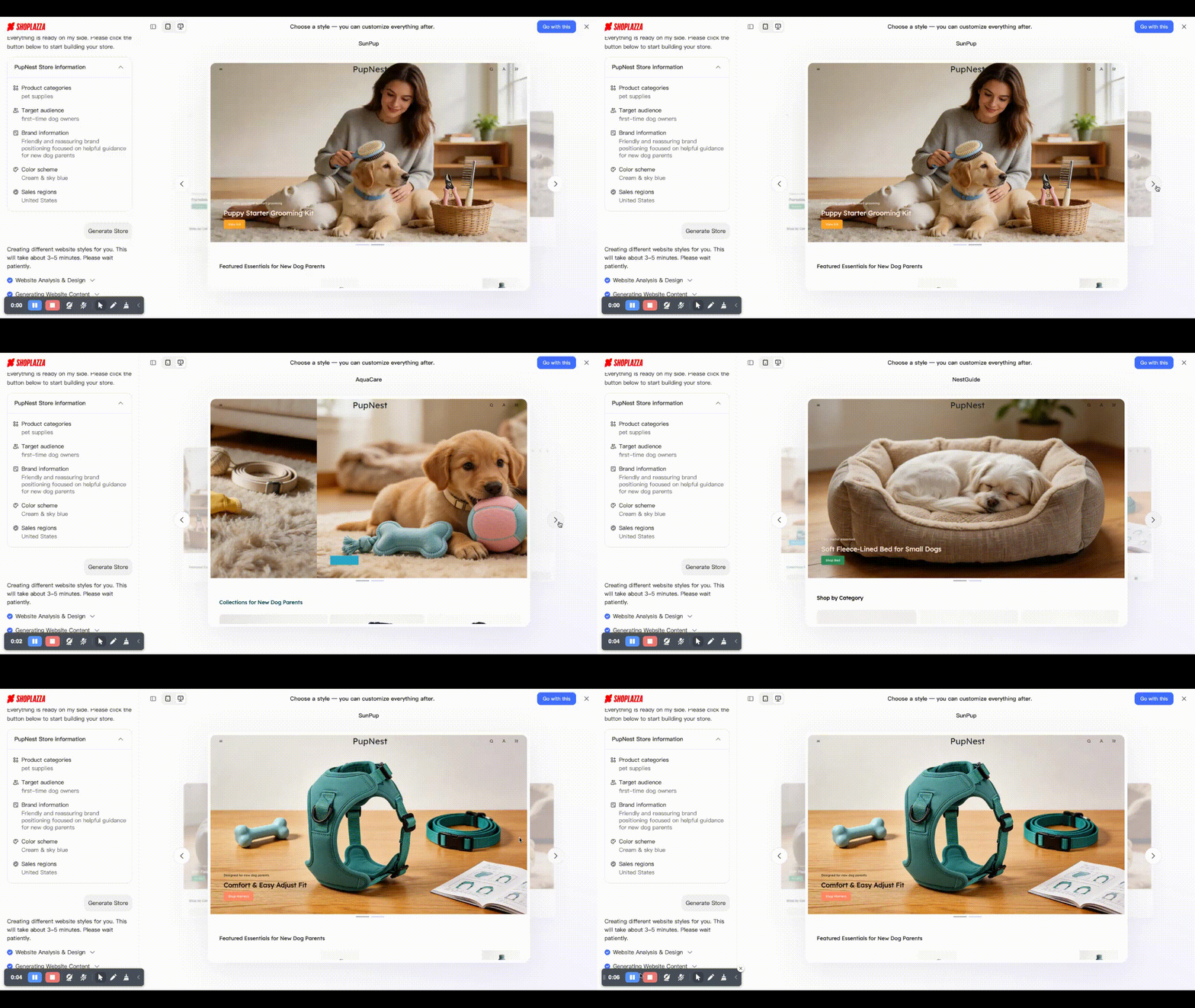
Pick the one that fits your brand, and the AI builds it out into a complete online store, including a homepage, product pages, checkout flow, About page, Contact page, and policy pages. Your store is ready within five to ten minutes, no coding required.
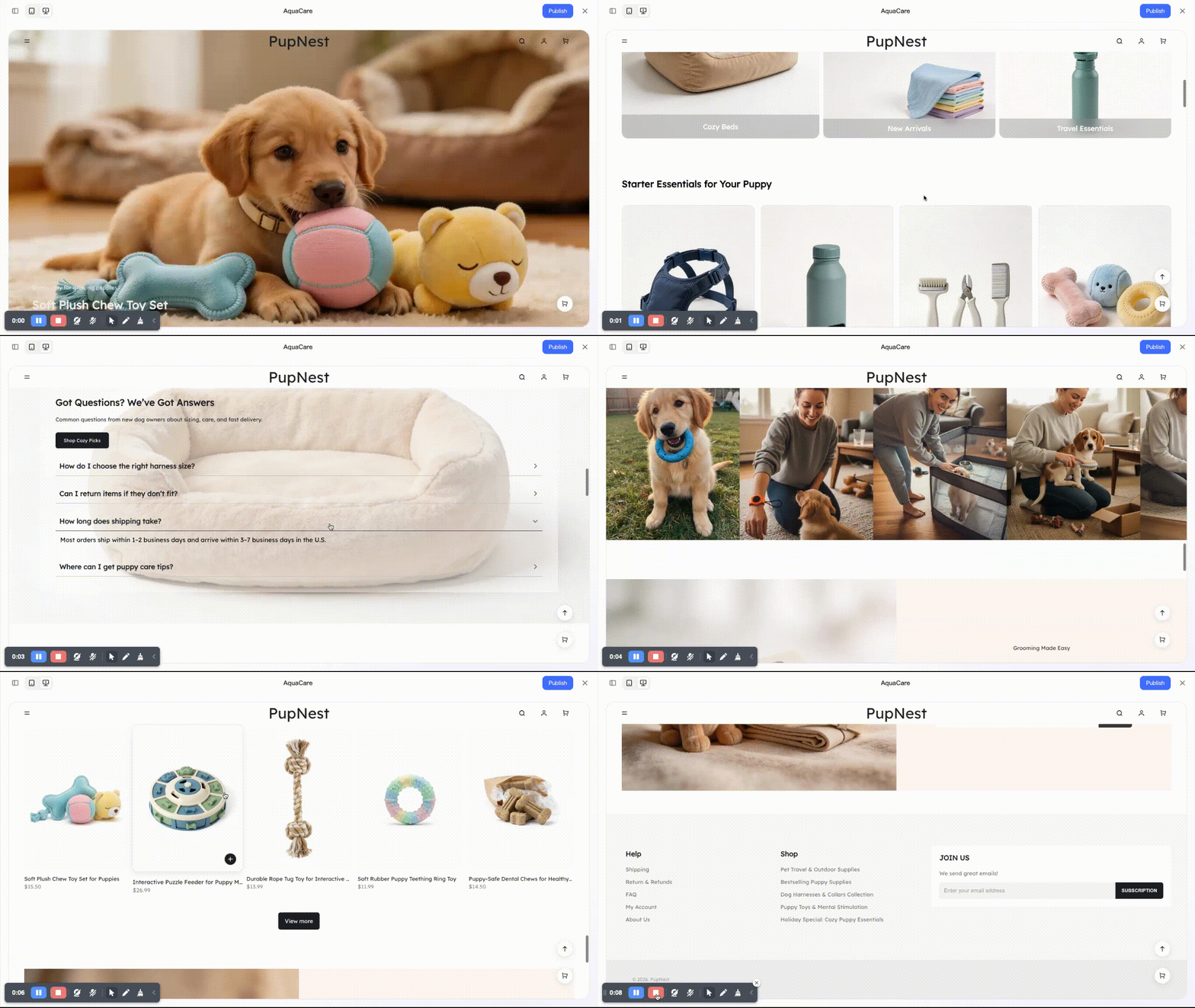
Getting a store live fast means you can test whether a product actually converts before the trend window closes. And if it does not, you move on without having lost days of setup time.
Connect your supplier and import products in one click
Shoplazza has CJdropshipping and EPROLO directly integrated into the platform. Once your store is live, you can import verified products without switching platforms, manually copying descriptions, or setting up separate supplier accounts. Inventory synchronization, pricing, and order routing are managed automatically through the integration.
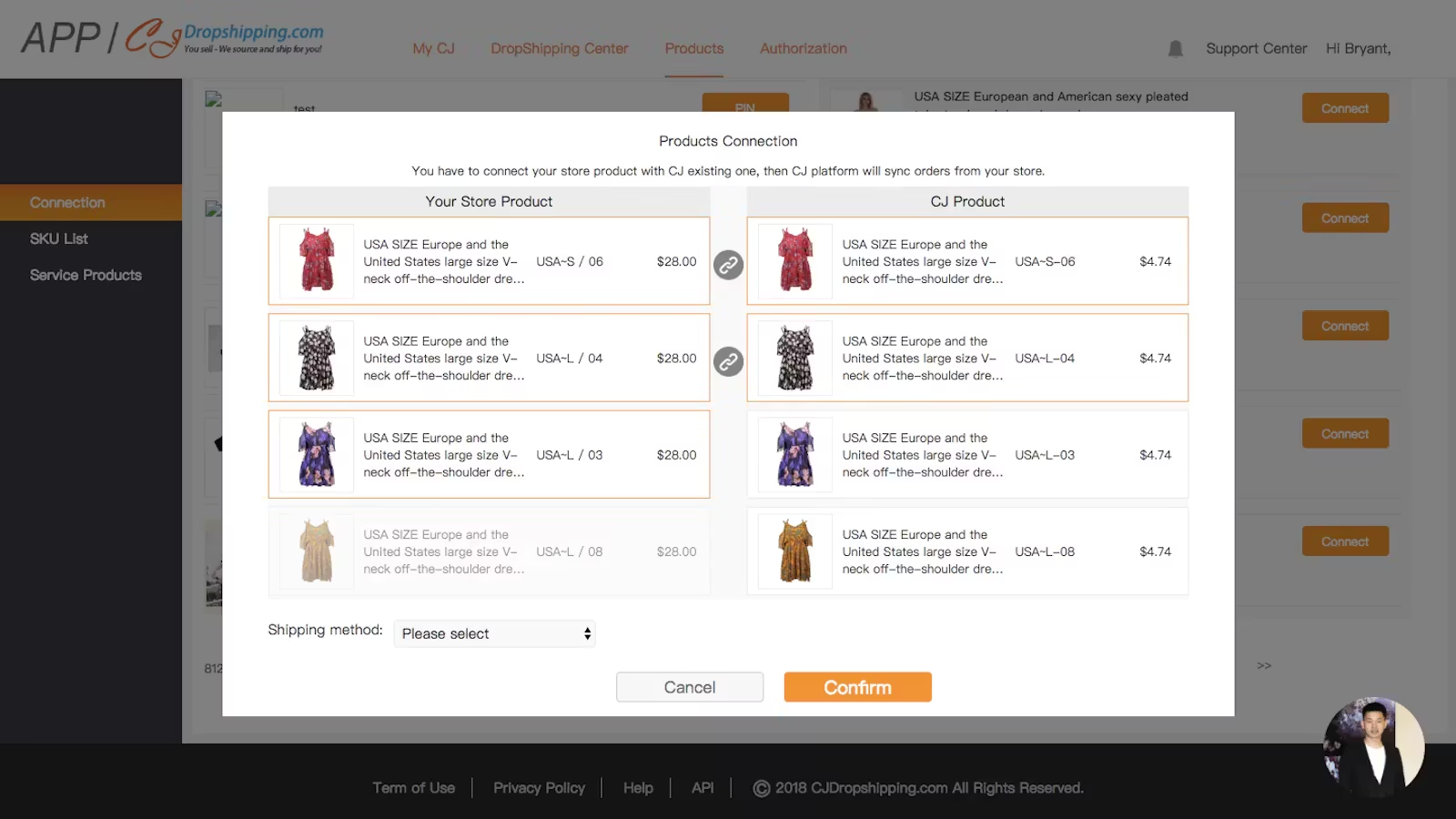
If you prefer working with other suppliers — Doba, for example, or AliExpress directly — install Skuowner from the Shoplazza App Market for free. Skuowner enables one-click product import from Doba, AliExpress, and a broader range of supplier catalogs, keeping your entire sourcing workflow inside one dashboard without the need to manage multiple platforms separately.
Automate operations from day one with Athena
Once products are live, the operational workload, including listing management, SEO optimization, order processing, and discount configuration, can quickly become a bottleneck for a small team. Shoplazza's Athena AI Agent handles this layer by executing tasks directly in the platform backend. It is not a chatbot that gives instructions; it is an agent that acts.
Athena covers:
- Auto product listing and catalog management: add, edit, and organize products at scale without manual processing
- AI-generated SEO titles and descriptions: optimized per target market, applied across your catalog in bulk
- Automated order processing and logistics setup: routes and manages orders without manual intervention
- Business performance data queries: pulls sales and store data into clear visualizations on demand
High-risk operations such as pricing changes or bulk edits show a confirmation preview before execution, so you retain oversight without doing the work manually. Athena is currently available to Shoplazza merchants at no additional cost.
Polish your product content with AI
Supplier product photos are frequently generic, low-resolution, or carry manufacturer branding, and that directly hurts conversion rates on your product pages.
LazzaStudio, Shoplazza's built-in AI product picture maker, lets you replace supplier photos with branded, high-quality product visuals directly from your store backend. You can generate lifestyle-style images that fit your store aesthetic without hiring a photographer or using external editing tools. For a new store running its first product test, this removes a friction point that would otherwise require either settling for poor visuals or delaying launch.
On the copy side, Shoplazza's AI product description generator produces optimized product descriptions from basic product information. Rather than rewriting supplier copy that is often poorly translated or generic, you input the key product details, and the AI generates a structured, readable description with relevant keywords built in. Each merchant gets 200 free responses per month, which covers a reasonable test catalog without any additional cost.
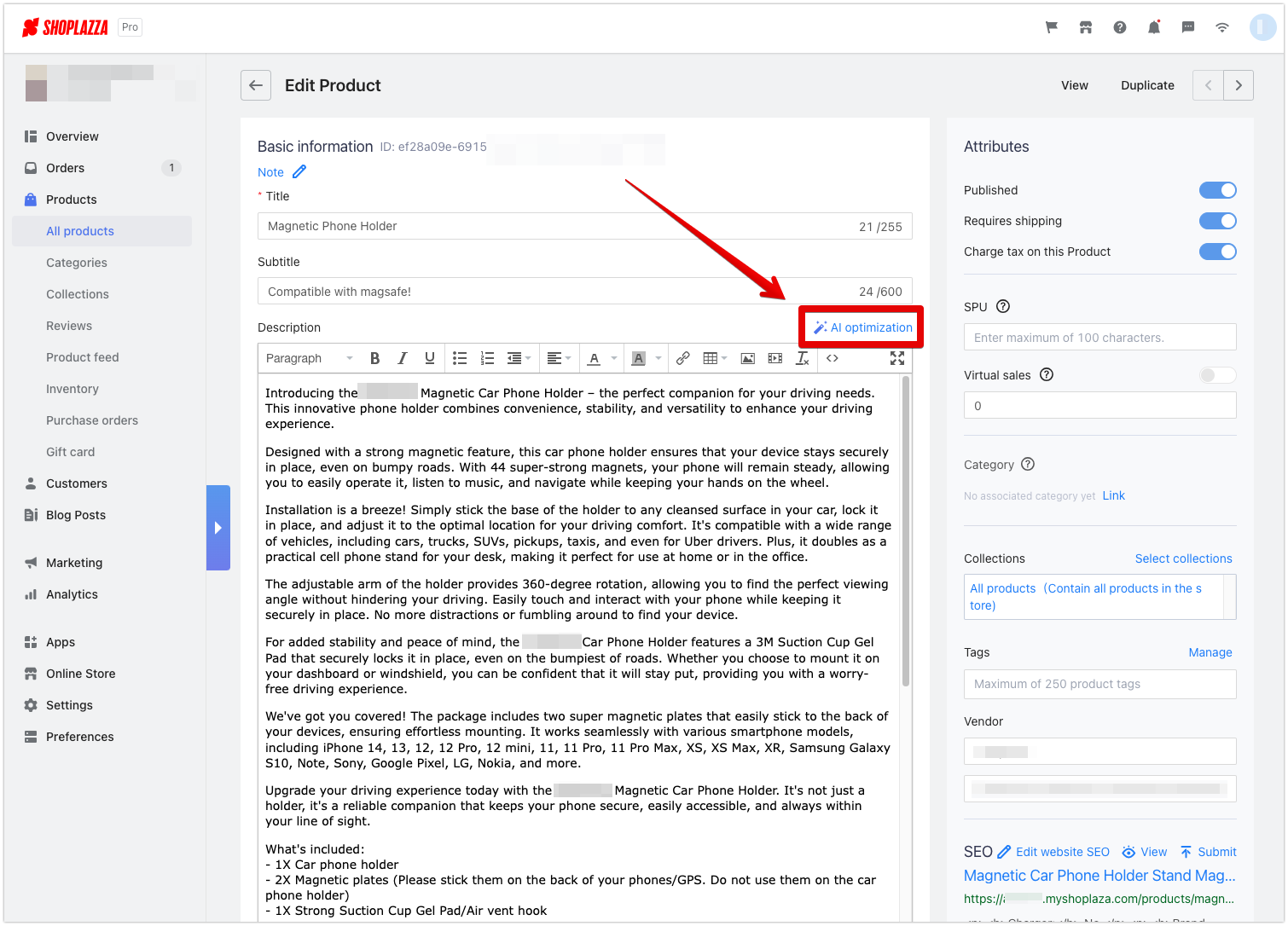
Together, these two tools mean your product pages are presentable and searchable from day one, without a copywriter or designer on the team.
Conclusion
Learning how to find winning products with AI dropshipping is less about finding a magic tool and more about building a repeatable workflow. AI platforms help you surface candidates faster and validate them with real data. Manual cross-checks keep you from spending on the wrong ones. And once you have something worth testing, Shoplazza's integrated suppliers, AI store builder, and backend automation mean you can go from verified product to live store without the setup overhead eating into your launch window.
Frequently asked questions about AI dropshipping
Q: What is the difference between using AI for dropshipping product research versus doing it manually?
Manual product research involves browsing supplier catalogs, checking order counts, and cross-referencing marketplace data one source at a time. It is time-intensive and produces a snapshot that can be outdated by the time you finish. AI research tools analyze multiple data sources simultaneously and surface products where positive signals align across all of them. According to Sell The Trend's 2026 report, AI-assisted research can reduce research time by up to 85% and lead to 45% fewer failed product tests compared to manual methods.
Q: Do I need multiple AI tools for product research, or can one tool handle everything?
It depends on your approach. A single all-in-one platform like Sell The Trend or Doba Pilot can cover the core research and sourcing workflow without additional tools. However, many experienced sellers use a layered approach: a discovery tool like Sell The Trend for initial shortlisting, a competitor analysis tool like Dropship.io for validation, and a general AI assistant like ChatGPT for content production. The right stack depends on your budget and how deeply you want to investigate each candidate product before testing it.
Q: How do I know if an AI research tool is showing me real data versus guesses?
Ask where the data comes from. Tools that pull from actual marketplace transaction data — AliExpress order counts, live ad spend data, real store revenue — are generally more reliable than those relying on algorithmic projections alone. Dropshipping Copilot, as an official AliExpress partner, has direct platform access. Dropship.io tracks actual store revenue. Sell The Trend ingests live data from multiple marketplaces. ChatGPT, by contrast, does not have access to live market data, which is why it works best as a brainstorming layer rather than a primary research tool.
Q: How should I validate a product after AI research suggests it could be a winner?
Run it through three free manual checks: search the Facebook Ad Library to see whether competitors are actively spending on ads over a sustained period; check the TikTok Creative Center to assess organic and paid traction; and review the search trajectory on Google Trends to confirm demand is growing rather than declining. If all three signals are positive, the product is worth a small, controlled test budget. If signals are mixed, investigate further before spending.
Q: Once I find a winning product, how quickly can I get it live in a store?
With the right platform, the gap between a validated product and a live store can be under an hour. Using Shoplazza's AI Store Builder, you can generate a complete store in minutes, then import your verified product directly through integrated suppliers like CJdropshipping and EPROLO, or through Skuowner for Doba, AliExpress, and other catalogs. Shoplazza's Athena AI Agent handles bulk listing optimization, SEO title generation, and order processing from day one, so the operational side of the store scales with your catalog without requiring proportionally more manual work.